
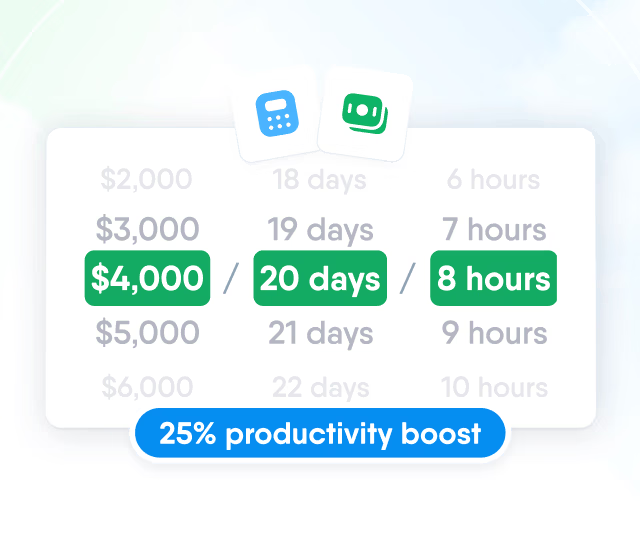
HR efficiency estimator
How does the HR efficiency estimator from PeopleForce work.
Calculate your impact



KPI: what it is and how to calculate it
What key performance indicators are, the KPI formula and examples
What is a KPI?
A KPI (key performance indicator) is a measurable value that shows how close a company, team or employee is to a specific goal over a set period. For example, a sales team's KPI might be monthly revenue, while a recruiter's KPI might be the average time to fill a vacancy.
A goal on its own doesn't tell you whether the team is moving in the right direction. KPIs turn goals into concrete numbers you can check regularly, compare with the plan and use to adjust the work in time.
How to calculate a KPI: the formula
The basic formula shows the percentage of the plan achieved:
KPI achievement = actual result / target × 100%
For example, the monthly sales target is $50,000 and actual revenue is $45,000. KPI achievement: 45,000 / 50,000 × 100% = 90%.
If a lower value is better for the metric (response time, cost per lead), flip the formula: target / actual result × 100%.
When an employee or team has several KPIs, calculate overall achievement using the weight of each indicator. The weights add up to 100%:
| KPI | Weight | Target | Actual | Achievement | Contribution |
|---|---|---|---|---|---|
| Revenue | 50% | $50,000 | $45,000 | 90% | 45% |
| New clients | 30% | 20 | 24 | 120% | 36% |
| Customer response time | 20% | 4 h | 5 h | 80% | 16% |
| Total | 100% | 97% |
KPI examples
| Area | KPI examples |
|---|---|
| Sales | revenue, number of closed deals, lead-to-deal conversion, average deal size |
| Marketing | qualified leads, cost per lead, website conversion rate |
| HR and recruitment | time to hire, cost per hire, turnover rate, eNPS |
| Customer support | first response time, first contact resolution rate, customer satisfaction |
| Finance | gross margin, operating expenses, revenue per employee |
Formulas for the most common HR metrics:
- Turnover rate = employees who left during the period / average headcount × 100%.
- Cost per hire = (internal + external recruiting costs) / number of hires.
- eNPS = % promoters − % detractors.
- Time to hire = number of days from first contact with a candidate to their acceptance of the offer.
Types of KPIs
- Strategic and operational. Strategic KPIs measure long-term company goals, such as annual revenue. Operational KPIs track processes over shorter periods, such as a department's monthly sales.
- Financial and non-financial. Financial KPIs relate to money (revenue, margin, costs), while non-financial KPIs measure the quality of processes, customer experience and the team (satisfaction, turnover, speed).
- Leading and lagging. Lagging KPIs show results already achieved (quarterly revenue). Leading KPIs signal future results (number of client meetings), so they help you act in time.
- KPI levels. Indicators are set for the whole company, a division, a team or an individual employee, and lower levels should support the goals above them.
How to set KPIs
- Start with the goal. Every KPI should be tied to a specific company, team or individual goal.
- Choose a few key indicators. Three to five KPIs per person or team is enough: with too many, they stop being key.
- Make them measurable and time-bound. “Reach result X by date Y” leaves no room for different interpretations.
- Check that KPIs don't conflict. For example, a strict target for the number of calls can lower the quality of client conversations.
- Review targets regularly. Targets should match the company's stage of growth and the market.
- Explain the methodology to the team. Employees should know their KPIs, understand the formula and see their progress.
KPIs for employees
Individual KPIs turn team goals into personal responsibility, but poorly designed indicators can hurt motivation. Keep individual KPIs within the employee's control, link them to team goals and discuss progress in regular one-on-one meetings. KPI results also give a solid, data-based starting point for a performance review.
KPI vs OKR: what's the difference?
KPIs show whether a company or process is running steadily: they maintain the level. OKRs (objectives and key results) define an ambitious change the team wants to achieve in a quarter. That's why companies often combine OKRs and KPIs: OKRs drive growth, while KPIs keep core metrics healthy.
In PeopleForce, KPIs are managed in the Perform module with KPI tracking. You can set a KPI for the company, a division, a location, a department or an individual employee, choose the metric (percentage, number or currency) and set a target for each month. The system compares results with targets and shows whether a KPI is on track. For ambitious goals, the same module offers OKR management.


Let us show you what's possible
From Core HR to advanced workforce analytics — see the platform saving 80 hours a month for teams just like yours. Fully tailored to your workflow.