
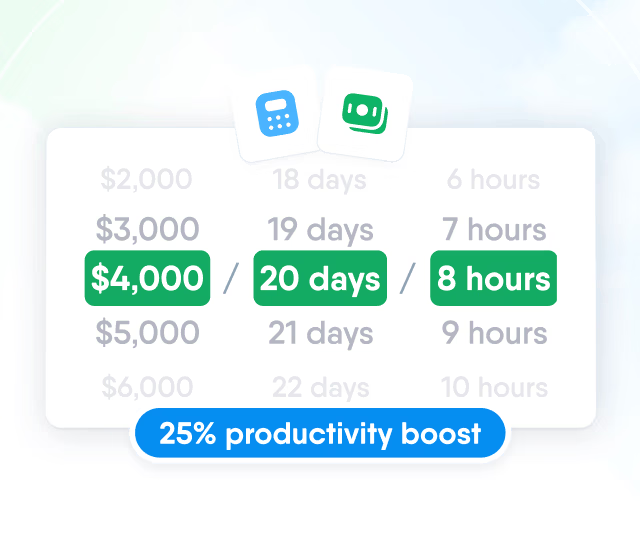
HR efficiency estimator
How does the HR efficiency estimator from PeopleForce work.
Calculate your impact



Recruitment process
What recruitment is, the stages of the hiring process and the methods that work
What is recruitment?
Recruitment is the process of finding, attracting, selecting and hiring people for a company's open roles. It starts with the need for a new employee and ends when a candidate accepts the offer and starts work. Recruitment covers the job description, candidate search, interviews, assessment, negotiating terms and handing the new hire over to onboarding.
Recruitment is broader than the paperwork of hiring: it determines how fast a company fills roles, what that costs and whether new people stay. The process is usually run by a recruiter together with the hiring manager, and in larger companies it is part of a wider talent acquisition strategy. The roles of a recruiter and a hiring manager differ: the recruiter runs the process, while the hiring manager decides on the candidate.
Stages of the recruitment process
| Stage | What happens | Who owns it |
|---|---|---|
| 1. Identifying the need | why the role is needed, what it will cover and the budget | manager, HR |
| 2. Role profile and vacancy | job description, requirements, conditions, job posting text | recruiter, hiring manager |
| 3. Plan and channels | where to look for candidates, who interviews, timelines | recruiter |
| 4. Sourcing and attraction | publishing the vacancy, sourcing, employee referrals | recruiter |
| 5. Screening | CV review, first call, test task | recruiter |
| 6. Interviews | structured interviews with the team, assessment with scorecards | hiring manager, team |
| 7. Offer | agreeing terms, offer letter, reference checks | recruiter, manager |
| 8. Start | paperwork and handover to onboarding | HR |
Together the stages form a recruiting funnel: some candidates drop out at every step, and funnel metrics show where the process slows down.
Internal vs external recruitment
| Internal recruitment | External recruitment | |
|---|---|---|
| Where candidates come from | current employees | the labour market |
| Speed | usually faster | slower: search and selection take time |
| Cost | lower | higher: ads, agencies, recruiter time |
| Benefits | the person already knows the culture and processes, team motivation grows | new skills and a fresh perspective |
In practice, companies combine both: they first look at internal candidates and their talent pool, then open the role externally.
Recruitment methods and channels
- Job boards and social media: posting vacancies on job sites, LinkedIn and community channels.
- Your own candidate database: going back to people who have already been through selection.
- Employee referral programme: employees recommend people they know and get a bonus for a successful hire.
- Sourcing: actively searching for passive candidates, including with boolean search.
- Internal transfers and promotions.
- Rehiring former employees.
- A company career site and recruitment marketing.
- Recruitment agencies and executive search for urgent or rare roles.
- Internships for junior roles.
- Job fairs, conferences and professional communities.
Volume recruitment
Volume recruitment is needed when many similar roles must be filled in a short time: during rapid growth, new location openings or seasonal peaks. The stages stay the same, but fast screening against clear criteria, email templates, automation of routine tasks and feedback to every candidate, including rejected ones, become more important: this directly affects the employer brand.
Recruitment metrics
| Metric | What it shows |
|---|---|
| Time to hire | how many days pass from first contact with a candidate to offer acceptance |
| Time to fill | how many days a vacancy stays open |
| Cost per hire | the average cost of one hire |
| Offer acceptance rate | the share of offers that are accepted |
| Quality of hire | how well new hires perform and whether they stay |
Compliance in recruitment
Recruitment is regulated in most countries. In the UK, for example, employers must carry out a right to work check before a person starts, and the EU pay transparency directive, which member states are bringing into national law, requires employers to tell candidates the starting salary or salary range. Job ads and interview questions also have to avoid discrimination, and candidate data must be handled in line with the GDPR or local data protection law.
PeopleForce's Recruit module runs the whole recruitment process in one place: from multiposting vacancies to job boards and a career site to the candidate pipeline, interviews, team feedback and the offer. The Prospector browser extension adds candidates to your database straight from their online profiles, and once an offer is accepted, the new hire moves into Core HR without re-entering data. A comparison of ATS systems for recruiters helps choose the right tool for your team.


Let us show you what's possible
From Core HR to advanced workforce analytics — see the platform saving 80 hours a month for teams just like yours. Fully tailored to your workflow.