
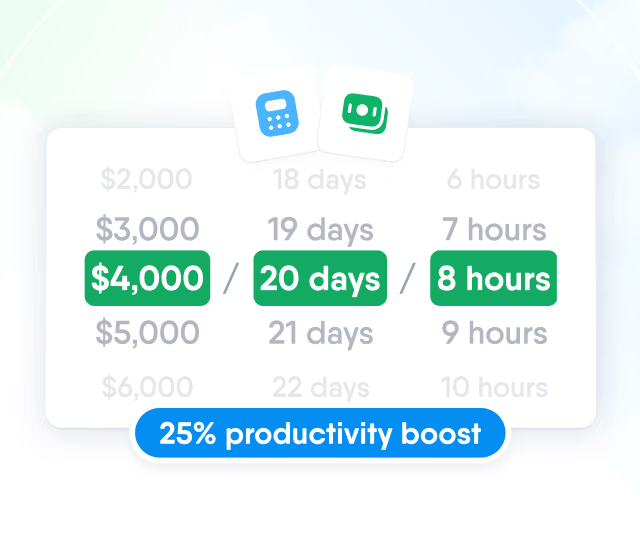
HR efficiency estimator
How does the HR efficiency estimator from PeopleForce work.
Calculate your impact



Key worker
Who is a key worker?
A key worker is someone whose absence stops or seriously degrades work that other people depend on. The label is used in two different ways, and mixing them up is the source of most confusion around it.
Two meanings of the term
In the public sense, a key worker is someone in a role a society cannot pause: medical staff, energy and utilities, transport, food supply, emergency services. The definition comes from a government or local authority, it is attached to the occupation rather than the person, and it usually carries obligations such as working through a shutdown or on irregular shifts. The COVID-19 period made this reading familiar almost everywhere.
In the company sense, a key worker is an employee the business genuinely cannot run without for long: the only person who can close the books, the one engineer who understands a legacy system, the account manager two thirds of revenue is attached to. Here nobody hands you the definition. You have to find these roles yourself, and most companies only discover them during a resignation.
How to identify key roles rather than key people
The useful question is not who is valuable, because everyone hired should be. It is what stops if this seat is empty on Monday. Four signals are worth checking role by role:
- Single point of failure. Nobody else can perform the task at an acceptable standard, and there is no written procedure to follow.
- Scarce skill. The market has few candidates, so the time to fill is measured in months, not weeks.
- Direct exposure. The role sits on revenue, safety, payroll or a legal obligation, so a gap turns into money or liability quickly.
- Long ramp-up. Even a strong replacement needs half a year to be trusted with the same decisions.
Rate roles against those four and the list is usually shorter and more surprising than the leadership team expects. Seniority correlates with it far less than people assume.
Key person risk
Once a role is critical and undocumented, the company is carrying a risk it has not priced. The cost shows up as delayed delivery, decisions nobody feels authorised to make, clients who were loyal to a person rather than to the company, and a hiring process run in a hurry under pressure. This is also where employee turnover stops being an average and starts being a specific problem: losing five people from a team of eighty is survivable, losing one of them may not be.
Reducing the dependency
- Write the role down. Knowledge management exists precisely for this, and the critical roles are where documentation pays for itself first.
- Name a deputy for every critical role and let that person actually cover holidays, not just appear on a chart.
- Cross-train deliberately through job shadowing and rotating who handles routine cases, which also closes part of your skills gap.
- Build the bench into workforce planning so a replacement is being developed before anyone resigns.
- Split the role if it has quietly absorbed three jobs. Concentration is often an accident of history rather than a design choice.
Keeping key workers without buying loyalty
Pay has to be defensible: check the role against the market through salary benchmarking and look at the compa-ratio before assuming money is the issue. Beyond that, what usually keeps people in critical roles is a visible career path, real professional development and not being permanently on call because nobody else was trained. A stay interview with each of them once a year costs an hour and surfaces the reasons long before a resignation letter does.
Common mistakes
Telling someone they are a key worker and nothing else changes, which reads as flattery and often accelerates their exit. Building a retention plan around a person while leaving the dependency intact, so the risk simply continues. And treating the critical list as permanent: roles become critical and stop being critical as systems, clients and team size change, so it is worth rebuilding the list once a year alongside the rest of your retention strategy.
Managing key roles in PeopleForce
Core HR holds the structure the analysis needs: positions, divisions, reporting lines, direct reports in each profile and an org chart that can be viewed by people or by department, which is where a role with no backup becomes visible. Leave policies carry a substitution rule, so when a request is approved the cover passes automatically to the reporting manager, the manager's manager, the third-level manager or a specific named person, which turns the deputy from an intention into a setting.
Around that, the knowledge base in Desk is where the procedures for critical roles get written and kept current, Perform holds competency models and review history so readiness is assessed against the same requirements each cycle, and the reports in HR analytics cover turnover, tenure and headcount by department, so you can see whether the concentration of experience is improving or getting worse.


Let us show you what's possible
From Core HR to advanced workforce analytics — see the platform saving 80 hours a month for teams just like yours. Fully tailored to your workflow.