
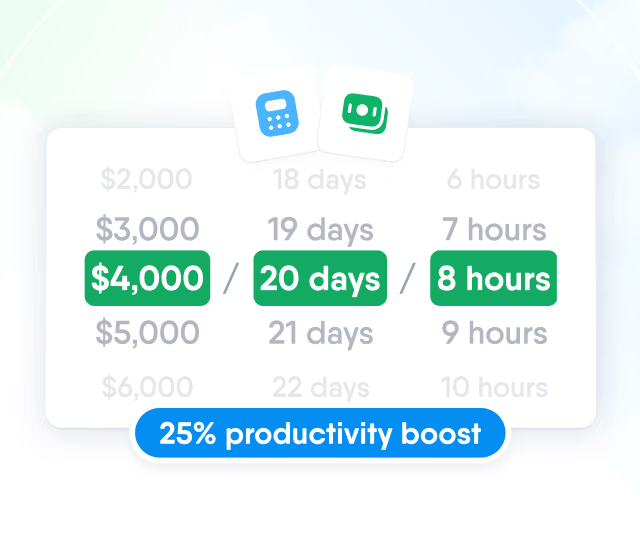
HR efficiency estimator
How does the HR efficiency estimator from PeopleForce work.
Calculate your impact



Top 10 ATS systems: The ultimate recruiter's guide

Looking for an Applicant Tracking System that actually makes hiring easier instead of adding more complexity? You're not alone. With hundreds of ATS platforms out there, finding the right one feels like searching for a needle in a haystack – except the haystack is on fire and the needle keeps changing shape.
Here's the deal: the right ATS can cut your time-to-hire in half, improve candidate experience, and make your recruiters actually enjoy their jobs. The wrong one? That's a $50K investment that'll have your team drowning in clunky workflows and missed candidates.
This guide breaks down the top 10 ATS systems that recruiters are actually using in 2026 – from nimble startups to enterprise giants. We've analyzed their websites, dug through G2 reviews, and compared pricing so you don't have to. No fluff, no affiliate bias, just straight talk about what works and what doesn't.
How we selected these ATS systems
We evaluated platforms based on:
- Core ATS functionality (candidate tracking, pipeline management, job posting)
- User reviews from G2, Capterra, and TrustRadius
- Pricing transparency and value for money
- Integration capabilities and tech stack compatibility
- Recruiter feedback on day-to-day usability
Let's dive in.
1. PeopleForce: The all-in-one HR platform that doesn't break the bank
Best for: Small to mid-sized companies (50-500 employees) wanting an affordable, modular HR solution with strong ATS capabilities
Pricing: Starting at $2.50 per employee/month (minimum $125/month for up to 50 employees)

What PeopleForce actually does
PeopleForce is that rare platform that combines a full-featured ATS with HR management tools without the enterprise price tag. Originally built for SMBs, it's evolved into a genuinely versatile system that works whether you're hiring 5 people or 50.
The ATS (called "PeopleRecruit") sits inside their larger HR platform, which means when you hire someone, they seamlessly flow from candidate to employee without re-entering data. It's the kind of integration that sounds obvious but most standalone ATS platforms can't pull off.
Key features
The ATS core:
- Kanban-style candidate pipeline with drag-and-drop
- Multi-job board posting (50+ boards)
- Chrome extension ("Prospector") for LinkedIn sourcing
- Resume parsing and candidate database
- Interview scheduling and feedback forms
- Offer management with eSignature
- Automated email sequences
What makes it different:
- Modular pricing - Only pay for modules you use (CoreHR, Recruit, Perform, Pulse, Desk, Time)
- Quick implementation - 14-day free trial with full feature access
- No per-job pricing - Unlimited active job postings included
- Customizable workflows - Build your own hiring process without coding
What recruiters are saying (G2 Reviews)
The Good:
- "Price-to-functionality ratio is unmatched" - Multiple reviewers highlight getting enterprise features at SMB prices
- "Customer support responds in minutes, not days" - Fast, knowledgeable support team
- "Setup took less than a week" - Quick onboarding compared to competitors
- "Finally consolidated Factorial and Greenhouse into one system" - Users appreciate the all-in-one approach
The Challenges:
- Some features require admin support to configure initially
- Interface can feel complex for new users (but improves once you understand it)
- Mobile app could use more features
The real talk
PeopleForce is the "Why isn't everyone using this?" option. It's not trying to be everything to everyone—it's focused on companies that want solid HR and recruiting without paying Greenhouse prices.
The ATS itself is straightforward: post jobs, track candidates, collect feedback, make offers. Where it shines is the integration with the rest of HR. New hires automatically get onboarding workflows, performance review schedules, and time-off policies without anyone manually updating five different systems.
Who Should Skip It: Enterprise companies needing advanced analytics and complex approval workflows. PeopleForce is powerful, but it's not built for 5,000-employee organizations with matrix reporting structures.
Who Should Try It: Any growing company (20-500 employees) that's tired of juggling separate systems for recruiting, HR, performance management, and time tracking. The 14-day free trial is actually useful—you get full access, not a gimped demo.
2. Greenhouse: The analytics powerhouse
Best for: Mid-market to enterprise companies (200+ employees) that treat recruiting as a data-driven operation
Pricing: Custom pricing; typically $6,000-$25,000+ annually depending on company size and features
What Greenhouse actually does
Greenhouse is what you get when engineering-minded people build an ATS: structured hiring processes, deep analytics, and endless configurability. It's the platform recruiters point to when they want to "prove ROI" to leadership.
The core philosophy is "structured hiring"—consistent interview processes, standardized scorecards, and data to back up hiring decisions. If your CEO asks "Why is engineering hiring so slow?" Greenhouse gives you charts, not guesses.
Key features
- Structured Interviewing: Build consistent interview kits with prescribed questions and evaluation criteria
- Advanced Analytics: Custom dashboards tracking time-to-hire, source effectiveness, pipeline health, quality-of-hire metrics
- 500+ Integrations: Deep connections with HRIS, background checks, assessments, job boards
- Candidate Experience Tools: Branded career pages, self-scheduling, application tracking
- Diversity & Inclusion: Built-in tools for removing bias and tracking diversity metrics
Pricing breakdown (based on user reports)
- Essential Plan: ~$10,000-$15,000/year for small teams
- Advanced Plan: ~$18,000-$25,000/year with enhanced features
- Expert Plan: $30,000+ with full customization and premium support
Add-ons like sourcing tools, advanced analytics, and integrations cost extra. One user reported:"We were quoted $27K for 190 employees, plus $1K implementation fee."
The real talk
Greenhouse is the Salesforce of ATS platforms: powerful, expensive, and loved by data nerds. If you have a recruiting ops team and need to prove that your $2M recruiting budget is working, Greenhouse delivers.
But here's the catch: you're paying a 30-50% premium for the brand and polish. Functionally, Greenhouse does what Lever, Ashby, and even PeopleForce do—just with more enterprise-grade reporting and a bigger support org.
Who Should Skip It: Startups, small teams, or anyone hiring fewer than 20 people/year. Greenhouse is overkill if you're not regularly running recruiting data analysis.
Who Should Try It: Companies with dedicated recruiting teams, executive buy-in for structured hiring, and budget for a premium tool. If you're scaling from 100 to 500+ employees, Greenhouse scales with you.
3. Ashby: The data nerd's dream ATS
Best for: Tech startups and growth companies (50-500 employees) that want best-in-class analytics without enterprise bloat
Pricing: Starting at $300-$400/month for small teams; scales with company size. No free trial. "Elevated" user seats cost $800/year per seat.
What Ashby actually does
Built by ex-Google engineers frustrated with clunky ATS platforms, Ashby is what happens when you prioritize data and speed over everything else. Think of it as Greenhouse's younger, faster, more affordable cousin.
The killer feature? Custom reporting that doesn't require a data science degree.You can build dashboards tracking any recruiting metric imaginable—time-to-hire by source, quality-of-hire by channel, conversion rates at each funnel stage—in minutes, not hours.
Key features
- AI-Powered Everything: Interview recording with auto-summaries, AI candidate filtering, email personalization
- Unlimited Custom Reports: Build dashboards for any recruiting metric without SQL
- All-in-One Platform: ATS + CRM + Sourcing + Scheduling in one system
- Chrome Extension: Source candidates from LinkedIn without leaving your browser
- Advanced Automations: Build complex workflows without coding
What makes it different
Ashby consolidates what usually takes 3-4 tools: ATS, CRM, sourcing platform, and analytics. Most teams report eliminating other subscriptions after switching to Ashby.
The AI features actually work—interview summaries catch details you missed, candidate filters use natural language ("Find candidates with startup experience and ML skills"), and email templates adapt to context.
The real talk
Ashby is for teams that get recruiting metrics. If your CEO asks "What's our engineering funnel conversion rate?" and you light up instead of panic, Ashby is your platform.
The pricing is interesting: $5-8 per employee/month sounds cheap, but "elevated" user access ($800/year per recruiter) adds up fast. For a 200-person company with 5 recruiters, you're looking at $10K-15K/year minimum.
Who Should Skip It: Non-technical teams, companies with simple hiring needs, or anyone who doesn't care about data beyond "did we hire someone?" Ashby rewards power users but frustrates casual ones.
Who Should Try It: Tech startups hiring 20-100 people/year, companies with recruiting ops teams, or any org where "data-driven recruiting" isn't just buzzwords. If you're currently using 4 different tools for recruiting, Ashby pays for itself quickly.
4. SmartRecruiters: The enterprise workhorse
Best for: Mid-market to enterprise companies (250+ employees) needing high-volume, multi-location recruiting with strong compliance
Pricing: Custom quote-based pricing; typically quote-based with annual contracts
What SmartRecruiters actually does
SmartRecruiters bills itself as a "Talent Acquisition Suite" (not just an ATS), which is marketing speak for "we do recruitment marketing + applicant tracking + analytics all in one."
The real strength? Handling scale. If you're hiring 500 people across 20 locations in 10 countries, SmartRecruiters keeps everything organized without falling apart. It's built for the messy reality of enterprise recruiting.
Key features
- AI Talent Matching: Auto-rank applicants against job criteria, cutting manual screening time
- Recruitment Marketing: Custom career sites, one-click job distribution to 350+ boards and social media
- Conversational AI: Chatbot guides candidates through applications, reducing drop-off rates
- 350+ Integrations: HRIS, background checks, assessments, job boards, compliance tools
- Global Compliance: Multi-language support, regional job boards, localization features
The real talk
SmartRecruiters is the Honda Accord of ATS platforms: reliable, gets the job done, not particularly exciting, but you won't regret buying it.
It's especially strong if you're hiring hourly workers, managing remote teams, or need multilingual support. The recruitment marketing tools (career sites, job distribution) are better than most standalone ATS platforms.
Who Should Skip It: Small teams (under 50 employees), companies wanting cutting-edge analytics, or tech-forward startups that prioritize speed over enterprise features.
Who Should Try It: Multi-location companies, retail/hospitality businesses hiring in volume, or any org with complex compliance needs (healthcare, finance). If you're running 50+ requisitions simultaneously, SmartRecruiters keeps you sane.
5. Lever: Beautiful design, premium price
Best for: High-growth startups (50-200 employees) that prioritize candidate experience and employer branding
Pricing: Custom pricing; industry reports suggest $6-8 per employee/month or $12K-25K annually depending on features
What Lever actually does
Lever is what happens when designers build an ATS: clean interface, smooth workflows, and candidate-facing tools that actually impress applicants. It combines ATS + CRM (they call it "LeverTRM"), which means you can nurture passive candidates alongside active applicants.
The interface is Lever's calling card. It's genuinely intuitive—hiring managers can use it without training, recruiters onboard in hours instead of days, and candidates regularly compliment the application experience.
Key features
- ATS + CRM Combined: Track active applicants and build talent pipelines for passive candidates
- Automated Scheduling: Calendar integrations, candidate self-scheduling, reduced back-and-forth emails
- Candidate Portal: Applicants can track status, schedule interviews, submit materials
- 400+ Integrations: Connects with Slack, Greenhouse Onboarding, DocuSign, background checks, assessments
- Visual Pipelines: Drag-and-drop candidates between stages
What recruiters are saying
The Good:
- "Cleanest interface of any ATS we've tested"
- "Onboarding time was minimal—team was productive immediately"
- "LinkedIn integration works seamlessly"
- "In-app support chat solves problems quickly"
The Challenges:
- "Pricing is 30-50% higher than competitors for similar features"
- "Reporting and analytics are basic compared to Greenhouse or Ashby"
- "Limited customization in job posting templates and workflows"
- "Search and filtering with large candidate pools feels clunky"
- "Auto-renewal terms can be sneaky—read the contract carefully"
The real talk
Lever is the ATS you choose when candidate experience and employer brand matter more than cutting-edge analytics. If you're a startup competing against Google/Facebook for talent, Lever makes your hiring process feel premium.
But you're paying for polish. Functionally, Lever does what Greenhouse, Ashby, and even Workable do—just prettier and with less depth. One user summed it up:"We're paying $18K/year for Lever when JazzHR would do the same for $4K."
Who Should Skip It: Budget-conscious startups, companies needing advanced analytics, or enterprise-scale recruiting. Lever is built for speed and simplicity, not complexity.
Who Should Try It: Startups in competitive hiring markets, companies where employer brand is a recruiting advantage, or any team that's watched candidates drop off due to clunky application processes. The UI genuinely matters here.
6. Workable: The sourcing champion
Best for: Small to mid-sized companies (20-250 employees) that prioritize candidate sourcing and global hiring
Pricing: Starting at $169/month (up to 20 employees); scales with company size. Free 15-day trial.
What Workable actually does
Workable is the ATS for teams that find candidates, not just process applications. The sourcing tools—LinkedIn Recruiter integration, AI-powered candidate matching, access to 400M+ candidate profiles—are legitimately best-in-class for a mid-market platform.
It's also expanded beyond pure ATS: Workable now includes HRIS features (onboarding, time tracking, payroll reporting), making it a lightweight alternative to full HR suites like BambooHR.
Key features
- Advanced Sourcing: LinkedIn Recruiter integration, 400M+ candidate database, AI candidate matching
- 200+ Job Board Distribution: Post to Indeed, LinkedIn, specialized boards with one click
- AI Screening: Auto-rank candidates, surface best matches, reduce manual resume review
- Global Hiring Support: Multi-language, multi-currency, international job boards, local compliance
- HRIS Features: Onboarding workflows, time & attendance, PTO tracking, payroll integration (ADP/Xero)
What recruiters are saying
The Good:
- "Sourcing tools are exceptional for the price point"
- "AI candidate matching saves hours per week"
- "Smooth Slack integrations keep everyone updated"
- "Automated interview scheduling eliminated email ping-pong"
The Challenges:
- "Pricing scales with company size, which punishes larger orgs" - A 200-person company pays the same whether hiring 2 or 20 roles
- "Reporting customization is limited"
- "Video interviews and SMS cost extra ($59/month each)"
- "Some features feel incomplete or need more polish"
- "AI accuracy depends heavily on input data quality"
Pricing reality check
Workable's pricing model is interesting (and controversial): you pay based on total employee count, not active job postings. That's great if you're a 50-person company hiring aggressively, but painful if you're a 300-person company filling 3 roles.
- Starter: $169/month (up to 20 employees)
- Standard: $299/month (21-50 employees)
- Premier: $599/month (51-100 employees)
Add the HR module? Prices jump to $249/$349/$679 respectively.
The real talk
Workable is the "value pick" for growing companies. You get enterprise-grade sourcing tools, solid ATS functionality, and basic HRIS features for less than Greenhouse or Lever.
The catch? You're locked into company-size pricing. If you're a 200-person company hiring occasionally, you're overpaying. If you're a 50-person startup hiring aggressively, it's a steal.
Who Should Skip It: Large companies with low hiring volume, enterprises needing deep analytics, or anyone who wants granular control over workflows.
Who Should Try It: Startups and scale-ups (20-200 employees) hiring 10+ people/year, especially in competitive markets where sourcing tools matter. The 15-day trial is generous—use it to test the sourcing features specifically.
7. Recruitee: The collaborative hiring expert
Best for: Companies (any size) that prioritize team collaboration and want transparent pricing
Pricing: Starting at $109/month for unlimited job postings; flat rate regardless of company size
What Recruitee actually does
Recruitee (now part of Tellent) is the ATS for teams that actuallycollaborateon hiring. The platform is built around the idea that great hiring happens when recruiters, hiring managers, and team members work together seamlessly.
The standout feature? Transparent, flat-rate pricing. Most ATS platforms hide pricing or charge per employee/per job. Recruitee just says "$109/month for unlimited jobs, period." That honesty is refreshing.
Key features
- Kanban-Style Pipelines: Visual candidate tracking with customizable hiring stages
- Team Collaboration: Shared candidate profiles, real-time notes, @mentions, centralized feedback
- 1,450+ Job Board Distribution: Post to multiple boards simultaneously, manage sourcing budget effectively
- Branded Career Sites: No-code builder for custom, multilingual career pages
- Interview Scheduling: Built-in tools to coordinate interviews, reduce scheduling conflicts
- Analytics & Dashboards: Track hiring bottlenecks, optimize pipeline performance
What recruiters are saying
The Good:
- "Transparent pricing with no hidden fees"
- "Collaborative features make hiring manager involvement easy"
- "Career page builder is surprisingly powerful for a no-code tool"
- "Customer support is responsive and helpful"
- "18-day free trial gives enough time to really test it"
The Challenges:
- "Mobile app could be better organized"
- "Customer support is chat/email only—no phone support"
- "Some features aren't available in all countries"
- "They raised prices 442% for one user after 5 months" (controversial pricing change reported by one reviewer)
The real talk
Recruitee is the "honest broker" ATS. No games, no hidden pricing, no "contact sales for a quote." You know what you're paying from day one, and the platform delivers solid ATS functionality without trying to be everything to everyone.
The collaboration tools are genuinely useful—hiring managers can leave feedback, view candidate history, and track progress without needing recruiter hand-holding. That alone saves hours per week.
Who Should Skip It: Enterprise companies needing advanced analytics or AI-powered features. Recruitee is straightforward but not cutting-edge.
Who Should Try It: Any company (startup to 500 employees) that wants predictable pricing and collaborative hiring. The flat-rate model makes it especially attractive for high-volume hiring without per-job costs.
8. Breezy HR: The user-friendly starter
Best for: Small businesses (10-100 employees) hiring occasionally and wanting extreme ease of use
Pricing: Free "Bootstrap" plan for 1 active job; paid plans start at ~$157/month
What Breezy actually does
Breezy is the ATS for teams that find most recruiting software too complicated. The entire platform is designed around "make it simple"—drag-and-drop pipelines, visual candidate tracking, minimal clicks to complete tasks.
It's not trying to replace Greenhouse or compete with Ashby's analytics. Breezy's mission is helping small businesses hire without needing a dedicated recruiter.
Key features
- Visual Drag-and-Drop Pipeline: Move candidates between stages visually
- 50+ Job Board Posting: One-click distribution to Indeed, LinkedIn, etc.
- Automated Candidate Communication: Email templates, bulk actions, rejection emails
- Interview Scheduling: Calendar integrations, automated reminders
- Chrome Extension: Source candidates from LinkedIn easily
- Customizable Workflows: Build hiring processes without coding
What recruiters are saying
The Good:
- "Easiest ATS we've ever used—team learned it in minutes"
- "Great for HR teams of one"
- "Affordable pricing for small businesses"
- "Customer support is responsive and helpful"
The Challenges:
- "Reporting and analytics are basic"
- "Job postings require manual compliance review (can take days)"
- "Some features locked behind higher tiers"
- "Occasional glitches and slow loading times"
- "Integration with ADP/Google Meet isn't perfect"
The real talk
Breezy is the "starter ATS" that small businesses graduate from, not to. It's perfect when you're hiring 5-10 people/year and don't have a dedicated recruiter. But once you're hiring regularly or need analytics, you'll outgrow it.
One user nailed it:"After deploying Breezy at four organizations, I can say it's one of the most thoughtfully designed ATS for small teams. Hiring managers are productive immediately."
Who Should Skip It: Mid-sized to large companies, high-volume recruiters, or anyone needing advanced analytics and automation.
Who Should Try It: Small businesses (10-50 employees) hiring 1-5 people/year, HR teams of one, or anyone upgrading from Excel spreadsheets. The free plan lets you test with one active job—enough to decide if it fits.
9. Rippling: When you need HR + IT + Finance in one platform
Best for: Tech-forward companies (50-1000 employees) wanting unified HR, payroll, IT management, and recruiting
Pricing: Base HRIS starts at $8 per employee/month + $35/month platform fee; recruiting module is an add-on
What Rippling actually does
Rippling isn't an ATS company—it's aworkforce management platform that happens to include recruiting. If you need to hire someone, provision their laptop, set up payroll, grant software access, and start performance reviews all from one system, Rippling does that.
The ATS module is solid but not groundbreaking. Where Rippling shines is what happens after you hire: seamless onboarding, automated IT provisioning, instant payroll setup, benefits enrollment—all connected.
Key features
ATS capabilities:
- Job requisition management with headcount planning integration
- Customizable job boards and career pages
- Applicant tracking with interview scheduling
- AI-generated job descriptions and candidate screening
- Offer management with automatic data flow to HRIS
Beyond recruiting:
- HRIS: Onboarding, employee database, org charts, document management
- Payroll: Global payroll in 185 countries, automated tax filing
- IT Management: Device provisioning, software access control, security policies
- Benefits Administration: Health insurance, 401(k), perks management
What users are saying
The Good:
- "Consolidated 5+ HR/IT tools into one platform"
- "Onboarding is seamless—candidates become employees instantly"
- "Support is fast and knowledgeable"
- "Automation saves hours per week"
The Challenges:
- "Learning curve is steep—platform is complex"
- "Pricing gets expensive quickly as you add modules"
- "No free trial—you have to demo with sales"
- "Some features require significant setup"
The real talk
Rippling is the ATS you choose when recruiting is part of your problem, not the whole problem. If you're also struggling with IT provisioning, payroll across multiple states/countries, or benefits administration, Rippling makes sense. If you just need an ATS? It's overkill.
The pricing is modular: start at $8/employee/month, add recruiting (~$4-8/employee/month), add payroll ($35-50/month base + per-employee fees), add IT management ($5/employee/month), add benefits, add time tracking... You see where this goes.
For a 100-person company using HRIS + Recruiting + Payroll + IT: expect ~$25-35 per employee/month total, so $30K-42K annually.
Who Should Skip It: Small businesses under 50 employees (too complex), companies needing best-in-class ATS features (recruiting is not Rippling's strength), or anyone on a tight budget.
Who Should Try It: Tech companies (50-500 employees) managing remote teams, companies hiring internationally, or any org that's currently juggling separate systems for HR, payroll, IT, and recruiting. The unified approach pays off if you use multiple modules.
10. Deel: The global hiring specialist
Best for: Companies hiring international contractors and employees across 150+ countries
Pricing: Contractor management ~$49/month per contractor; EOR services ~$599/year per employee; custom pricing for HR platform
What Deel actually does
Deel is the "hire anyone, anywhere" platform. Need to hire a developer in Brazil? Designer in Poland? Customer success rep in Singapore? Deel handles the legal entity, local compliance, payroll, benefits, and tax filings so you don't have to.
The ATS functionality exists, but it's not Deel's strength. Where Deel dominates isglobal employment logistics—turning "We want to hire internationally" from a 6-month nightmare into a 2-day process.
Key features
- Global Contractor Management: Hire, pay, and manage contractors in 150+ countries
- Employer of Record (EOR): Hire full-time employees without setting up local entities
- Global Payroll: Pay in 120+ currencies, automated tax calculations, local benefits
- Compliance Automation: Contracts, labor law adherence, tax filings handled automatically
- HRIS Features: Onboarding, time tracking, PTO management, employee database
- Integration: Connects with HRIS, payroll, accounting software
What users are saying
The Good:
- "Hiring internationally went from 6-8 weeks to 1-2 days"
- "Payments are always on time, no currency issues"
- "Compliance tools give peace of mind"
- "Customer support is responsive (24/7 availability)"
The Challenges:
- "EOR pricing is steep for long-term hires" ($599/employee/year adds up)
- "Customer support can be slow via email (3 days to 1 month response)"
- "Currency conversion fees add up"
- "Interface can feel cluttered for certain tasks"
- "Reporting customization is limited"
The real talk
Deel is not an ATS-first platform—it's a global employment platform with ATS features tacked on. If your primary need is international hiring logistics, Deel is unmatched. If you just need a better way to track candidates in your home country? Look elsewhere.
The pricing makes sense for contractors ($49/month per contractor is reasonable) but gets expensive for full-time employees. At $599/year per employee for EOR services, a 10-person international team costs $6K/year just for Deel—not including payroll, benefits, or HRIS modules.
Who Should Skip It: Domestic-only hiring, small budgets, or anyone needing ATS-first functionality. Deel's recruiting tools are basic compared to dedicated platforms.
Who Should Try It: Companies hiring remote contractors, startups building distributed teams, or any org expanding internationally without local entities. If you're asking "How do we hire in Europe?" Deel answers that question immediately.
Comparison table: quick reference
Platform | Best For | Starting Price | Key Strength | Main Weakness |
|---|---|---|---|---|
PeopleForce | SMBs (50-500) | $2.50 | Affordable all-in-one HR + ATS | Not built for enterprise complexity |
Greenhouse | Enterprise (200+) | ~$10K-$25K/year | Analytics & structured hiring | Expensive; premium features cost extra |
Ashby | Tech startups (50-500) | $300-400/month | Best-in-class analytics & AI | No free trial; steep learning curve |
SmartRecruiters | Enterprise (250+) | Custom pricing | High-volume, multi-location hiring | Reporting lacks customization |
Lever | Growth startups (50-200) | $12K-25K/year | Beautiful UI & candidate experience | Premium pricing for basic features |
Workable | SMBs (20-250) | $169/month | Sourcing tools & global hiring | Company-size pricing hurts larger orgs |
Recruitee | Any size | $109/month flat | Transparent pricing, collaboration | Basic analytics & AI |
Breezy HR | Small biz (10-100) | $157/month | Extreme ease of use | Basic features, limited scalability |
Rippling | Tech (50-1000) | $8 | Unified HR/IT/Finance platform | Complex setup; expensive with add-ons |
Deel | Global hiring | $49 | International hiring & compliance | ATS features are basic; EOR costs high |
How to choose the right ATS for your team
If you're a startup (10-50 employees):
- Budget-conscious: Breezy HR or PeopleForce
- Tech-forward: Ashby or Lever
- Global hiring: Deel
If you're a growth company (50-250 employees):
- Data-driven: Ashby or Greenhouse
- Affordable all-in-one: PeopleForce or Workable
- Collaboration focus: Recruitee or Lever
If you're hiring internationally:
- Contractors: Deel
- Full-time employees: Deel (EOR) or Rippling
- Multi-country teams: Workable or PeopleForce
The bottom line
There's no "best" ATS for everyone—only the best ATS for your situation. Here's the honest truth:
- PeopleForce delivers the best value if you want HR + ATS in one affordable package
- Greenhouse dominates if you need analytics and have the budget
- Ashby wins for tech startups obsessed with data
- SmartRecruiters handles enterprise complexity without falling apart
- Lever makes your hiring process feel premium (even if features are standard)
- Workable nails sourcing tools for the mid-market
- Recruitee offers the most honest, transparent pricing
- Breezy is perfect for small teams that find other ATS platforms too complex
- Rippling makes sense if recruiting is one piece of a larger HR/IT puzzle
- Deel solves international hiring logistics like nothing else
The right move? Pick 2-3 platforms from this list based on your size/budget/needs, then actually test them. Most offer free trials or demos. Ask your recruiters to try building a real job posting, tracking a candidate, and running a report. The best ATS is the one your team will actually use without complaining.
Good luck hiring. You've got this.
With over five years in HR tech content creation, Maria explores how technology, people, and culture shape the workplace of today. Her interests include HR, AI, IT, and personal development, and she brings a data-driven, human-centered perspective to her writing.


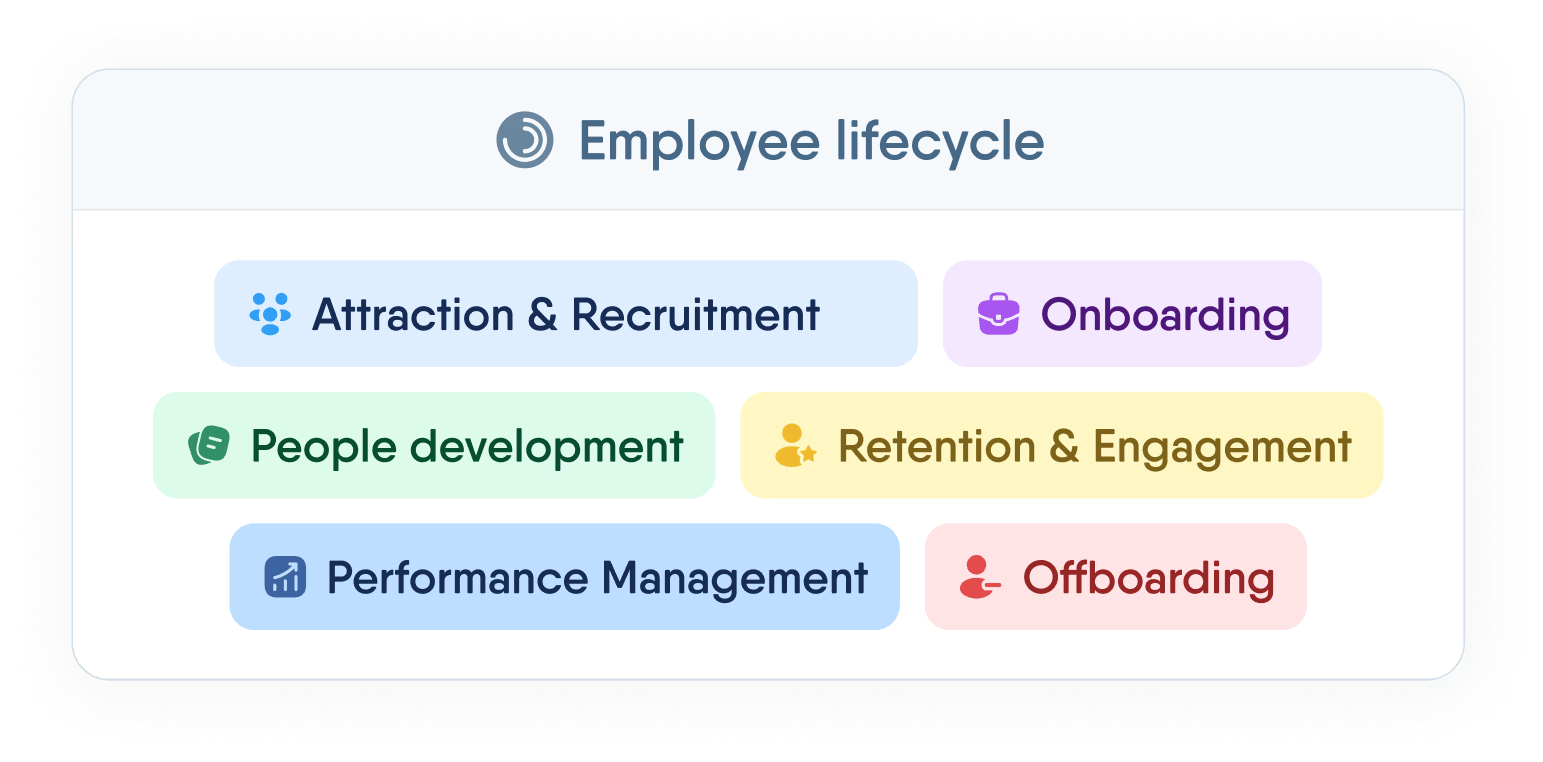
One login. Every HR tool you'll need.
Manage the full employee lifecycle — from first interview to final offboarding — without switching tabs or losing data.
Recent articles
 2025-07-21
Comparing the top 10 HRM systems: How to choose the best one?
Struggling to choose the right HRM system for your team? Want to know which platform offers the best value, features, and support? We’ve compared the top 10 HRM solutions to help you decide — with real user ratings, pricing breakdowns, and key use cases.
2024-03-18PeopleForce vs Alternatives: How PeopleForce stands out against competitors
Use this guide to assess PeopleForce against alternatives and choose the right HRM.
2024-08-26How much time HR platform saves for HRs and admins
Discover how modern, all-in-one HR software simplifies complex processes, ensures compliance, and boosts efficiency to help HR teams manage growing responsibilities with ease.