
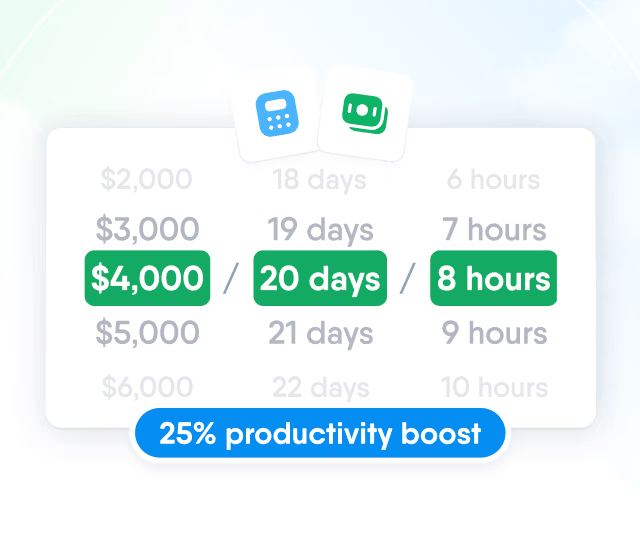
HR efficiency estimator
How does the HR efficiency estimator from PeopleForce work.
Calculate your impact



Independent contractor
Who is an independent contractor?
An independent contractor is a self-employed person or business that provides services to a company under a commercial contract rather than an employment contract. They invoice for results, decide how the work gets done, carry their own tax and social contributions, and bear their own commercial risk.
The point that matters most in practice: classification is not decided by what the contract is called. Labour inspectorates and courts look at how the relationship actually works, and a contract headed "services agreement" that describes a person sitting in your team, on your schedule, under your supervision, will be read as employment regardless of its title.
The tests authorities actually apply
The wording differs by country, but the questions are remarkably consistent:
- Control. Who decides when, where and how the work is done. Fixed hours and a seat in the office point to employment.
- Integration. Is the person part of the organisation or supplying it? Appearing on the org chart, managing employees or holding an internal role are integration signals.
- Substitution. Can they send someone else to do the job? A genuine contractor usually can; an employee cannot.
- Economic dependence. One client providing nearly all of someone's income looks a lot like employment to an inspector.
- Tools and risk. Who provides equipment, who fixes defects at their own expense, who loses money if the project overruns.
No single answer decides it. What decides it is the overall picture, which is why the safest arrangements are the ones that look like contracting on every question rather than on most of them.
What misclassification costs
Reclassification is rarely a warning letter. It usually means back payment of contributions and taxes for the whole period, plus interest and penalties, and the person acquires employee rights retroactively: paid leave accrued but never taken, notice periods, severance, protection against dismissal. The company also inherits records it never kept, because nobody was tracking working time for someone who was formally a supplier.
The risk is asymmetric in an important way. The arrangement usually suits both sides right up until it does not, and the trigger is almost always a dispute: someone is let go, the relationship sours, and the claim to be an employee all along follows. That is worth remembering when the contractor is the one asking for the arrangement.
When a contractor is genuinely the right choice
Contracting fits a defined deliverable with an end point, specialist work you need occasionally rather than continuously, a genuinely independent professional with several clients, and short-term capacity that does not justify a permanent role. It fits badly where the work is continuous core activity, where the person must follow your process step by step, where you need to direct their daily priorities, and where the role would sit permanently inside a team.
The blunt version of the test: if you would be uncomfortable with the person unilaterally deciding to work Tuesdays only and sending a colleague on Thursdays, you are describing an employee.
Managing contractors without treating them as staff
- Keep them out of employee processes. Performance reviews, internal goals and mandatory training all read as subordination. Milestones and acceptance of deliverables do not.
- Handle IP explicitly. Rights do not transfer automatically in every jurisdiction. Assignment clauses and confidentiality terms belong in the contract, signed before work starts.
- Track access as carefully as for employees. Contractors often keep system access long after the last invoice, which is where offboarding gaps turn into security incidents.
- Keep the headcount question honest. Contractors are not headcount but they are capacity and cost, so exclude them from one number and include them in the other.
How PeopleForce handles contractors
In PeopleForce, the form of cooperation is its own field, called work type, and the list is configurable rather than fixed, so a company can separate employees, contractors and any other arrangement it uses instead of squeezing everyone into one category. Because that field feeds filters and reports, headcount by work type is a report rather than a manual exclusion, and the employee directory and org chart can be narrowed to employees only when the question is about the organisation rather than about capacity.
Contracts, annexes and acceptance documents are generated from templates and signed through electronic signature, so the paperwork exists in one place instead of in someone's mailbox. Access and offboarding run on workflows anchored to the end date of the engagement, which closes the gap where a finished contractor keeps their accounts. For project work, each person carries a cost rate and a billable rate that can be overridden per project with their own start and end dates, so time logged turns into cost without a separate spreadsheet.


Let us show you what's possible
From Core HR to advanced workforce analytics — see the platform saving 80 hours a month for teams just like yours. Fully tailored to your workflow.