
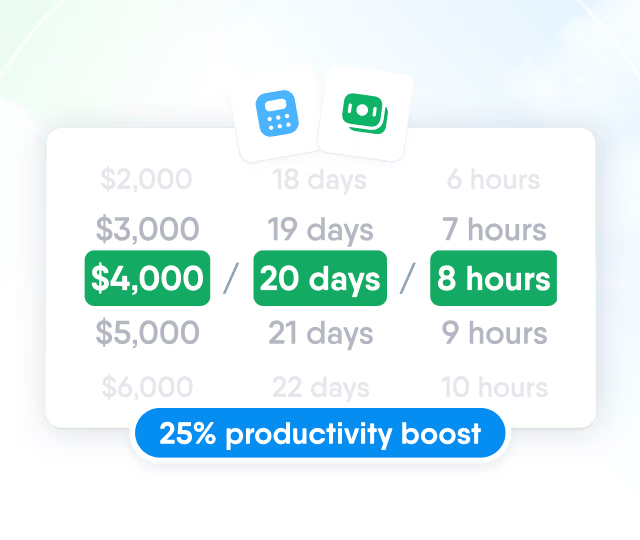
HR efficiency estimator
How does the HR efficiency estimator from PeopleForce work.
Calculate your impact



Seasonal employment
What is seasonal employment?
Seasonal employment is hiring tied to a period of predictable peak demand that repeats on a cycle: the harvest, the summer tourist season, the run-up to Christmas in retail, the winter in logistics. The engagement has a defined start and end, and the same peak comes round again next year.
It is worth separating seasonality from contract length. A fixed-term contract says how long the engagement lasts; seasonality says why it ends. That distinction matters legally in several countries, because seasonal work often has its own rules that do not apply to ordinary temporary hiring, and it matters practically because a season is predictable and a temporary need usually is not.
What makes seasonal hiring hard
- Volume in a narrow window. A year's worth of hiring compressed into a few weeks, with the offer-to-start gap measured in days rather than weeks.
- Onboarding that has to be short and still real. Safety training, equipment and access cannot be skipped just because someone will be gone in three months.
- Peak-season working time. Overtime, weekend shifts and rest periods all get stretched exactly when nobody has time to keep records properly, which is where inspections find problems.
- Paperwork at scale. Fifty contracts signed in a week is a different administrative problem from fifty signed across a year.
- Leave and final pay. Short engagements still accrue leave, and unused days usually have to be paid out at the end.
Returning workers are the whole game
The single biggest lever in seasonal work is the return rate. Someone who worked last season knows the equipment, the site and the process, needs a fraction of the onboarding, and is productive from day one instead of day ten. A company that brings back half its crew each year is running a fundamentally cheaper operation than one that recruits from scratch every time, even if the two pay identical wages.
That makes the end of the season more important than it looks. How people are paid out, whether the last week is chaotic, and whether anyone tells them they would be welcome back decide next year's recruiting cost. Keeping the contact details and the performance note of everyone who left on good terms is the cheapest talent pipeline a seasonal business has, and returning employees are worth tracking deliberately rather than by memory.
Planning the season before it starts
- Work backwards from the peak date, not forwards from today. Subtract hiring lead time, onboarding and training to find when sourcing must start.
- Base the numbers on last season's actuals rather than on the plan that was written for it, including the no-show rate between offer and first day.
- Decide in advance which roles must be covered by returners and which can be filled by anyone, because they need different timelines.
- Prepare the documents as templates before the rush, not during it.
All of this is ordinary workforce planning, only with a much shorter cycle and a much less forgiving deadline. A permanent role filled two weeks late is an inconvenience. A harvest crew short by ten people is lost product.
How PeopleForce supports a season
The hiring half runs in Recruit, where a vacancy can be multiposted to job boards at once rather than published one by one, and the candidate base from previous seasons stays searchable, so last year's crew is a filter rather than an old spreadsheet. For people who are coming back, the employee record can be reactivated through a dedicated rehire flow instead of being created from zero, which keeps their history in one profile.
On the administrative side, seasonal staff sit under their own work type in Core HR, so headcount reporting separates them from permanent employees without manual filtering. Contracts are generated from templates and signed with electronic signature, and onboarding and offboarding run on workflows anchored to the hire and end dates with offsets, so the same checklist fires for fifty people without anyone chasing it. Leave policies accrue with the first period prorated, which is exactly the case for a three-month engagement, and hours worked during the peak are recorded in Time rather than reconstructed afterwards.


Let us show you what's possible
From Core HR to advanced workforce analytics — see the platform saving 80 hours a month for teams just like yours. Fully tailored to your workflow.