
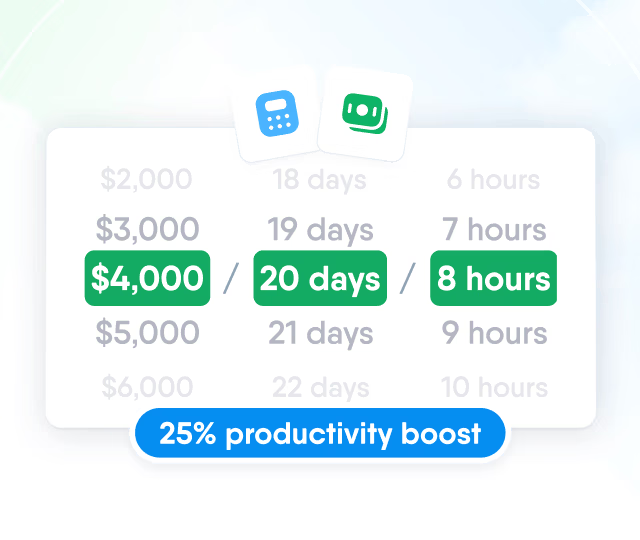
HR efficiency estimator
How does the HR efficiency estimator from PeopleForce work.
Calculate your impact



Upskilling
What is upskilling?
Upskilling is the planned expansion of an employee's existing skills so they can do their current job at a higher level or absorb adjacent work. The role stays the same; what grows is depth, range and the size of problem the person can be trusted with.
The quickest test of whether you are upskilling or reskilling is to ask what happens to the job. A support agent who learns SQL and stops escalating data questions has been upskilled. The same agent who moves into analytics full time has been reskilled. Both close a skills gap, but they differ in cost, timeline and risk.
Upskilling starts with a gap, not a course catalogue
A programme assembled from whatever training vendors happen to be selling produces certificates rather than capability. The sequence that works runs the other way round: define what each role requires, measure what people actually have, then buy or build only for the difference. Competency mapping gives you the first half and a training needs analysis the second.
Three things make that gap usable:
- Requirements recorded per role with a level attached. "SQL" is not a requirement; "SQL at proficient level" is.
- Current levels recorded per person and refreshed after each review cycle, so the dataset does not quietly go stale.
- The delta ranked by business risk rather than by headcount, so the gap that would stall a product launch gets funded before the one that irritates a manager.
Formats, and what each one is actually good for
Every format buys something different, and the mistake most programmes make is using one format for everything.
- Stretch assignments are the cheapest and fastest option and work best where the skill is already partly present. They require a manager willing to accept a slower first attempt.
- Structured mentoring and coaching transfer judgement and context well and technical fundamentals poorly.
- Courses run through a learning management system scale and leave an audit trail, but completion is not competence.
- Job shadowing is the only format that reliably moves tacit knowledge out of one person's head.
- Certification earns its cost where a client or regulator demands proof, and rarely anywhere else.
Why upskilling programmes quietly die
Most of them fail for reasons that have nothing to do with the training itself:
- No protected time. Learning scheduled around the work is learning that does not happen.
- No visible career path. People who gain skills and see no route to use them take both to another employer.
- The wrong metric. Hours logged and courses completed are easy to count and tell you nothing. The honest question is what the person can now do without supervision.
- Stale data. Skills captured once during onboarding and never touched again make the whole inventory unusable inside a year.
Where upskilling pays off fastest
Internal capability is almost always cheaper than external hiring once you count the full cost of a vacancy: the recruiting spend, the weeks the seat sits empty, and the ramp-up before the new hire is productive. Upskilling also protects institutional knowledge, because the person who gains the new skill already understands your customers, your systems and your decision history. That advantage is invisible on a training invoice and obvious six months later.
How PeopleForce supports upskilling
In PeopleForce, skills sit on the employee profile with an explicit level rather than as free-text tags: interested, basic, proficient or expert. Colleagues can endorse a skill, which makes the self-assessment harder to inflate. The same four-level scale is used on the job profile to record what a role requires, so the distance between required and actual is something the system holds rather than something a spreadsheet owner maintains by hand.
From there, the module Perform turns those gaps into commitments — goals with owners and deadlines, review cycles that revisit them, and regular one-on-one meetings where progress is discussed while it can still be corrected. Reference material, internal guides and course notes live in the Desk knowledge base, with version history and audience rules so each team sees the articles that apply to it.


Let us show you what's possible
From Core HR to advanced workforce analytics — see the platform saving 80 hours a month for teams just like yours. Fully tailored to your workflow.