
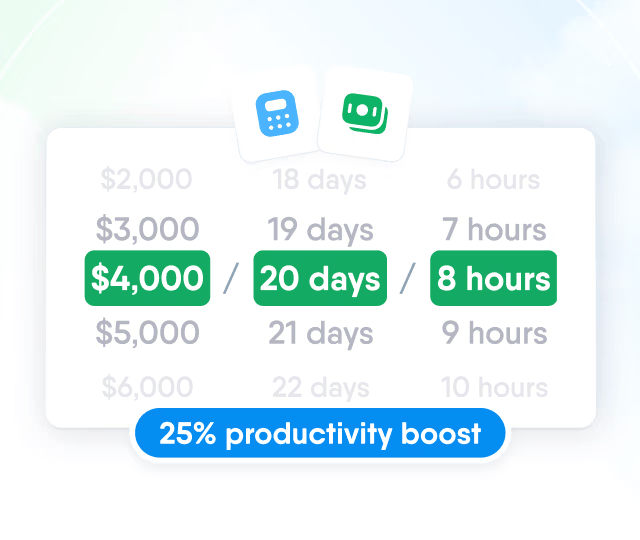
HR efficiency estimator
How does the HR efficiency estimator from PeopleForce work.
Calculate your impact



Wellness programs
What are wellness programs?
A wellness program is an employer-organised set of activities, services and benefits intended to support employees' physical and mental health. In practice it ranges from gym subsidies and health checks to counselling access, ergonomic equipment and financial education, held together by a budget and someone whose job it is to run it.
The useful distinction is between a wellness program and a wellness budget. A budget buys memberships. A program has a stated problem it is trying to solve, a way of knowing whether it worked, and a willingness to change the work itself when the data points there. Most of what gets called a program is a budget.
The four domains
- Physical. Sport and gym access, health screening, ergonomic setup for desk and remote work, vaccination campaigns.
- Mental. Access to counselling, manager training on recognising strain, clear routes to ask for help without it becoming a performance conversation. See mental health at work for the wider picture.
- Financial. Salary advances, pension guidance, budgeting education. Frequently the highest-impact and least-funded domain.
- Social. Belonging, team rituals, volunteering. Cheap to run and easy to overdo to the point where it reads as mandatory fun.
Why most wellness programs fail
The uncomfortable finding that keeps repeating in this field is that wellness perks do very little when the underlying job design is the problem. A yoga class at six in the evening does not offset a workload that requires ten-hour days, and a meditation app does not fix a manager who sends messages at midnight. Programs that treat the symptom while leaving the cause untouched produce a specific and recognisable outcome: low participation, high cynicism and an engagement score that does not move.
- Wrong problem. Offering resilience training when the actual issue is chronic understaffing reads as blaming people for the system they work in.
- Designed for the already-healthy. The people who sign up for the running club are the ones who were already running. The population the program should reach usually does not self-select.
- One-size packages. A single offering has to average across shift workers, parents, remote staff and office staff, and ends up fitting none of them.
- Measured by attendance. Counting sign-ups tells you about marketing, not health.
What tends to work instead
Start by asking what people actually struggle with, then check whether the answer is inside the program's reach or inside the job design. If it is job design, fix that first, because no amount of wellness spend compensates for it. Where the program is the right tool, the patterns that hold up are: choice rather than a fixed package, small amounts of protected time rather than after-hours offerings, and manager behaviour treated as part of the program rather than as a separate leadership topic.
Watch the leading indicators rather than the participation count. Unused leave balances, absence patterns concentrated in one team, and a falling score on workload questions are signals that arrive before burnout shows up as resignations.
Measuring without surveillance
This is where wellness programs most often cross a line. An employer has no business collecting individual health data, and an app that reports individual activity to HR destroys trust faster than the program builds it. The workable approach is aggregate and anonymous: team-level sentiment, aggregated absence trends, and voluntary self-reporting that nobody can trace back to a person. If a measurement would feel intrusive to you as an employee, it will feel intrusive to your colleagues.
How PeopleForce supports wellness programs
The measurement side runs through Pulse. Alongside company-wide and lifecycle surveys, there is a mood check-in on a one-to-five scale with an optional comment, which gives a running signal rather than an annual snapshot, and the resulting mood report is exportable. Results break down by driver and can be cut by department, location, division and position, with a heatmap that makes a single struggling team visible instead of averaged away. Anonymity is enforced at the survey level with a minimum response threshold, so small teams cannot be identified by elimination, which is precisely the guarantee that makes honest answers possible.
The absence side sits in leave tracking within Core HR, where unused balances and absence patterns are visible per team rather than only as a company total. Enrolment in whatever the program offers runs through request forms, and the practical details of each offering belong in the Desk knowledge base so that finding them is not itself a source of friction.


Let us show you what's possible
From Core HR to advanced workforce analytics — see the platform saving 80 hours a month for teams just like yours. Fully tailored to your workflow.