
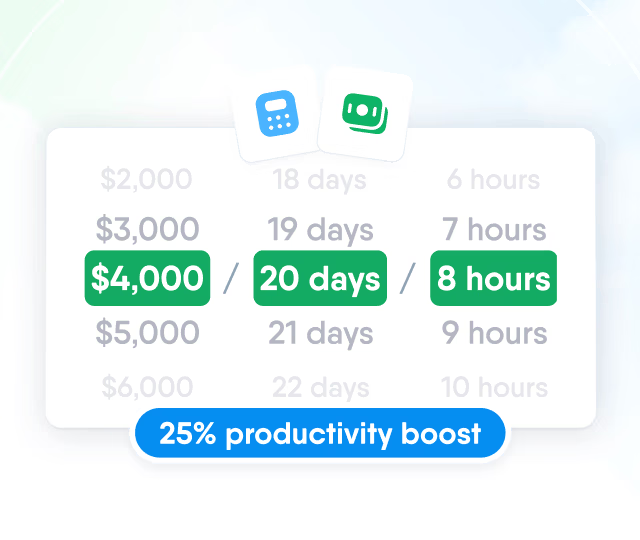
HR efficiency estimator
How does the HR efficiency estimator from PeopleForce work.
Calculate your impact



Zero-based budgeting
What is zero-based budgeting?
Zero-based budgeting is a method in which every budget cycle starts from zero and each line has to be justified again from scratch. Nothing is inherited. Instead of asking how much more or less than last year a department needs, the question becomes what this activity delivers and why it deserves funding at all.
The contrast is with incremental budgeting, where last year's number is the starting point and the discussion is only about the change. The clearest test is what happens to a line nobody actively defends. Under incremental budgeting it survives; under zero-based budgeting it disappears. That single difference explains both the appeal of the method and the resistance it meets.
How it actually works
The mechanics are less exotic than the name suggests. Each activity is written up as a decision package: what it does, what it costs, what happens if it is not funded, and what a cheaper version would look like. The packages are then ranked against each other across the organisation, and money is allocated down the ranked list until it runs out. Everything below the line is not funded this cycle.
The uncomfortable and useful part is the ranking, because it forces comparisons that departments normally avoid making out loud. A training programme and a software licence end up on the same list, and someone has to say which one matters more this year.
Where the method fits
Contrary to a common assumption, zero-based budgeting is not only a small-company technique. It is used most aggressively by large organisations under cost pressure, precisely because scale is where accumulated spending hides best. It fits well where costs have crept up without anyone deciding they should, where two teams are paying for overlapping tools, and after a merger, when two sets of habits have to be reconciled anyway.
It fits badly where the work is long-horizon and the payoff sits outside the budget year. Research, brand, maintenance and capability building all look expensive and optional in a single-year justification, which is exactly why they are the first casualties when the method is applied mechanically.
What it means for the HR budget
An HR budget is mostly people, so zero-based budgeting lands here with unusual force. Done well, it produces real clarity: every role and every programme states what it delivers, and long-dormant spend surfaces. Done badly, it becomes a headcount reduction wearing a methodology's name, which is a different decision with different legal and human consequences and should be called what it is.
- Separate the questions. Whether an activity is worth funding and whether a specific person keeps their job are two decisions. Merging them produces bad answers to both.
- Justify programmes, not individuals. The package should describe the work, not the people currently doing it.
- Count the full cost. A role cut this year that has to be rehired next year costs recruiting spend, a vacancy gap and ramp-up time, which rarely appears in the saving column.
- Protect what compounds. Training and engagement work show returns over years and defend badly over one budget cycle.
Where zero-based budgeting fails
- The time cost. Rebuilding every line takes weeks of management attention. Running it annually across an entire company usually collapses into a ritual; running it on a rotating subset of cost areas is what survives.
- Gaming. Once people learn the format, packages get written to survive the format rather than to describe reality.
- Short-termism. Anything whose payoff is longer than a year loses the ranking argument to anything visible this quarter.
- Savings that quietly return. Cuts made without changing the underlying process reappear as overtime, contractors or a rehire within two quarters.
How PeopleForce helps build the numbers
Zero-based budgeting is only as good as the data behind each package, and for people costs that data usually lives in several places at once. In PeopleForce, the headcount report in HR analytics gives current numbers with hire and termination dates, broken down by seniority, position, department, division, location and manager, which is the level of detail a defensible package needs. The same data over time shows whether a cost line grew because of a decision or because nobody was watching.
On the benefits side, assignments are stored per plan rather than as free text, so take-up per tier is a report rather than an estimate, and a benefit nobody enrols in becomes visible instead of rolling over by default. And when a package does result in a new role, the vacancy request in Recruit carries the salary range, seniority, location and legal entity through its approval route, so the approved budget and the actual hire stay connected rather than diverging in two separate files.


Let us show you what's possible
From Core HR to advanced workforce analytics — see the platform saving 80 hours a month for teams just like yours. Fully tailored to your workflow.