
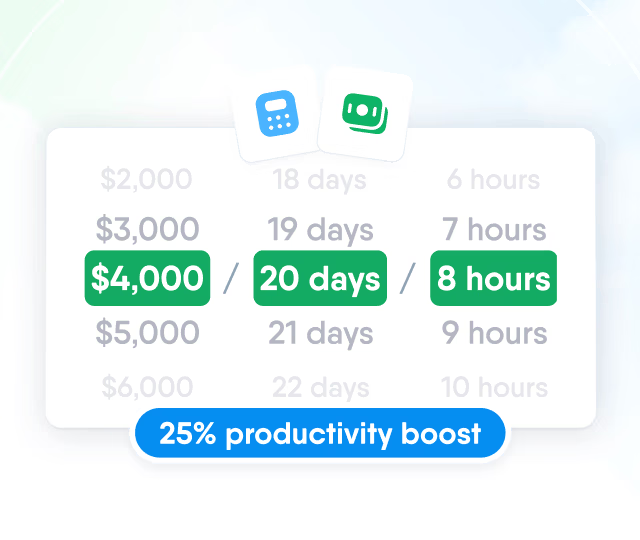
HR efficiency estimator
How does the HR efficiency estimator from PeopleForce work.
Calculate your impact



Competency mapping
What is competency mapping?
Competency mapping (skills mapping) is a strategic process that enables a company to define the specific skills, knowledge, behaviors, and attributes required for success across different roles. It creates a clear connection between individual capabilities and business objectives, ensuring that employees are equipped not only to meet current expectations but also to adapt to future demands.
Competency mapping typically covers:
- role-specific skills (technical or professional)
- behavioral competencies (communication, ownership, teamwork)
- expected proficiency levels (basic, strong, expert)
Rather than being a one-time HR exercise, competency mapping functions as a continuous framework that helps a company evaluate performance, identify development needs, and build a more agile and future-ready workforce.
At a practical level, competency mapping helps answer three questions:
- What does high performance look like in a given role, beyond basic job descriptions?
- Which competencies consistently distinguish top performers from average ones?
- How do current employees compare to these expectations, and where are the gaps?
Competency mapping example
Consider a global SaaS company that is integrating AI into its products.
For the role of a Customer Success Manager, the company defines several critical competencies, including AI product literacy, the ability to interpret customer usage data, strategic account management skills, and effective cross-functional collaboration.
After conducting a competency assessment, the company discovers that a significant portion of its Customer Success team lacks confidence in explaining AI-driven features to clients, while others struggle to use data insights effectively in decision-making.
To address these gaps, the company launches a structured internal certification program focused on AI fundamentals, integrates real-time analytics dashboards into daily workflows, and introduces mentorship initiatives that connect Customer Success Managers with product and data teams.
As a result, the company observes faster adoption of new features, more proactive customer engagement, and a measurable improvement in retention rates within just a few months.
How to map competencies in PeopleForce?
With PeopleForce, competency mapping can be applied through performance reviews, OKR management, and 1:1s.
1. Define competencies as evaluation criteria:
- Go toPerformance → Review cycles.
- Create or edit a review cycle.
- Add competencies as questions or criteria (e.g., communication, leadership, technical skills).
- Use rating scales (e.g., 1–5) to standardize evaluation.
2. Group competencies by role or level:
- Create different review templates for roles (e.g., engineers vs. managers).
- Assign templates to specific teams or positions.
3. Link competencies to goals (OKRs):
- Go toPerformance → Goals (OKRs).
- Align competencies with measurable outcomes.
- Example: “Leadership competency” → “Lead 2 cross-team projects”.
4. Track competency development over time:
- Use review history and analytics to compare scores across cycles.
- Identify gaps and improvement trends per employee or team.
5. Store competency data in employee profiles:
- Add custom fields (e.g., “Core competencies,” “Skill level”).
- Build a competency matrix across the company.
6. Use reports for competency insights:
- Export or view performance data to analyze skill gaps, high-potential employees, and training needs.
Why competency mapping matters?
Competency mapping plays a critical role in aligning talent strategy with business evolution. Companies rely on it to:
- ensure that workforce capabilities are directly aligned with shifting strategic priorities and market demands;
- introduce more objective and transparent performance evaluation criteria that reduce bias;
- identify skill gaps early and design targeted learning and development initiatives;
- provide employees with clearly defined career paths and progression opportunities;
- support internal mobility by making skills and potential more visible across the company.


Let us show you what's possible
From Core HR to advanced workforce analytics — see the platform saving 80 hours a month for teams just like yours. Fully tailored to your workflow.