
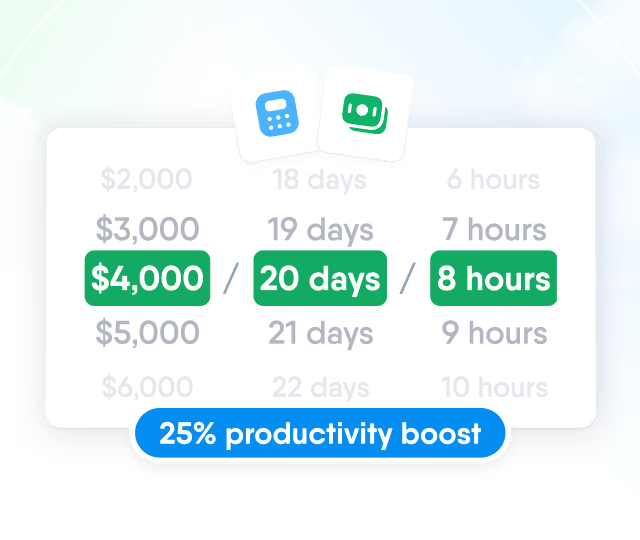
HR efficiency estimator
How does the HR efficiency estimator from PeopleForce work.
Calculate your impact



Internal recruitment
What is internal recruitment?
Internal recruitment is filling an open role with someone who already works at the company rather than hiring from outside. The vacancy is published internally, current employees apply or are approached, and selection runs on evidence the company already has: performance history, competencies and how the person works with others.
It is not the same as a promotion handed out quietly. Internal recruitment is a process with a posting, criteria and a decision that can be explained, which is what separates it from a manager moving a favourite into a better seat.
Forms of internal recruitment
- Promotion. A move up a level, usually along a defined career path.
- Lateral move. A change of function at the same level, the main mechanism behind a career lattice and a good answer to a career plateau.
- Internal transfer. The same role in a different team, office or legal entity.
- Temporary assignment. A secondment or project role, often preceded by job shadowing, which lets both sides test the fit before committing.
- Expanding an existing role. Giving current work more scope instead of opening a new headcount, sometimes described as quiet hiring.
An employee referral program sits next to this: the candidate comes from outside, but the channel is internal.
Advantages of internal recruitment
The case for hiring internally is mostly about speed and certainty:
- Shorter cycle. No sourcing, no screening, fewer interview rounds, so time to hire drops sharply.
- Lower cost. No job board spend, no agency fee, no signing bonus in most cases.
- Better prediction. You are judging demonstrated work rather than an interview performance, which is why quality of hire tends to be higher.
- Faster ramp-up. The person already knows the products, tools and people.
- Retention signal. Visible internal moves are one of the strongest drivers of engagement and the retention rate, because they prove the career path is real.
Disadvantages and limits
Internal recruitment does not create capacity, it moves it. Every internal hire leaves a second vacancy behind, and in a small team that can be the harder one to fill. It also narrows the gene pool: a company that hires only from inside reproduces its existing thinking, which is a problem when the skills gap is in something nobody currently does. And unsuccessful internal candidates are a real risk, because a rejection from your own employer lands harder than a rejection from a stranger.
Internal or external
A workable default is to post internally first for a fixed window, then open the role externally while keeping internal applicants in the same process. Go external from the start when the role requires a capability the company has never had, when the team needs a different perspective after a period of stagnation, or when every plausible internal candidate is already critical somewhere else. Go internal when the role is well understood, speed matters, and upskilling can close the remaining distance.
How to run it without damaging trust
- Publish every internal vacancy in the same place. If some roles are filled silently, nobody believes the process.
- Write eligibility rules once. Minimum tenure in the current role, performance standing, manager notification, and stick to them.
- Do not let managers block moves. A manager who can veto a transfer will, and word travels faster than any policy.
- Assess against the role, not against loyalty. Use the same scorecard as for external candidates, informed by performance review history rather than replaced by it.
- Give real feedback to those who do not get it. Name what was missing and what would change the answer next time, otherwise the next vacancy gets no internal applicants at all.
Internal recruitment in PeopleForce
Recruit runs internal openings through the same pipeline as external ones: a vacancy request goes through approval, the role is published, and applicants move through stages with funnel and time-in-stage reporting, so an internal process can be measured against an external one instead of being assumed faster. Candidates who were strong but not selected stay in talent pools and can be found again when the next role opens.
The evidence side comes from Perform: review cycles, competency models, development plans and one-on-one records show who is ready for a bigger role and what is still missing. Workflows in Core HR then carry the move itself, including the document, access and introduction steps that a transfer needs and that usually get forgotten because the person is not new to the company.


Let us show you what's possible
From Core HR to advanced workforce analytics — see the platform saving 80 hours a month for teams just like yours. Fully tailored to your workflow.