
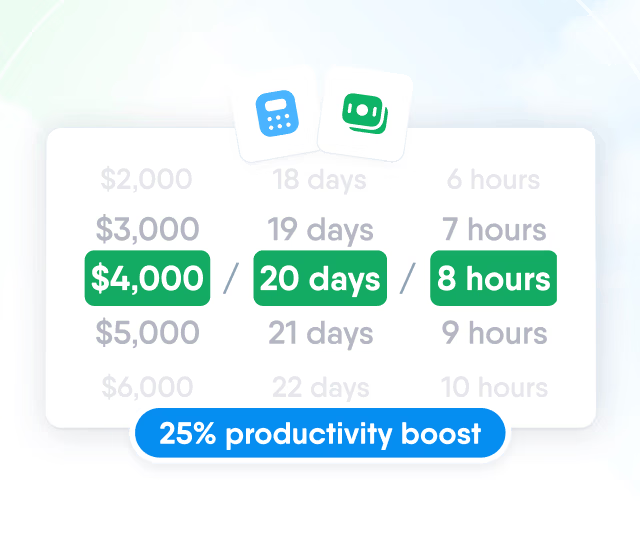
HR efficiency estimator
How does the HR efficiency estimator from PeopleForce work.
Calculate your impact



Job shadowing
What is job shadowing?
Job shadowing is a hands-on learning method where an employee observes a colleague during their day-to-day work. Instead of formal training, the learner gains real-world insight by watching how tasks are performed, how decisions are made, and how challenges are handled in practice.
It’s commonly used in onboarding, internal mobility programs, and reskilling initiatives — especially in fast-changing, skills-driven organizations.
How job shadowing works?
Job shadowing is typically short-term and highly practical. It may last from a few hours to several weeks, depending on the goal.
A typical structure includes:
- Observation — the learner follows the host employee during meetings, tasks, and workflows
- Context sharing — the host explains what they’re doing and why
- Q&A moments — the learner asks questions in real time or during dedicated sessions
- Reflection — the learner summarizes key takeaways and next steps
Unlike traditional training, there’s no simulation. Everything happens in a real work environment.
Key benefits of job shadowing
- Faster skill development
Employees learn by seeing real scenarios, not just theoretical examples. This shortens the time needed to become productive in a new role.
- Better understanding of roles
Job shadowing provides clarity on responsibilities, expectations, and day-to-day realities — something job descriptions alone rarely capture.
- Increased employee confidence
Seeing how experienced colleagues handle tasks reduces uncertainty and helps new or transitioning employees feel more prepared.
- Stronger engagement and retention
Employees who understand their role and career path are more likely to stay and grow within the company.
- Reduced hiring risks
Companies can test internal talent in real contexts before making role transitions, minimizing costly hiring mistakes.
Common job shadowing use cases
1. Onboarding new hires — new employees shadow experienced team members to quickly understand workflows, tools, and team dynamics.
Example: a fintech company onboarding remote customer success managers introduced structured 3-day shadowing sessions via recorded calls and live CRM walkthroughs, reducing ramp-up time by 30%.
2. Internal mobility — employees exploring new roles can shadow colleagues before formally transitioning.
Example: a product marketing specialist interested in product management spent two weeks shadowing sprint planning and backlog grooming sessions, helping both the employee and manager validate the transition.
3. Reskilling and upskilling — companies use job shadowing to help employees move into new functions as business needs evolve.
Example: with the rise of AI-driven roles, HR teams introduced “AI workflow shadowing,” where non-technical employees observe prompt engineering and automation processes to build practical understanding.
4. Leadership development — future managers shadow senior leaders to learn decision-making, communication, and prioritization.
Best practices for effective job shadowing
1. Set сlear objectives
Define what the learner should gain — skills, knowledge, or exposure to specific tasks.
2. Choose the right host
Select employees who are not only skilled but also willing and able to explain their work clearly.
3. Structure the experience
Even though it’s informal, provide a loose agenda (e.g., meetings to attend, processes to observe).
4. Encourage active participation
Learners should ask questions, take notes, and reflect—not just passively observe.
5. Capture learnings
Document insights, feedback, and progress to make the experience measurable and reusable.
Challenges to сonsider
- Time constraints — hosts may struggle to balance their work with mentoring
- Lack of structure — without guidance, shadowing can become unproductive
- Inconsistent experiences — different hosts may provide varying levels of quality
These challenges can be mitigated with frameworks and tracking.


Let us show you what's possible
From Core HR to advanced workforce analytics — see the platform saving 80 hours a month for teams just like yours. Fully tailored to your workflow.