
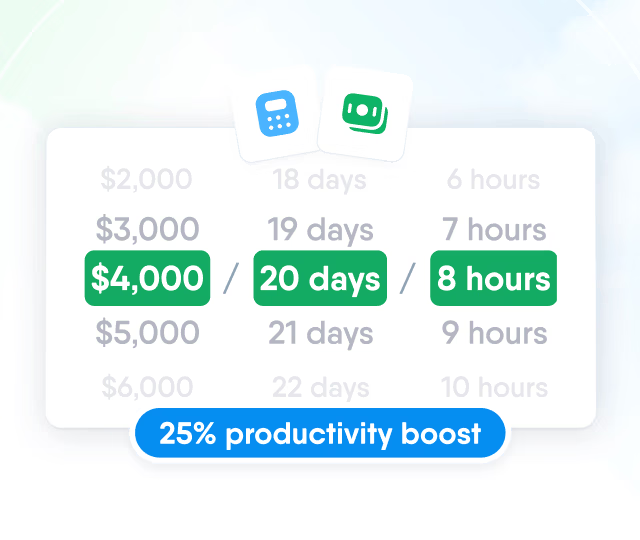
HR efficiency estimator
How does the HR efficiency estimator from PeopleForce work.
Calculate your impact



People operations
What is people operations?
People operations is the discipline of running the employee-facing side of a company as an operating system rather than a set of favours. It covers the processes, data and tooling behind hiring, onboarding, pay changes, absence, documents, performance cycles and exit: who does what, in what order, on which system, and how long it should take.
The term came out of the technology sector in the mid-2000s, and the distinction it draws is about where the work starts. Traditional HR asks which policy applies to a situation. People operations asks how often that situation occurs, what it costs each time, and whether the answer can be made repeatable enough that nobody has to ask again.
People operations, HR and the people partner
The three roles overlap and are not interchangeable. People operations owns the machinery: HR processes, records, systems and service delivery. The HR business partner works with a specific part of the business on its people decisions, and depends on the machinery working so the conversation is about talent rather than about a missing document. Human capital management is the wider frame that ties both to the company's plan, and HR strategy decides what the machinery is supposed to produce. A company can have an excellent strategy and still lose people because nobody can get a contract signed in under two weeks.
What sits inside people operations
- The employee lifecycle end to end, from preboarding and the onboarding process through to offboarding and the return of equipment.
- Records and documents: contracts, addenda, signatures, HR document management and the retention rules that go with it.
- Pay and benefits administration, including benefits administration and the inputs that feed payroll.
- Absence and working time, from leave balances to shift patterns.
- Systems and data: the HRIS, integrations, access rights and the data quality everything else depends on.
- Service delivery: how a person asks a question, who answers it, and how quickly. This is where knowledge management stops being a buzzword.
- Policy and compliance, held in a live employee handbook rather than a PDF nobody has opened since induction.
The operating model
Most people operations teams settle into three tiers. Tier zero is self-service: the person finds the answer or submits the request themselves. Tier one is a shared inbox or helpdesk that handles anything routine against a response target. Tier two is specialists in payroll, mobility or employment law. The measure of a healthy model is how much never reaches tier one, because every question answered by a well-written article is a question that did not interrupt anyone. Automating HR workflows is what makes tier zero possible at all.
How you know it is working
- Time to resolve a routine request, split by type. Contract amendments and leave questions do not belong in the same average.
- Self-service rate: how many requests are completed without a person in the loop.
- Data accuracy, measured as the share of records where the system and reality agree. This one is unglamorous and predicts most other failures.
- Onboarding completion by day one, day 30 and the end of probation.
- Cost per employee served, which is how the function gets a budget conversation rather than a headcount conversation.
Common failure modes
The first is automating a broken process, which produces the same wrong outcome faster and with less chance of a human catching it. The second is tool sprawl: a system for onboarding, another for signatures, a third for absence, and a spreadsheet to reconcile all three. The third is the rebrand, where the department changes its name to People Operations and keeps working exactly as before, which costs credibility with the people who noticed. The last is measuring effort instead of outcome, counting tickets closed while the time a new hire waits for a laptop keeps growing.
People operations in PeopleForce
Core HR holds the record everything else reads from, with an employee directory and org structure people can search themselves. Workflows drive onboarding and offboarding as sequenced tasks with owners and due dates instead of a checklist in someone else's notes, and request forms turn ad hoc asks into structured submissions that route to the right approver. Documents are signed in place through electronic signature, with Diia.Signature and id.gov.ua available in Ukraine and Autenti in Poland. Desk gives the tier zero layer a real home: a knowledge base with draft, editing and published states, version history you can restore from, and visibility rules inherited from the category so each audience sees only what applies to it. Analytics closes the loop with onboarding, offboarding, headcount and turnover reports that can be scheduled rather than rebuilt.


Let us show you what's possible
From Core HR to advanced workforce analytics — see the platform saving 80 hours a month for teams just like yours. Fully tailored to your workflow.