
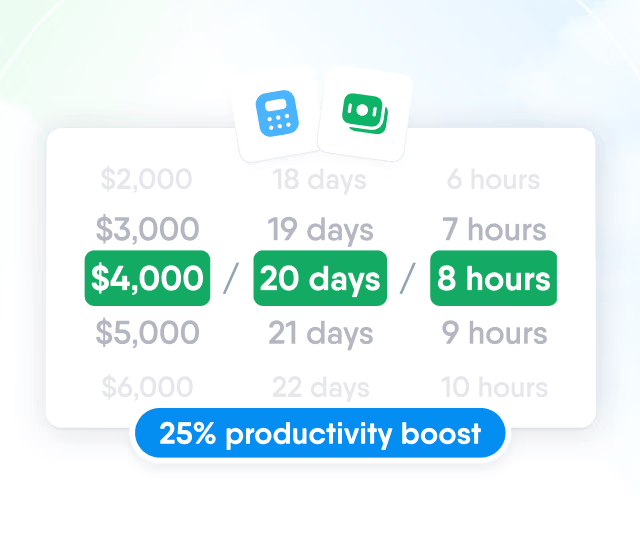
HR efficiency estimator
How does the HR efficiency estimator from PeopleForce work.
Calculate your impact



Performance improvement plan
What is a performance improvement plan?
A performance improvement plan, usually shortened to PIP, is a written and time-bound agreement between an employee and their manager that states four things: what specifically has to change, how the change will be measured, by when, and what support the company commits to providing. It is the formal end of the informal route in performance improvement.
A PIP is not a disciplinary sanction and it is not, by design, a dismissal in slow motion. It is the last structured attempt to keep someone in the role. That intent matters practically as well as ethically: the moment a team decides PIPs are how people get managed out, the document stops working and every person who receives one starts job hunting on day one.
When a PIP fits, and when it does not
It fits when the gap is specific and measurable, when expectations have already been stated clearly, and when feedback has been given and documented without the gap closing. It does not fit in four common situations: when the cause is workload or burnout and the plan would simply add pressure to a person already at their limit; when the manager has never actually said the standard out loud, which makes the PIP the first feedback the person has ever received; when the role changed underneath them without a new job description; and when the issue is conduct rather than performance, which belongs in disciplinary procedures, not here.
What goes into the document
- The gap, in observable terms. Not "lacks attention to detail" but "four of the last ten reports were sent to the client with figures that did not match the source data".
- The target and its measure. A number or a clear yes/no test, agreed in advance, ideally tied to an existing KPI rather than invented for the occasion.
- The timeframe. Thirty, sixty or ninety days, chosen to match how long the work actually takes to show results. A month is too short for anything with a long sales or delivery cycle.
- The support the company provides. Coaching hours, a mentor, training, reduced scope, changed access. A plan with an empty support column is a countdown, not a plan.
- The check-in schedule, usually weekly in a one-on-one, with the dates written down in advance.
- What happens at the end, stated plainly in both directions: what closing the plan means, and what not meeting it means.
- Acknowledgement. Both sides sign that they have read it. Signing is not agreement with the assessment, and it helps to say so in the document.
Running it week to week
Open with a private conversation, never an email that lands cold. The first meeting is for making sure the person understands the gap the same way the manager does, and for hearing what they think is causing it, because that answer often changes the plan. After that, each check-in gets a short written note: what happened, what moved, what the manager did on their side. If circumstances change mid-plan, for example a reorganisation or a long absence, adjust the plan in writing rather than quietly letting the dates slip. And close it explicitly on the final date. A plan that just stops has told the person nothing and left the company with a record that proves nothing.
The three possible endings
Sustained improvement is the intended one: close the plan formally, say so in writing, and keep a light monitoring period so the change is confirmed rather than assumed. Partial improvement is the awkward middle, and it justifies exactly one extension with a stated reason and a new date, not a rolling series of them. No meaningful change after real support means moving to involuntary termination or, where the person is strong but misplaced, to a different role on another career path. Whichever ending arrives, the documentation from the check-ins is what makes the decision defensible.
Where PIPs fail
- Targets nobody can verify. If two reasonable people can disagree about whether the target was met, the plan will end in a dispute.
- No support offered. This is the single clearest signal that the outcome was decided in advance.
- A moving standard. Adding new expectations in week three tells the person the goal is unreachable, and they will stop trying.
- Surprise. If the PIP is the first time the person hears about the problem, the failure is the manager's.
- Micromanagement dressed as support. Daily check-ins on a 60-day plan make the work harder, not easier.
Running a PIP in PeopleForce
In Perform, a PIP is set up as a development plan, which gives the document the structure it needs rather than leaving it in a shared file. Each plan has its own type and can start from a template, so the company keeps one consistent format instead of every manager inventing one. It runs between a start and an end date, which is the time-bound part made explicit, and its content is written in a block editor that holds an action list with individual due dates, plus files and links for the supporting material. Progress is calculated automatically from the action items checked off, so at any point both sides see the same completion figure without anyone estimating it. Comments live on the plan itself, which is where the weekly check-in notes belong, and notifications fire when the plan is created, when it is completed and when it goes overdue. One-on-ones and KPI tracking in the same module supply the check-in cadence and the measure, and the development plan report shows every active plan across the company, which is how HR spots the manager whose plans never come with support attached.


Let us show you what's possible
From Core HR to advanced workforce analytics — see the platform saving 80 hours a month for teams just like yours. Fully tailored to your workflow.