
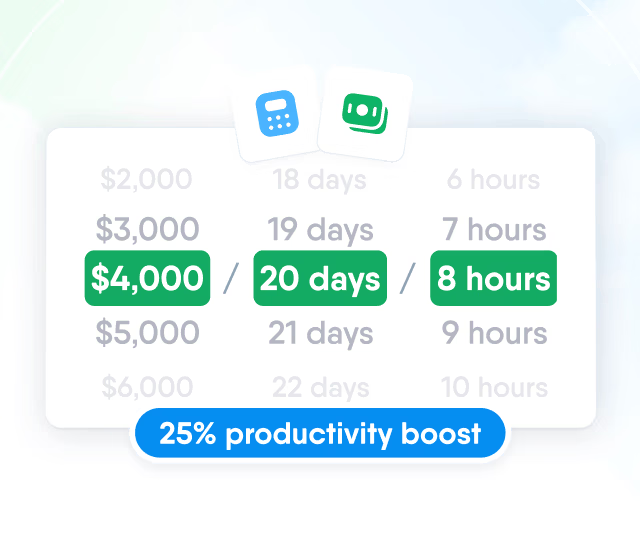
HR efficiency estimator
How does the HR efficiency estimator from PeopleForce work.
Calculate your impact



Retention strategy
What is a retention strategy?
A retention strategy is the deliberate plan for keeping the people a company needs, built from what actually makes them stay or leave rather than from a list of benefits copied off a competitor. It spans the whole relationship, from the first week to the exit conversation, and its job is to remove the reasons someone starts looking, not to argue with them once they already have an offer.
The target is not zero turnover. Some departures are healthy, some are overdue, and a team where nobody ever leaves usually has a different problem. What a strategy is aiming at is regretted turnover: the people the company wanted to keep, in the roles where replacing them is slow or expensive. Measuring at company level hides this completely, which is why an unremarkable overall turnover rate can sit on top of one team losing every senior it has.
Start with the data, not with perks
Before deciding what to change, find out where people are actually leaving from. Split retention by tenure band, by department, by manager and by whether the departure was voluntary. Two patterns show up in most companies: attrition concentrates heavily in the first year, and it clusters under specific managers rather than spreading evenly. Add the qualitative side through exit interviews, which tell you what went wrong after the fact, and eNPS plus pulse surveys, which tell you while there is still time to act.
The levers, roughly in order of impact
- Manager quality. The single largest variable in most datasets. Training managers to run real one-on-ones moves retention more than any benefit line.
- Role clarity and workload. Unclear expectations and sustained overload produce burnout, and burnout produces resignations that look sudden from the outside.
- Pay fairness. Internal equity matters more than market position: people tolerate being slightly under market far better than being under a peer doing the same work. Regular reviews of total compensation prevent the correction-by-resignation pattern.
- A visible path. A career path with named steps and criteria. Where none exists, the next step is at another company by definition.
- Flexibility. Control over hours and location is now a retention factor rather than a benefit, and removing it reads as a demotion.
- Recognition. Cheap, fast, and consistently underused.
- A real onboarding process. Given where first-year attrition sits, this is retention work, not admin.
The first ninety days
Because so much attrition happens early, the highest-return part of a retention strategy is usually the beginning of the relationship rather than the middle. Preboarding keeps the new hire warm between signature and start date, which is when quiet renegotiation with their old employer happens. Structured onboarding gets access, equipment and the first real task ready on day one rather than day nine. And scheduled check-ins at week two, day thirty and the end of probation catch the mismatch while it is still fixable, instead of discovering it in an exit interview four months later.
Stay interviews
An exit interview tells you why someone left. A stay interview asks, while they are still here, what would make them leave and what keeps them. It is a short conversation, separate from the performance discussion, run at tenure milestones or after a team change, and it works on four questions: what makes a good day here, what makes a frustrating one, what would tempt you if a recruiter called, and what one thing would you change. Two rules make it useful. It is not a one-on-one about tasks, and something visible has to change afterwards, or the next round gets polite non-answers.
Where retention strategies fail
- The counteroffer as the strategy. It works for a few months and teaches everyone that resigning is how you get a raise.
- Perks instead of causes. Fruit and a gym membership do not compete with a manager nobody wants to work for.
- Treating all turnover as bad. Without splitting regretted from unregretted, the number gives no signal to act on.
- One company-wide figure. Averages hide exactly the concentration you need to find.
- Retaining the wrong people. A strategy that keeps everyone equally also keeps whoever is blocking the team.
Retention in PeopleForce
Analytics supplies the segmentation the strategy depends on: turnover and tenure reports broken down by department, location and employment type, plus headcount movements and offboarding, and any of them can be scheduled to arrive rather than rebuilt each quarter. Pulse covers the early signal with company-wide and lifecycle surveys, eNPS, driver-level results and a heatmap that shows which team is drifting, with cuts by department, location and position and an anonymity threshold so small teams stay unidentifiable. Perform holds the manager side: one-on-ones, KPI results and development plans that give the career path something concrete behind it. And workflows make the first ninety days actually happen, with onboarding tasks that have owners and due dates instead of good intentions.


Let us show you what's possible
From Core HR to advanced workforce analytics — see the platform saving 80 hours a month for teams just like yours. Fully tailored to your workflow.