
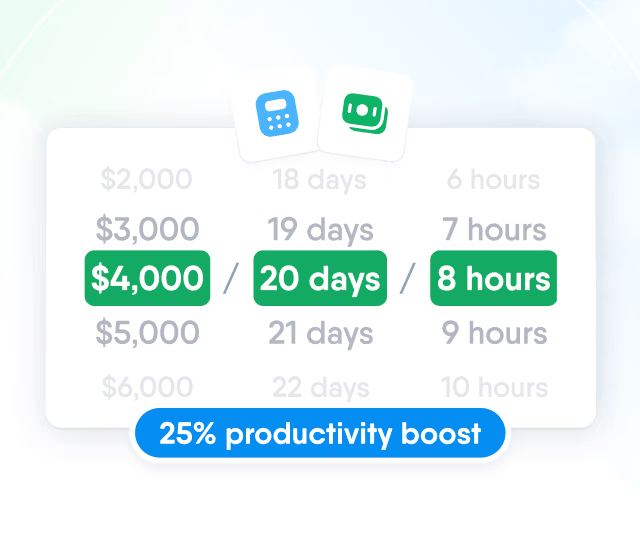
HR efficiency estimator
How does the HR efficiency estimator from PeopleForce work.
Calculate your impact



Vertical organization
What is a vertical organization?
A vertical organization is a company built as a hierarchy: authority runs top to bottom through a chain of management layers, each person reports to one manager, and decisions escalate upward until they reach someone with the mandate to make them. It is the pyramid most people picture when they hear the word "company", and it remains the most common structure in the world.
The quickest way to tell a vertical structure from the alternatives is to count reporting lines. In a vertical organization a person has exactly one manager. In a matrix organization they have two, usually a functional lead and a project lead. In a flat or agile organization the line may exist on paper but decisions are made inside the team rather than passed up.
Two numbers define any vertical structure
Everything else about the shape follows from these two, and most reorganisations are really an argument about them:
- Span of control: how many direct reports each manager has. Narrow spans give close supervision and, past a point, micromanagement. Wide spans force delegation and, past a point, neglect.
- Number of layers: how many steps separate the newest hire from the person who can approve an exception. Every layer adds a translation of intent and a delay.
The two trade off against each other. If you want fewer layers with the same headcount, spans must widen. A company that adds layers without widening spans ends up with managers who manage managers who manage two people each, which is how organisations quietly double their management cost without adding capacity.
What the vertical model is genuinely good at
- Unambiguous accountability. When something fails, there is one person who owns it. This sounds bureaucratic until you have worked somewhere without it.
- Fast escalation. A clear path upward means an urgent decision has a known route rather than a search.
- Legible progression. A visible ladder makes it easy to explain what promotion means, which matters more to most people than org theory admits.
- Control and compliance. Regulated work, safety-critical operations and anything with audit requirements benefit from a documented chain of authority.
What it costs
- Distance between information and decision. The people who see the customer are furthest from the people who decide, and each layer filters what travels upward, usually in a flattering direction.
- Slow cross-functional work. Anything spanning two departments has to travel up one branch and down another. This is why cross-functional teams get bolted onto vertical structures.
- Only one shape of career. If the ladder is the only route up, strong specialists become mediocre managers to get a raise. A career lattice with a parallel expert track is the usual fix.
- Bottlenecks at the top. The higher the escalation threshold, the more decisions queue behind a handful of calendars.
When vertical is the right answer
The structure should follow the work rather than fashion. Vertical fits where tasks are repeatable, quality standards are fixed, the cost of an error is high and the work divides cleanly by function: manufacturing, logistics, retail networks, healthcare delivery, regulated finance. It fits badly where the work is exploratory, requirements change weekly and the answer depends on combining several disciplines at once.
Most companies in practice run a hybrid. The reporting line stays vertical because someone has to own salary, performance and leave decisions, while delivery happens in temporary cross-functional groups. That works as long as everyone knows which of the two structures decides what.
How PeopleForce supports a vertical structure
In PeopleForce the org chart is generated from the employee data rather than drawn by hand, so it cannot drift away from reality the way a slide does. It can be built from any reference field on the employee record, not only the default manager, which means a company running dotted lines, mentors or legal entity ownership can render those as separate charts of the same organisation. There is also a department-level view for when the question is about structure rather than people, and the chart can be narrowed by location, position or employment type.
Access rules are respected inside the chart itself: branches a viewer is not permitted to see appear as restricted rather than leaking names, which matters in companies where compensation bands are inferable from the reporting line. Because the same records drive reporting, headcount by department, division, location and manager comes out of the analytics side without a separate spreadsheet, which is what makes a span-of-control conversation possible with evidence instead of impressions.


Let us show you what's possible
From Core HR to advanced workforce analytics — see the platform saving 80 hours a month for teams just like yours. Fully tailored to your workflow.