
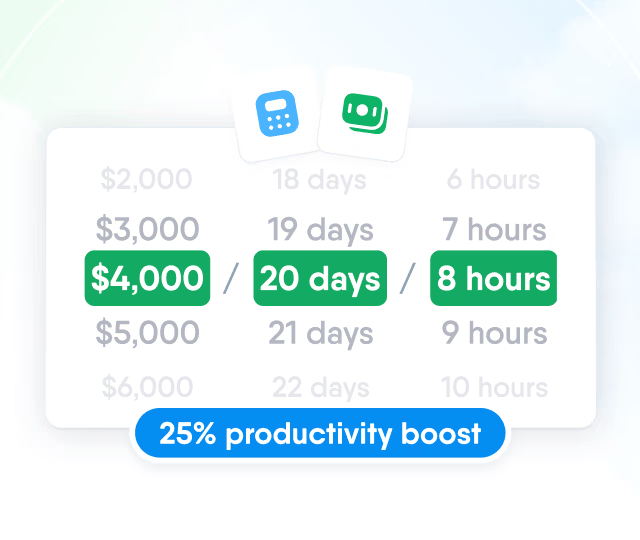
HR efficiency estimator
How does the HR efficiency estimator from PeopleForce work.
Calculate your impact



Availability analysis
What is availability analysis?
Availability analysis is a workforce measurement tool used to estimate how many qualified people from underrepresented groups — typically defined by gender, ethnicity, disability status, or other protected characteristics — exist in the relevant labor market for a given set of roles. In plain terms, it answers the question: of all the people who could realistically apply for these jobs, what proportion belong to groups that are currently underrepresented? That figure is then compared against the organization's actual workforce composition to reveal significant gaps.
How availability analysis works in practice
The process typically follows these steps:
- Job group analysis — Positions are grouped by similar duties, responsibilities, and career pathways. This creates a manageable set of categories rather than analyzing every job title individually.
- Defining the relevant labor market — For each job group, the organization determines where qualified candidates would realistically come from. For senior or highly specialized roles, this might be a national or even international pool. For entry-level positions, it is usually local or regional.
- Gathering availability data — External data sources are used to estimate the proportion of qualified candidates from underrepresented groups in the relevant labor market. These sources vary by country but typically include national census data, labor force surveys, and occupational statistics published by government agencies.
- Comparing internal representation to external availability — Where a job group falls significantly below its availability benchmark, the organization sets a target and identifies concrete steps to close the gap — such as expanding outreach, reviewing screening criteria, or investing in targeted development programs.
The regulatory context varies by country
While the methodology is broadly consistent, the legal frameworks that require or encourage availability analysis differ considerably around the world.
- In the United States, availability analysis was historically a core requirement for federal contractors under affirmative action regulations, though those obligations were significantly scaled back in early 2025.
- In Canada, the Employment Equity Act requires federally regulated employers to analyze workforce representation and compare it to labor market availability for four designated groups: women, Indigenous peoples, persons with disabilities, and visible minorities.
- In the United Kingdom, public sector organizations are required under the Equality Act 2010 to publish workforce diversity data and set measurable equality objectives — which in practice often involves benchmarking against labor market availability.
- Across the European Union, requirements vary by member state, but reporting obligations on gender pay gaps and workforce composition are becoming increasingly standardized, driven in part by the EU Pay Transparency Directive adopted in 2023.
- In Australia, the Workplace Gender Equality Act requires employers with 100 or more staff to report on gender composition across job categories and compare it against industry benchmarks.
Why it matters beyond compliance
Even where it is not legally required, availability analysis gives organizations an evidence-based foundation for workforce planning. Without it, a lack of diverse candidates in the pipeline can easily be misread as a lack of qualified candidates in the market — when the real issue may lie in sourcing, outreach, or employer reputation. Understanding what the available talent pool actually looks like is a prerequisite for doing anything meaningful about representation.


Let us show you what's possible
From Core HR to advanced workforce analytics — see the platform saving 80 hours a month for teams just like yours. Fully tailored to your workflow.