
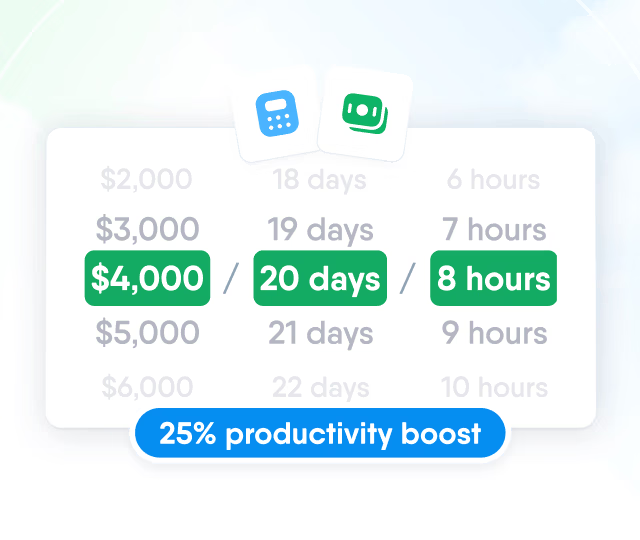
HR efficiency estimator
How does the HR efficiency estimator from PeopleForce work.
Calculate your impact



Holiday accrual
What is holiday accrual?
What is holiday accrual?
Holiday accrual refers to the process by which an employee earns or accumulates paid time off (PTO) or holiday entitlements over a specific period of time, typically based on their length of service or the number of hours worked. When an employee accrues PTO or holiday entitlements, they are basically earning time off that they can use for vacation, sick leave, personal time, or other reasons. The amount of PTO or holiday entitlements accrued varies based on factors such as company policy, the employee's employment contract, and local labor laws.
For example, a company may offer employees 10 days of paid vacation time per year. If an employee works for the company for six months, they may accrue five days of vacation time, which they can then use after their vacation time has been approved by their manager. Overall, it’s an important aspect of employment because it ensures that employees receive the time off they are entitled to based on their employment contract or company policy.
Why is holiday accrual necessary?
Promotes a healthier work-life balance
By accruing holiday time, employees can take time off from work to rest, recharge, and attend to personal obligations without fear of losing work. This boosts their well-being and productivity, thanks to increased morale and improved mental health.
Ensures legislative compliance
Many countries maintain laws that require employers to provide their employees with a certain amount of paid time off each year. Holiday accrual ensures that companies covered by such legislation are able to meet their legal obligations.
Provides fair compensation
Holiday accrual is a good way for employers to ensure that employees receive fair compensation for their work. It allows employees to accumulate paid time off for holidays, vacations or personal days and also minimizes disruption.
How do you calculate holiday accrual?
Most companies that need to calculate their holiday accrual rates most frequently use the same general formula:
Accrual Rate x Hours Worked = Accrued Hours
The accrual rate is the percentage of hours worked that an employee earns as holiday entitlements or PTO. For example, if the accrual rate is 5%, an employee would then earn five hours of PTO for every 100 hours worked.
To calculate accrued hours, you would multiply the accrual rate by the number of hours worked. For example, if an employee works 40 hours per week and the accrual rate is 5%, they would accrue 2 hours of PTO per week (40 x 0.05 = 2).
Let’s work an example and calculate holiday accrual for an employee who works 40 hours per week and has an accrual rate of 5%:
- Week 1: 40 x 0.05 = 2 hours accrued
- Week 2: 40 x 0.05 = 2 hours accrued
- Week 3: 40 x 0.05 = 2 hours accrued
- Week 4: 40 x 0.05 = 2 hours accrued
At the end of the month, the employee would have accrued 8 hours of PTO.
It is important to note that holiday accrual may be subject to caps or limits, such as a maximum amount of PTO that can be accrued or a use-it-or-lose-it policy. Local legislation may also play a role and limit the number of hours employees are or aren’t entitled to.
How do I manage holiday accrual?
You can use the formula outlined above to calculate holiday accrual for your employees manually, but that’s labor and time intensive. The PeopleForce HRM system ensures you don’t have to rely on spreadsheets, and you can customize leave types and policies, set paid and non-paid balances, and control who is responsible for approvals.
FAQ
What does accrued holiday mean?
Accrued holiday is the paid time off an employee has already earned but not yet taken. For example, if an employee earns 2 days of holiday per month and has worked 3 months without taking leave, they have 6 days of accrued holiday they can book or, in some countries, be paid for when they leave.
What are accrued hours?
Accrued hours are paid time off measured in hours rather than days. They grow with every hour or pay period worked, based on the accrual rate. With a 5% accrual rate, 40 hours of work add 2 accrued hours.
Is accrued holiday paid out when you leave a job?
It depends on local law and the contract. In the UK and the EU, untaken statutory holiday must be paid out when employment ends. In the US, some states require unused vacation to be paid out, while others allow employers to set their own rules.


Let us show you what's possible
From Core HR to advanced workforce analytics — see the platform saving 80 hours a month for teams just like yours. Fully tailored to your workflow.