
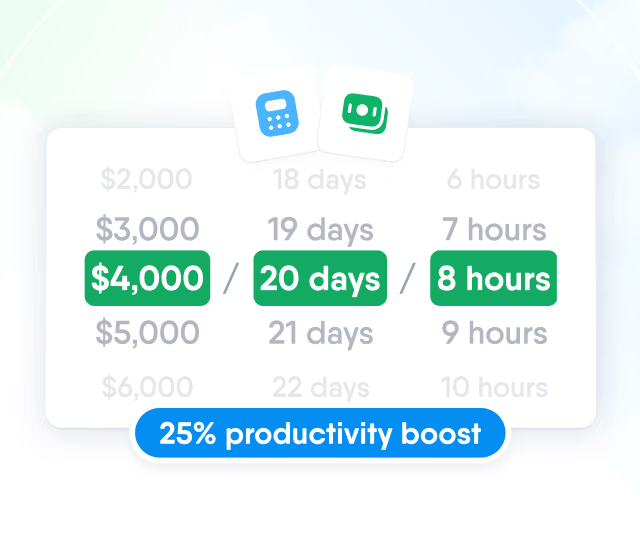
HR efficiency estimator
How does the HR efficiency estimator from PeopleForce work.
Calculate your impact



HR strategy
What is HR strategy?
An HR strategy is a long-term plan that defines how a company attracts, develops, rewards and retains the people it needs to reach its business goals. It answers a small set of hard questions: which capabilities the company must own, how many people it needs and when, what it pays for, and what kind of employee experience it commits to.
What separates a strategy from routine HR work is the time horizon. Everyday HR processes keep the company running this quarter, while the strategy decides what the workforce should look like in two or three years and which trade-offs get made to get there. Because talent is the most expensive and least replaceable resource most companies have, the HR strategy sits directly under the business strategy and is usually owned jointly by the HR lead and the executive team, with HR business partners translating it into department-level plans.
What an HR strategy covers
Priorities differ from company to company, but most HR strategies are assembled from the same components:
- Workforce planning: how many people are needed, in which roles and on what timeline, where workforce planning and headcount forecasts meet the budget.
- Talent acquisition: where candidates come from, how the employer brand and the employee value proposition are positioned, and which roles are filled through internal recruitment rather than external recruitment.
- Performance and goals: the cadence of goal setting and reviews, defined by the performance management system and supported by HR OKRs.
- Learning and development: closing the skills gap through upskilling, guided by a training needs analysis and by clear career paths.
- Compensation and rewards: how total compensation is structured and how rewards and recognition reinforce the behaviour the company wants more of.
- Engagement and retention: the employee experience the company designs on purpose, measured through employee engagement and the employee retention rate.
- HR technology and data: the HR tech stack, the HRIS that holds the record of truth, and the HR analytics that make the strategy measurable.
How the HR strategy connects to business strategy
An HR strategy written separately from the business plan usually ends up describing activity instead of outcomes. The connection runs in both directions. A company entering a new market needs hiring capacity and local employment expertise months before the first deal is signed, so strategic planning has to carry a staffing view from the start. A company facing a downturn needs a redeployment and cost plan that protects the capabilities it will need again in a year. Human capital management is the practice of managing that relationship continuously rather than revisiting it once a year.
How to build an HR strategy
A workable sequence looks like this:
- Start from the business goals. Revenue targets, new markets, product launches and margin pressure each translate into a different people requirement.
- Audit the workforce you have. Headcount by function, tenure distribution, turnover rate, critical roles with no backup, and the skills actually present in the company today.
- Name the gap. State the difference between the current workforce and the one the plan requires in roles, skills and timing, not in adjectives.
- Choose the trade-offs. Build capability internally or buy it on the market, pay at median or above it, centralise HR ownership or push it to managers. A strategy that avoids trade-offs is a wish list.
- Set measurable targets. Every priority gets a metric and a number, tracked as a key performance indicator.
- Assign owners and a review cadence. Quarterly reviews work for most companies. An annual review is usually too slow to catch a wrong assumption before it costs a hiring season.
Metrics that show whether the strategy works
A handful of indicators carry most of the signal:
- Turnover rate and retention rate, split by tenure band and by performance level, because losing strong first-year hires is a different problem from ordinary churn.
- Time to hire and quality of hire, which show whether the recruiting engine can keep pace with the growth plan.
- Employee net promoter score, tracked as a trend line rather than as a single number.
- Revenue per employee, which ties workforce cost back to business output.
- Internal fill rate, the share of open roles closed through internal recruitment, which tells you whether the development plan is producing candidates.
Common mistakes
Four failure patterns account for most stalled HR strategies:
- Treating it as a document. A strategy that is written once and filed away stops matching reality within two quarters.
- Copying a strategy from a company with a different size, market and cost structure.
- Measuring activity rather than outcome, for example counting training hours instead of checking whether the skills gap actually narrowed.
- Building on scattered data. Without a reliable data layer, and ideally some predictive HR analytics, every decision reverts to opinion.
How PeopleForce supports an HR strategy
A strategy needs one reliable source of workforce data and a way to check whether the plan is landing. PeopleForce Core HR keeps employee records, documents and the employee directory in one system, with an org chart for both people and departments that can be exported for planning sessions.
HR analytics adds ready-made reports on headcount, turnover, tenure, onboarding and offboarding, leave balances and the gender pay gap, alongside custom reports built from any employee field. Any report can be scheduled to arrive as an XLSX or CSV file for a chosen group of people on a recurring basis, which turns the quarterly strategy review into a routine instead of a project.
PeoplePerform carries the goal layer: objectives with key results and check-ins, KPIs, review cycles that combine self, manager, peer, upward and 360 feedback, competency frameworks, development plans and one-on-one meetings. On the hiring side, PeopleRecruit reports on the pipeline funnel and time in stage, so the workforce plan and actual hiring speed can be compared against each other instead of estimated.


Let us show you what's possible
From Core HR to advanced workforce analytics — see the platform saving 80 hours a month for teams just like yours. Fully tailored to your workflow.