
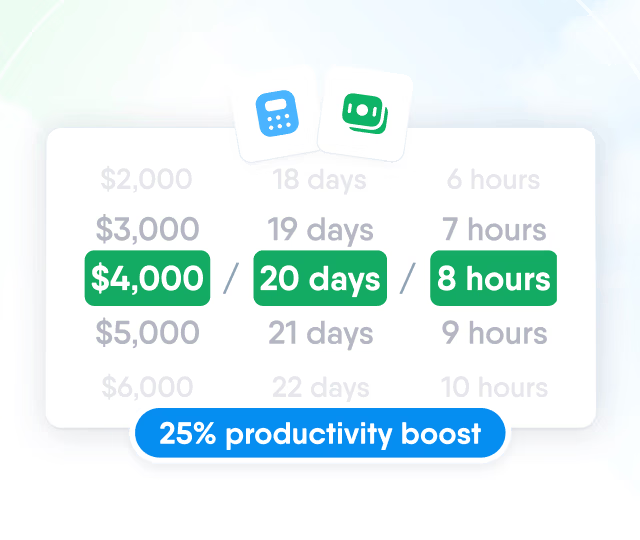
HR efficiency estimator
How does the HR efficiency estimator from PeopleForce work.
Calculate your impact



Labor market
What is the labor market?
The labor market is where the demand for work meets the supply of it. Employers need tasks done, people offer their time and skills, and the price that settles between them is the wage. Unlike most markets, it is heavily shaped by law, by geography and by the fact that the thing being traded cannot be separated from the person providing it.
For an HR team this is not an abstraction. Nearly every number you argue about internally, from salary bands to how long a search will take, is set outside the company by the market you are hiring in.
Supply, demand and what moves them
Supply is the available labor force: who can work, who wants to, and who has the specific skills in question. It shifts with demographics, education, migration, childcare availability and how many people are willing to relocate or work remotely. Demand comes from companies and moves with the economy, with technology and with the way work gets organised, including outsourcing and the use of independent contractors. Over it all sits labor law, which sets minimum wages, working time, dismissal rules and what an employment relationship even means.
Tight or loose: how to tell which one you are in
A tight market means more demand than supply, so candidates hold the leverage. A loose one means the opposite. You do not need national statistics to work out where you stand, because your own hiring data says it first:
- Applications per opening, and how many of them are actually qualified.
- Time to fill and time to hire trending up or down for the same role.
- Offer acceptance rate, and how often you meet a counteroffer.
- Your vacancy rate and how long roles stay open before anyone panics.
- Salary expectations arriving in first conversations versus your current band.
Two of those moving together for a quarter is a market signal. One of them moving is usually a problem with the job ad.
There is no single labor market
The phrase is singular, the reality is not. Each role, seniority level and location is effectively its own market with its own price and its own scarcity, which is why a company can struggle to hire one specialist for six months while hundreds of people apply for a role two floors away. Remote work widened some of these markets and left others strictly local, and global hiring means competing on pay with employers in another country entirely.
There is also an internal market. Every company has one, whether or not it admits it: people move between teams, and internal recruitment competes with the external market for the same roles, usually at a lower cost and with a much shorter ramp-up.
Where it changes HR decisions
Pay is the obvious one: bands built without salary benchmarking drift away from the market until either offers stop being accepted or the compa-ratio quietly says you are overpaying. Beyond pay, market conditions decide how far ahead workforce planning has to look, whether a skills gap is cheaper to hire away or to train away through upskilling, and how much your employer brand and employee value proposition have to carry when you cannot win on salary alone.
Reading the market without guessing
Three layers of data, in order of usefulness. Your own funnel is the most current and the most specific to you. Job board volumes and published salary ranges for the same role in the same city come next and update weekly. National statistics on employment, wages and participation come last: they are reliable, they set the wider frame, and they are almost always several months behind what your recruiters already felt. Use the slow data to understand the direction and the fast data to make this quarter's decisions.
Working with market data in PeopleForce
In Recruit, the funnel itself is your market instrument: sources, stages and conversion per vacancy show where candidates stop and how the same role behaves this quarter compared to the last. Vacancies are published to job boards from one place through multiposting and through the career site, with integrations for regional boards including Work.ua, Robota.ua and Djinni, so applications from each channel are comparable rather than scattered. Prospector covers the sourcing side when a market is too tight to wait for applications.
On the internal side, the vacancy request carries the salary, seniority, location and legal entity agreed before the role is opened, and the reports in HR analytics cover headcount, tenure and turnover by department and location, which is the other half of the picture: what the market is doing to the people you already have.


Let us show you what's possible
From Core HR to advanced workforce analytics — see the platform saving 80 hours a month for teams just like yours. Fully tailored to your workflow.