
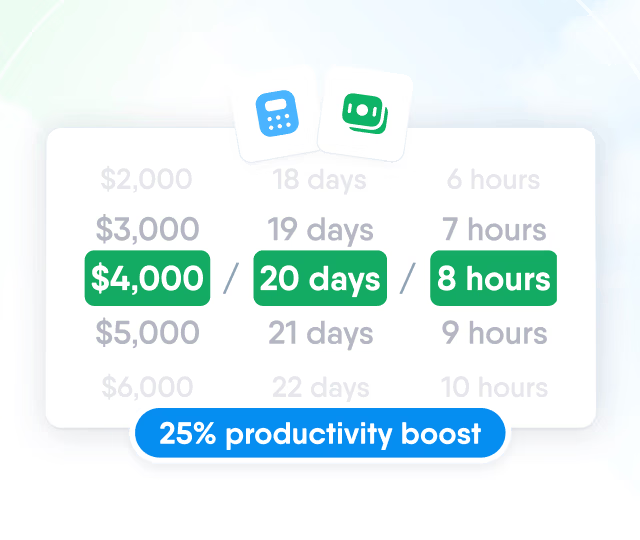
HR efficiency estimator
How does the HR efficiency estimator from PeopleForce work.
Calculate your impact



Leadership development
Leadership development is the deliberate work of building an organization's capacity to lead: judgement, decision-making and responsibility for other people's results. Experience with feedback develops it; job titles do not.
Leadership development is the deliberate work of building an organization's capacity to lead: the people who set direction, make decisions under uncertainty, and are responsible for the results other people produce. It covers everything from a first-time manager learning to hold a difficult conversation to a senior leader learning to run a function they have never run.
It is worth separating from two neighbours. Management training teaches the mechanics of the job: approving leave, running a review cycle, keeping a budget. Leadership development addresses judgement, which cannot be taught the same way. And it is not the same as a promotion, although companies routinely treat the title as the development.
The first-time manager is where the leverage is
Most organizations promote their strongest individual contributor and then provide nothing. This is the single most consequential transition in a career and the one with the least support around it, which is why so much of what companies later call a toxic manager or a retention problem traces back to a promotion nobody prepared anyone for.
The transition is harder than it looks because the source of competence changes completely. The new manager was good at the work and is now measured on other people doing it, which means their old instinct, doing it themselves, is now the failure mode. Add the things nobody practised before: giving feedback that lands, saying no to a request from above, running a conversation about pay. Six months of support here returns more than any executive programme.
What actually develops leaders
The evidence is consistent and mildly inconvenient for training budgets: most leadership capability comes from difficult experience, provided the experience is accompanied by feedback and reflection. A stretch assignment with no feedback produces a confident person who repeats their mistakes; a classroom with no application produces vocabulary.
- Real assignments with real stakes. Leading a project across teams, turning around a team that is struggling, launching something in an unfamiliar market. The developmental part is the ambiguity, not the workload.
- Feedback they cannot get from their own team. Direct reports rarely tell a manager the truth unprompted, which is why structured upward and peer input matters more at this level than at any other.
- A more experienced person in the loop. Coaching or mentoring, with the specific function of turning an experience into a conclusion rather than leaving it as an anecdote.
- Cohorts. A group of peers going through the same transition at the same time. Much of the value is discovering that the difficulty is the job, not a personal deficiency.
- Structured content, in small amounts. Useful when it arrives just before it is needed, largely wasted when it arrives on a schedule of its own.
Why programmes fail
The most common reason is that the participant returns to a job that has not changed. A manager who learns to delegate and then goes back to a workload that only works if they do everything themselves will delegate for two weeks. Development that is not accompanied by a change in the role is a pleasant interruption.
Second is selection. Programmes fill with the available rather than the promising, or with people being rewarded for tenure. Third is the absence of consequence: if behaviour counts for nothing in promotion decisions while results count for everything, everyone quickly learns what the programme is really worth. And fourth is treating leadership development as an event rather than a sequence, which is why a two-day offsite is remembered for the venue.
Making it measurable
Satisfaction scores from participants measure the catering. Better questions: does the manager's own team report a change, measured on the same survey items before and after; has turnover in their team moved; is the internal fill rate for leadership roles rising, which is the clearest sign that a pipeline exists; and do the people who complete the programme actually take on larger roles within two years.
The honest caution is attribution. Teams improve for many reasons, and a company that invests in development is usually investing in several things at once. Comparing teams whose managers went through the programme against comparable teams whose managers have not yet is imperfect but much better than a feedback form.
Succession is the same work under a different name
Leadership development and succession planning are usually run as separate initiatives and are really one question: if a key role opened next quarter, is there anyone ready. The useful version is not a list of names in a spreadsheet but a short answer per critical role covering who could step in now, who could in two years, and what specifically is missing in each case. That last part is what turns succession into a development plan instead of a wish.
Running leadership development in PeopleForce
The structural pieces live in PeoplePerform. Competencies are defined once and used inside review templates, so leadership behaviour is assessed against a written standard rather than an impression. Review cycles collect self, manager, peer and upward input, and the upward review is the part that matters most here: it is the only structured route by which a manager hears from the people they manage.
Development plans then carry the result. Each plan belongs to an employee, has a type, a start and end date and an open or completed status, and holds rich content with checklists and due dates plus comments, so an agreed development step is a tracked commitment rather than a note from a conversation nobody revisits. Plans can be built from templates so the same structure applies across a cohort of new managers. Recurring one-on-ones with talking points and action items give the coaching loop somewhere to live, feedback can be requested or volunteered with visibility set per entry, and objectives with key results and check-ins attach the development to something the person is actually delivering. HR analytics puts survey results, review scores and turnover side by side per team, which is where a change in a manager becomes visible in something other than their own opinion of themselves.


Let us show you what's possible
From Core HR to advanced workforce analytics — see the platform saving 80 hours a month for teams just like yours. Fully tailored to your workflow.