
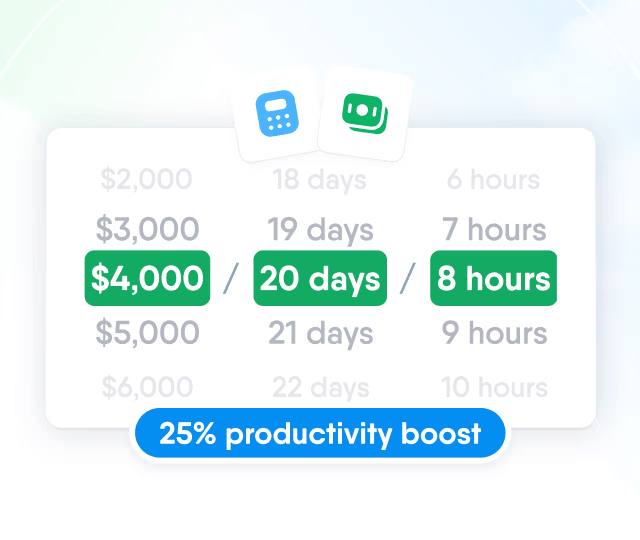
HR efficiency estimator
How does the HR efficiency estimator from PeopleForce work.
Calculate your impact



Leave of absence
What is a leave of absence?
A leave of absence is an agreed period away from work during which the employment relationship continues. The person stays on the books, keeps their role and usually keeps at least part of their benefits. What changes is whether the time is paid, how long it can last and what has to be provided to justify it.
The term covers everything from a planned holiday to six months of unpaid study leave, which is exactly why companies need named leave types rather than one generic category.
Statutory, contractual and discretionary
Three layers sit on top of each other, and confusing them is the most common source of disputes:
- Statutory leave is set by law: minimum annual entitlement, sick leave, parental and maternity leave, public holidays. The company cannot offer less, only more.
- Contractual leave is what the employment contract or collective agreement adds on top, often extra days tied to tenure.
- Discretionary leave is what the company grants because it wants to: birthday days, a mental health day, volunteering time, unpaid sabbaticals. It is granted under company rules, which means those rules have to be written down or every decision becomes a precedent.
The usual leave types
Most companies end up with somewhere between six and fifteen of them: paid time off for regular holidays, medical leave with its own rules on sick leave pay, parental leave, bereavement leave, disability leave, military leave, study leave, unpaid personal leave and the occasional sabbatical. Around them sit public holidays and, in more flexible setups, a floating holiday people can spend when it suits them.
The number matters less than the discipline: one type per set of rules. The moment two genuinely different situations share a type, the balance stops meaning anything and reporting becomes guesswork.
What a leave policy has to answer
Write these down before the first request arrives, because each of them will otherwise be decided ad hoc by whoever is asked first:
- Paid or unpaid, and whether the days count as working time.
- Counted in working days or calendar days, and what happens when a public holiday falls inside the period.
- How the entitlement appears: all at once on a fixed date, or accrued month by month, and whether the first year is prorated from the hire date.
- Carryover: none, unlimited, or up to a set number of days, and whether carried days expire after a few months.
- Notice: the minimum days ahead a request must arrive and the maximum distance into the future it can be booked.
- Evidence: which types require a document, and who is allowed to see it.
- Approval: one manager, a chain, or HR as a second step.
- Negative balance: whether people may go below zero and by how much.
Where leave management usually breaks
Spreadsheets are the classic failure: balances live in a file only HR can edit, so employees ask instead of checking, managers approve without knowing the balance, and the year-end reconciliation takes a week. The second failure is approving leave without arranging cover, which turns one person's holiday into a team's problem. The third is having a generous policy nobody can find, which is a documentation problem more than a leave problem and usually belongs in the employee handbook.
Tracking is also the only honest input to absence management: patterns worth acting on, like absences clustering in one team, are invisible until requests are recorded in one place with a type attached to each one.
Leave in PeopleForce
Leave tracking in Core HR is built as leave types with policies underneath them. A type is tracked in days or in hours; a policy on top of it sets whether the time is paid, unpaid or counted as working, whether it runs in working or calendar days, how the allowance appears, and the rounding used for partial days. Accrual policies prorate the first period or grant the full amount, add extra days at tenure levels you define, and handle carryover as none, unlimited or up to a fixed number, with an expiry delay for carried days. Minimum and maximum notice periods, a required attachment for types that need proof, and an allowed negative balance are all per policy rather than per request.
Requests run through an approval chain, and each policy carries a substitution rule so cover passes automatically to the reporting manager, the manager's manager, the third-level manager or a named person when the request is approved. Balances are visible to the employee rather than held by HR, team availability shows who else is away in the same period, and the reports in HR analytics cover leave balances, leave used and requests by type, which is what turns time off tracking from bookkeeping into something you can plan with.


Let us show you what's possible
From Core HR to advanced workforce analytics — see the platform saving 80 hours a month for teams just like yours. Fully tailored to your workflow.