
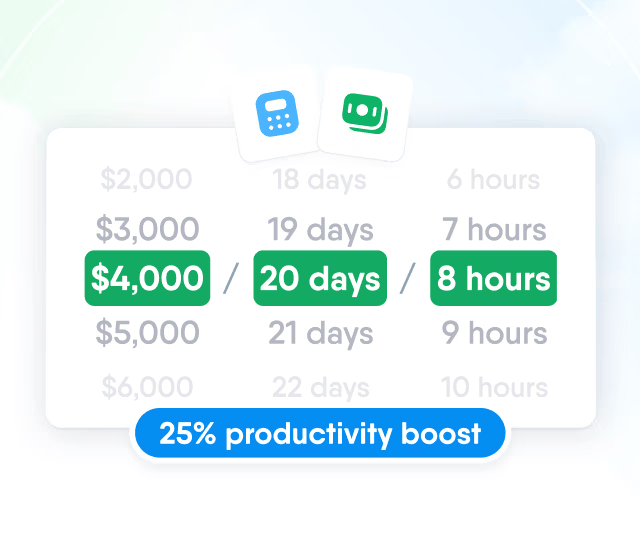
HR efficiency estimator
How does the HR efficiency estimator from PeopleForce work.
Calculate your impact



Pay equity
Pay equity means paying employees who perform work of equal or comparable value the same, with any differences explained only by legitimate, job-related factors such as experience, performance, or location, never by gender, ethnicity, age, or other protected characteristics.
What is pay equity?
Pay equity is the principle that people doing the same job, or different jobs of comparable value, should receive comparable pay, and that any difference must be explainable by factors related to the work rather than to who the person is. Legitimate factors include experience, skills, performance, tenure, shift or location differentials, and market conditions for the role. Illegitimate factors include gender, ethnicity, age, disability, nationality, or how well someone negotiated at hiring.
The concept has two layers. Equal pay is the narrow version: two people in the same role with comparable qualifications and performance earn the same. Equal pay for work of equal value is the broader version, enshrined in ILO Convention 100 and EU law: a warehouse supervisor and an office team lead with comparable skill, effort, responsibility, and working conditions should be paid comparably, even though the jobs look different. This second layer is where most systemic gaps hide, because female-dominated job families have historically been valued lower.
Pay equity vs. pay equality vs. the gender pay gap
Pay equality means paying everyone in the same role the same amount regardless of experience or performance. Few companies want this; it removes the ability to reward contribution.
Pay equity allows differences, but only for defensible reasons. Two engineers can earn different salaries if one has five more years of experience; they cannot if the only difference is gender.
The gender pay gap is a statistic: the difference between the average or median earnings of men and women across an organization, usually expressed as a percentage. It is influenced by pay equity but also by representation: if most senior roles are held by men, the raw gap will be large even if every individual role is paid equitably. Closing the gap therefore requires both equitable pay within roles and equitable access to higher-paid roles.
Pay equity laws
Most countries have had equal pay legislation for decades; what has changed is enforcement. The EU Pay Transparency Directive (2023/970) obliges employers with 100 or more employees to report their gender pay gap, requires a joint pay assessment with employee representatives when the gap in any category exceeds 5 percent and cannot be justified, gives employees the right to information about average pay by sex for their job category, and shifts the burden of proof in pay discrimination claims to the employer. In the United States, the Equal Pay Act and Title VII apply federally, and several states have stricter equal-value standards and salary history bans. Canada, Australia, and the UK combine equal pay law with mandatory gap reporting for larger employers.
Common causes of pay inequity
- Negotiation at hiring. Starting salary is often set by what the candidate asked for. Groups that negotiate less, or are penalized for negotiating, start lower and the gap compounds with every percentage-based raise.
- Salary history anchoring. Basing an offer on previous pay imports inequities from former employers.
- Missing or unused salary bands. Without ranges and placement criteria, pay is set case by case and drifts.
- Uncalibrated performance ratings. If ratings are biased, so are the merit increases and bonuses built on them.
- Counteroffers and retention raises. Raises given only to people who threaten to leave reward mobility, not contribution.
- Career interruptions. Parental leave and part-time work often stall pay progression even after return to full-time.
- Job segregation. Roles dominated by women or minority groups are valued lower in job evaluation, which is why the equal-value standard matters.
How to run a pay equity audit
- Define comparable groups. Group employees who do the same or equivalent work, using job levels from job evaluation rather than titles. Groups need to be large enough to analyze; very small groups are reviewed case by case.
- Collect the data. Base salary, variable pay, allowances, and equity, alongside the legitimate explanatory factors: level, tenure, experience, performance rating, location, hours.
- Analyze. For each group, compare average and median pay by gender (and other characteristics where legally permitted). In larger organizations, a regression that controls for the legitimate factors isolates the unexplained portion of the gap.
- Investigate outliers. Individuals far above or below peers with similar profiles are reviewed one by one to find the cause.
- Classify. Separate gaps that are explained by legitimate factors from those that are not. Only the unexplained portion is a pay equity problem; the rest may be a representation problem.
- Remediate. Budget for salary adjustments, prioritizing the largest unexplained gaps. Adjustments are made upward; lowering anyone's pay to close a gap is both illegal in most places and destructive.
- Fix the process. Address the root cause: introduce or enforce bands, ban salary history questions, calibrate ratings, review counteroffer practices.
- Document and repeat. Keep a record of the methodology and decisions for regulators, and repeat the audit annually, ideally before the merit cycle so corrections can be built into it.
How to prevent pay inequity
Prevention is cheaper than remediation. Set starting salaries from the band and the candidate's placement criteria, not from what they ask for. Stop asking about salary history. Calibrate performance ratings across managers before they feed into pay decisions. Review pay after parental leave to make sure progression has not stalled. Tie pay transparency to the structure so that ranges and criteria are visible and inequities are hard to sustain. And review the gender balance of promotions and high-paid roles, because pay equity within roles will not close the overall gap on its own.
Pay equity in an HRIS
A pay equity audit is only as good as the data it runs on, and most of that data already sits in the HR system. In PeopleForce Core HR, each employee record holds position, job profile, department, legal entity, location, hire date, and the full base salary history with effective dates, alongside additional compensation components such as bonuses and allowances. Job profiles carry salary bands with a minimum and maximum, so pay can be compared not just between people but against the range the company itself defined. HR analytics includes a dedicated gender pay gap report that breaks pay down by job profile, flags outliers for individual review, and highlights records with missing gender data, which turns the first four steps of the audit into a report rather than a spreadsheet project. Performance ratings from review cycles in PeopleForce Perform sit on the same profile, so the legitimate explanatory factors are available where the pay data is, and role-based access keeps all of it restricted to the people who need it.
Frequently asked questions
Is a pay gap the same as pay discrimination?
No. A gap becomes discrimination when it cannot be explained by legitimate job-related factors. That is exactly what a pay equity audit determines.
How often should a pay equity audit be done?
Annually is standard, timed before the merit cycle. Companies under the EU directive with 100 or more employees also have fixed reporting cycles.
Can we lower salaries to close a gap?
No. Equal pay law in most jurisdictions prohibits reducing pay to achieve equity, and doing so would destroy trust. Gaps are closed by raising those who are underpaid.
Who should own pay equity?
HR runs the process, but finance, legal, and leadership need to be involved: finance for the remediation budget, legal for privileged handling of findings, leadership for the decisions on process change.


Let us show you what's possible
From Core HR to advanced workforce analytics — see the platform saving 80 hours a month for teams just like yours. Fully tailored to your workflow.