
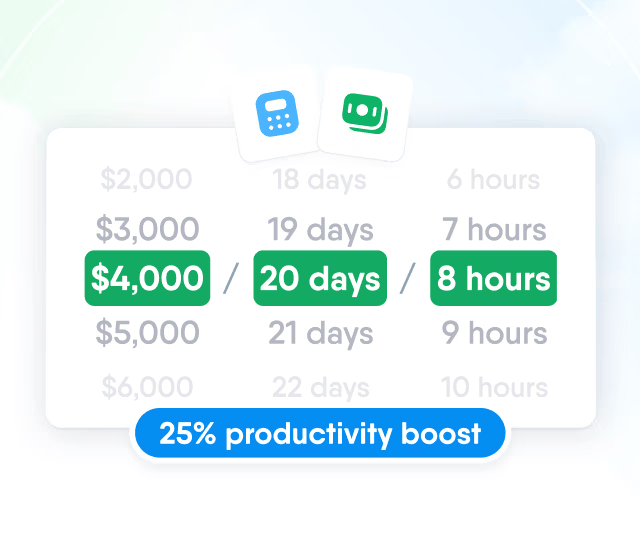
HR efficiency estimator
How does the HR efficiency estimator from PeopleForce work.
Calculate your impact



Merit increase
How performance-based raises work, how they differ from cost-of-living adjustments and promotions, and how to run a merit cycle that people trust
A merit increase, or merit raise, is a permanent increase to an employee's base salary awarded for individual performance. Unlike a bonus, it does not have to be re-earned: once granted, it becomes part of the salary going forward. Merit increases are usually decided once a year in a merit cycle that follows the performance review, and they are the main tool companies use to pay their strongest people more over time without changing their role.
Merit increase vs. other pay changes
- Cost-of-living adjustment (COLA). A general raise applied to everyone to offset inflation. It rewards nobody; it keeps pay from falling in real terms.
- Market adjustment. A raise given because salary benchmarking shows the role is underpaid relative to the market, regardless of the individual's performance.
- Promotion increase. A raise tied to moving into a bigger role with a higher pay range.
- Bonus. A one-off payment for results in a period; it is variable pay and does not raise base salary.
In practice a single annual raise often blends several of these. Keeping them separate in the pay decision, even if they are communicated together, makes the reasoning explainable to the employee and defensible later.
Typical merit increase percentages
Most companies set a merit budget as a percentage of total payroll, commonly in the range of 3% to 5% in a normal year, and then differentiate within it. A merit matrix maps two inputs to a percentage: the performance rating and the employee's position in the pay range, often expressed as a compa-ratio. A top performer paid below the midpoint of their range might receive 7% to 10%; a solid performer at the midpoint 3% to 4%; someone already at the top of the range a small increase or a one-off lump sum instead, so pay does not drift outside the band. The exact numbers depend on inflation, the labour market, and the company's compensation philosophy.
How to run a merit cycle
- Fix the budget. Finance and HR agree the total pool before any individual decisions are made.
- Finish reviews first. Merit decisions should rest on completed, calibrated performance ratings, not on managers' impressions in the moment.
- Apply the matrix. Managers propose increases within the guidelines; HR checks for consistency across teams and for gaps that would widen pay equity problems.
- Calibrate. Leaders review proposals side by side so that the same rating earns a similar increase in different departments.
- Communicate individually. Each employee should hear the new salary, the effective date, and the reason from their manager, not from a payslip.
Common pitfalls
Spreading the budget evenly across everyone turns merit pay into a disguised cost-of-living raise and tells top performers their extra effort is not noticed. Tying increases to unstructured ratings invites bias, so they should follow a calibrated review process with clear key performance indicators or competency criteria. And a merit raise that is not recorded with its reason and effective date is impossible to audit when an employee, a regulator, or a pay-transparency report asks why two people in the same role are paid differently.
Merit increases in PeopleForce
Merit cycles in PeopleForce start from the review data in PeopleForce Perform: performance scores, competency ratings, and manager reviews are stored per cycle, so the raise decision and the rating it rests on live in the same system. In Core HR, the new base compensation is entered with an effective date, so approved increases can be scheduled ahead of payday and the previous and upcoming values stay visible side by side. The base compensation history report then shows every merit change over time, and the gender pay gap report checks whether the cycle has pushed anyone outside their compensation band. Salary changes can also trigger workflows, for example generating a salary addendum for signature or notifying payroll.


Let us show you what's possible
From Core HR to advanced workforce analytics — see the platform saving 80 hours a month for teams just like yours. Fully tailored to your workflow.