
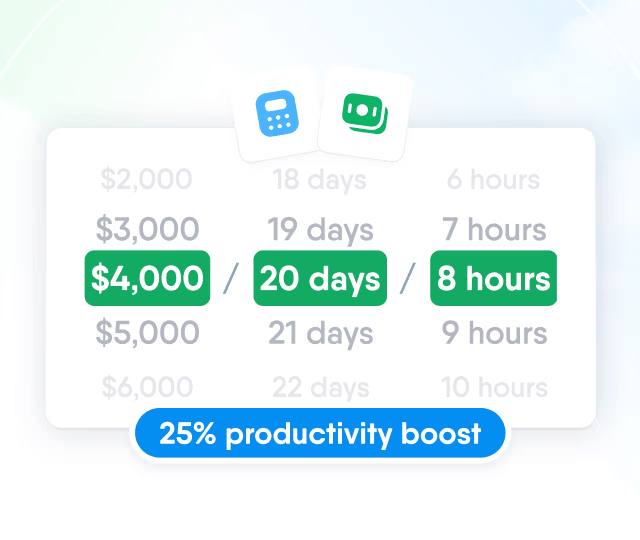
HR efficiency estimator
How does the HR efficiency estimator from PeopleForce work.
Calculate your impact



Performance improvement
What is performance improvement?
Performance improvement is the deliberate work of closing the gap between how someone is performing now and what the role actually requires. It applies at three levels: an individual whose results have slipped, a team that keeps missing its commitments, and a system where the process itself makes good work hard. The label usually gets attached to the first case, which is why the other two survive so long.
Before treating a gap as a person problem, check whether the conditions allow the result at all. A great deal of what looks like underperformance turns out to be unclear expectations, missing access, conflicting priorities from two managers, or a year without a single piece of specific feedback. If three people in the same team are struggling, the answer is not three improvement plans.
Diagnose the gap before you fix it
Four questions separate the cases that need different treatment. Does the person know what good looks like, in observable terms rather than adjectives? Do they have the tools, access and time the work requires? Is there a feedback loop short enough for them to correct course, or does the first signal arrive at the annual performance review? And finally, is this a skill gap or a will gap? A skill gap responds to coaching, mentoring and upskilling. A will gap is about motivation, fit or something happening outside work, and training will not touch it.
The tools, from lightest to heaviest
Escalating too fast damages trust, escalating too slowly lets the problem harden into a team norm.
- An expectations reset in a one-on-one meeting, where the manager states the standard in concrete terms and confirms the person heard the same thing.
- Continuous feedback on specific work, close to when it happened. This is what continuous performance management is for.
- Targeted development: a short plan against one or two competencies, with a mentor or a course attached and a date to check.
- Reassignment when the person is strong but wrong for this role. Moving someone along a different career path is cheaper than replacing them.
- A formal performance improvement plan, with written targets, support and a review date, when the informal route has been tried and documented.
- Exit, handled through the proper disciplinary procedures, when the gap stays open after genuine support.
What makes an improvement stick
Name behaviours and outputs, not traits. Nobody can act on being told they lack ownership; they can act on being told that three of the last five handovers went out without test coverage. Set a measure that both sides can see without arguing, and a baseline, because without one there is no way to show progress. Keep the review cadence short, two to four weeks, since a plan checked only at the end is not a plan. And make the manager accountable for their half: the support promised in writing has to actually arrive, or the whole exercise reads as theatre.
Where performance improvement goes wrong
- Feedback saved up for review season. Six months of silence followed by a list of failures is an ambush, not a correction.
- The halo effect in reverse: one visible mistake colours every rating that follows.
- Using a plan as a paper trail. If the decision to dismiss is already made, the plan is a formality that everyone sees through and the team learns not to trust the process.
- Ignoring the cause. Burnout, micromanagement and job dissatisfaction all look like underperformance from the outside and none of them respond to a targets table.
- Improving one number and breaking another, such as pushing ticket throughput until quality and handover notes collapse.
Performance improvement in PeopleForce
Perform carries both halves: the diagnosis and the follow-through. Review cycles collect self, manager and peer assessments, with peer reviewers nominated and approved rather than picked at random, and the results shown side by side on a radar chart so the gap between how a person sees their work and how others see it is visible instead of implied. One-on-ones keep the conversation running between cycles, and KPI tracking gives the measure everyone agreed on. Development plans are where an improvement actually lives: each one has a type and can start from a template, runs between a start and end date, and is written in a block editor with an action list, due dates, files and links. Progress is calculated automatically from the items checked off, so nobody has to estimate how far along it is, and the plan carries comments plus notifications when it is created, completed or overdue. Reporting covers development plans, KPI results, objective ownership and one-on-one coverage, which is how you see whether the support promised in a plan is actually happening across the company.


Let us show you what's possible
From Core HR to advanced workforce analytics — see the platform saving 80 hours a month for teams just like yours. Fully tailored to your workflow.