
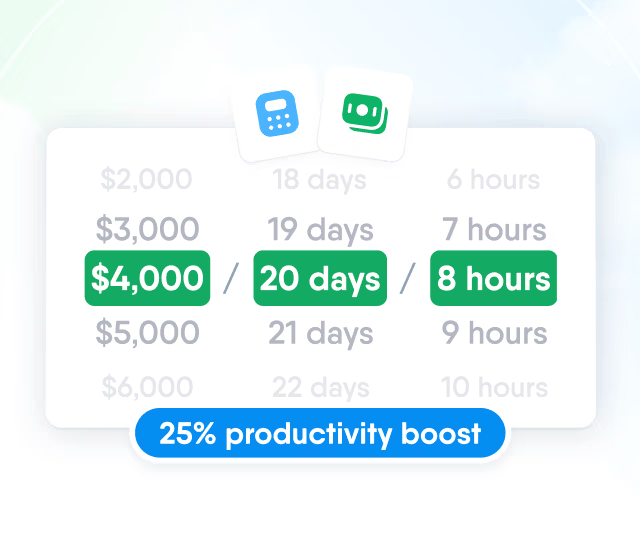
HR efficiency estimator
How does the HR efficiency estimator from PeopleForce work.
Calculate your impact



Time tracking
What is employee time tracking?
Time tracking is the recording of working time: when a person starts and stops, how long they worked, and, in many companies, what they worked on. It covers two different questions that are often mixed up. Attendance answers whether someone was at work and for how long. Project time answers where those hours went.
The distinction decides what the data is good for. Attendance data feeds payroll, overtime calculation and legal records. Project data feeds client billing, pricing and utilization analysis. Trying to run both from one badly designed log is the usual reason a rollout fails.
Why companies keep records
The motivation is rarely suspicion. It is usually one of four things:
- Legal obligation. In the EU, employers must keep objective, reliable records of daily working time, and national labour codes set the format.
- Correct pay. Hourly work, night shifts, overtime premiums and weekend rates all depend on hours that can be proven.
- Billing. Agencies and service firms invoice from tracked hours, so an unrecorded hour is unpaid revenue.
- Planning. Without a baseline of where hours go, capacity discussions are guesswork.
Tracking and surveillance are different things
Screenshots, keystroke counters and activity scores measure presence at a screen, not contribution, and they cost more in trust than they return in data. A record of hours with a clear purpose is accepted by most teams; continuous monitoring is not. The practical rule is to collect the minimum that answers the question you actually have, and to tell people what is collected and why, especially in teams with flexible working hours.
What to define before you start
Decide the rules first, because changing them later invalidates the history:
- Whether people record a duration or a start and end time.
- Whether breaks are inside or outside working time, and their minimum and maximum length.
- How overtime is requested, approved and compensated.
- Who approves timesheets, and what happens when that person is away.
- How this connects to time off tracking, so an absence does not appear as a missing day.
How time tracking works in PeopleForce
In the Time module, an attendance policy holds the rules: working hours and special hours, break settings with a minimum and maximum limit, the overtime types available, the approval chain, and which locations and employees the policy covers. Entries are recorded either as a duration or as a start and end time, and each entry is marked as tracked with a live timer or entered manually. Breaks are stored as separate entries rather than subtracted by hand, and every entry follows the employee's own time zone.
For billable work, entries are linked to a project and task. If the task is billable and the employee has a cost rate and a billable rate, the system calculates the cost and the billable amount for that entry, which is how project profitability becomes visible without a second tool. A timesheet then moves from draft to submitted, and the manager approves or rejects it with a comment, so the month closes on approved data. The reports library exports the result to XLSX or CSV for payroll or the client invoice.


Let us show you what's possible
From Core HR to advanced workforce analytics — see the platform saving 80 hours a month for teams just like yours. Fully tailored to your workflow.