
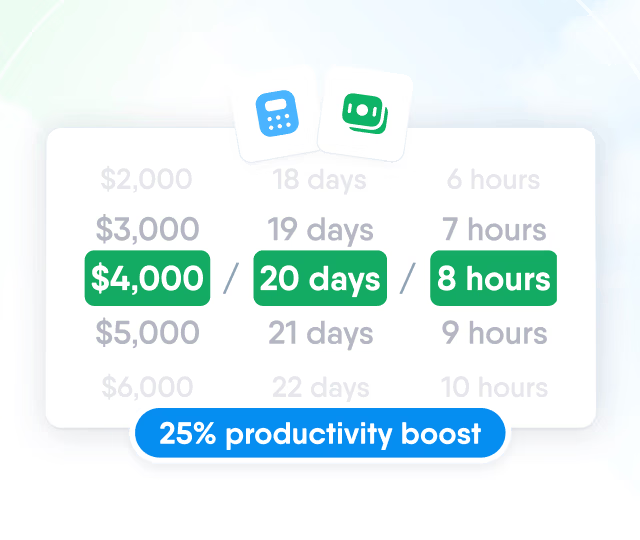
HR efficiency estimator
How does the HR efficiency estimator from PeopleForce work.
Calculate your impact



Voluntary benefits
What is a voluntary benefit?
A voluntary benefit is a perk the employer arranges but the employee chooses to take, usually paying for it in whole or in part through payroll deduction. The company negotiates the terms and provides the channel; the individual decides whether the cover is worth the money to them.
The distinction from the rest of the package comes down to two questions: who pays, and who chooses. Statutory contributions are mandatory and mostly employer-funded. Core employee benefits are employer-funded and automatic. Voluntary benefits are opt-in and largely employee-funded, which is exactly why they can be broad without wrecking the budget.
What usually sits in the voluntary tier
The contents vary by country, because whatever the state already covers well tends not to appear here. Common items:
- Extended or family health cover on top of whatever the employer already provides.
- Dental, vision and physiotherapy, which base policies often exclude.
- Life, accident and critical illness cover at group rates.
- Private pension or long-term savings contributions.
- Gym, sport and wellness programs memberships.
- Language courses, education budgets and professional memberships.
- Pet insurance, legal assistance, travel cover and similar niche products with real take-up in specific groups.
Why offer something you do not pay for
The logic is not charity, it is purchasing power. A company of three hundred people buys insurance on terms no individual can obtain alone, and payroll deduction removes the friction of another monthly payment to arrange. For the employer this widens the employee value proposition at close to zero direct cost, and the tax treatment of some items makes the same money go further than a raise of equivalent size.
There is also a segmentation argument. A single twenty-four year old and a parent of two want completely different things, and a fixed package has to choose between them. A voluntary tier lets the same budget serve both, because each person spends it where it matters to them.
Where voluntary benefits fail
- Nobody enrols. Take-up below roughly one in ten usually means the benefit is either priced badly or was never explained. A benefit nobody uses still costs administration time.
- Too much choice. Twenty options with overlapping cover produce paralysis, not appreciation. Fewer, clearly differentiated plans get chosen more often.
- Communicated once a year. Enrolment windows are mentioned in one email in November and forgotten. Life events, not calendars, are when people actually want cover.
- Sold as compensation. Presenting a discount an employee pays for as part of total compensation reads as inflating the number, and people notice.
How to decide what to offer
Start by asking rather than guessing, then check the answer against behaviour. A short survey tells you what people say they want; enrolment rates per plan after six months tell you what they actually wanted. Review the list annually and remove anything below a threshold you set in advance, otherwise the catalogue only ever grows.
Segment the review by life stage rather than by department. Take-up of family health cover among people with young children is a meaningful number; take-up across the whole company is an average that hides both the success and the waste.
How PeopleForce supports voluntary benefits
In PeopleForce benefits are modelled in two levels, which matches how voluntary offerings actually work. A benefit is the offering itself, with its description and the currency it is priced in; underneath it sit the plans, meaning the tiers a person can choose between. Each employee is then linked to one specific plan with the date their cover starts, so the record answers the question that matters during an audit or a payroll query: who was on which tier, from when.
Enrolment itself runs through request forms with their own approval route, and the terms of each plan live in the Desk knowledge base rather than in an attachment somebody mailed last year. Because assignments are stored per plan rather than as free text, take-up per tier is a report rather than a manual count, which is what makes the annual cut-or-keep decision an evidence-based one.


Let us show you what's possible
From Core HR to advanced workforce analytics — see the platform saving 80 hours a month for teams just like yours. Fully tailored to your workflow.