
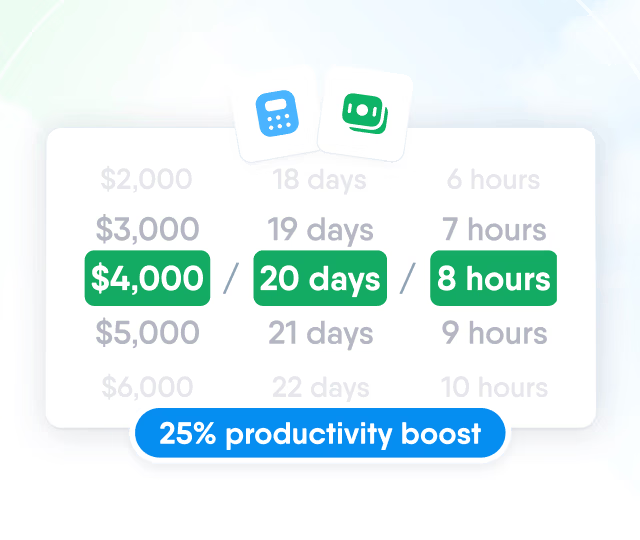
HR efficiency estimator
How does the HR efficiency estimator from PeopleForce work.
Calculate your impact



Workforce planning
What is workforce planning?
Workforce planning is the process of deciding how many people with which skills a company needs, in which locations, by when, and then closing the distance between that answer and the workforce it actually has. It is the bridge between a business plan and a hiring plan, and it fails whenever those two are written by different people who never compare notes.
It is not the same as headcount budgeting. A headcount budget is a number finance approves; workforce planning is the reasoning that should produce the number. The test is simple: if you can explain why the answer is fourteen people rather than eleven, and what breaks at eleven, you are planning. If the number arrived as last year plus ten percent, you are budgeting.
The four steps, and which one actually decides the outcome
- Supply analysis. What you have today: headcount by role, skills, locations, contract types, plus expected departures based on your own turnover rate rather than an industry average.
- Demand analysis. What the business plan implies. Two new markets, a product launch and a support model change are all headcount statements even when nobody writes them as such.
- Gap analysis. The difference, split by whether it is a volume gap or a skills gap. They have completely different solutions and get confused constantly.
- Action and monitoring. Build, buy, borrow or redesign the work, then check quarterly whether reality matched the plan.
Most of the value sits in the third step. Supply and demand analysis are data exercises that a competent analyst can do; deciding which gaps to close, in what order, with what budget, is a judgement call that determines everything downstream.
Two horizons, two different exercises
Operational planning covers the next four quarters and works with specifics: these roles, these approved requisitions, this time to fill, this budget. Strategic planning covers one to three years and works with capabilities rather than job titles, because the titles will have changed by the time you get there. Companies that run only the first are permanently reactive; companies that run only the second produce documents nobody uses.
What you need before you start
- Clean headcount data with a single definition of what counts as an employee. Contractors, part-timers and people on long leave are where most disagreements start.
- Your own attrition history, ideally split by tenure band, because first-year attrition behaves nothing like fourth-year attrition.
- Realistic hiring lead times per role from your own records, not from the recruiter's optimism.
- An honest read of the labor market for the roles you depend on.
Where workforce planning goes wrong
- Planning only for growth. A plan that has no answer for a downturn turns into redundancy decisions made in a panic.
- Ignoring internal supply. The cheapest source of a mid-level hire is usually someone already inside who is one skill short.
- Annual only. A plan refreshed once a year is wrong by March. Quarterly review with the same model is the minimum.
- Detached from the budget cycle. A perfect plan delivered after finance closed the numbers changes nothing.
How PeopleForce supports workforce planning
The supply half of the exercise comes straight out of HR analytics in PeopleForce. The headcount report holds hire dates and termination dates alongside seniority, position, department, division, location and manager, so you can cut current numbers by any of those dimensions rather than rebuilding a pivot table each quarter. The same data drawn over time gives the trend line, and attrition is available per employee record rather than only as a company-wide figure, which is what makes tenure-band analysis possible.
On the skills side, job profiles carry required skills with an explicit level and employee profiles carry actual levels on the same four-point scale, so a volume gap and a capability gap are visibly different things rather than one blurred number. When a gap turns into a hire, the vacancy request in Recruit carries the salary range, seniority, location and legal entity through its approval route, which keeps the plan and the actual requisition attached to each other instead of drifting apart in two separate spreadsheets.


Let us show you what's possible
From Core HR to advanced workforce analytics — see the platform saving 80 hours a month for teams just like yours. Fully tailored to your workflow.