
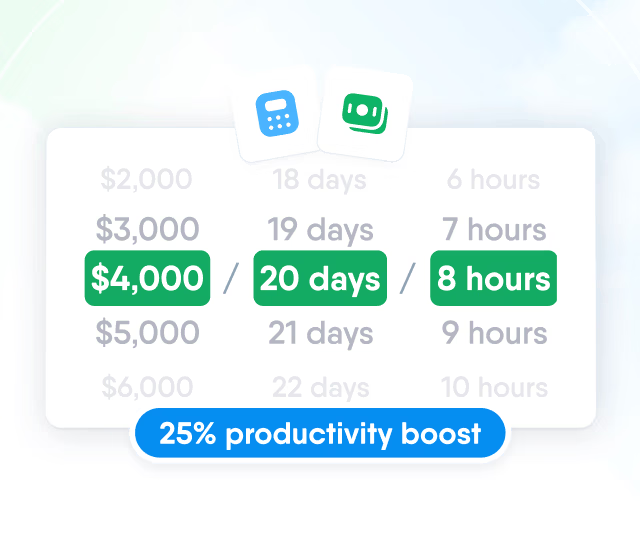
HR efficiency estimator
How does the HR efficiency estimator from PeopleForce work.
Calculate your impact



Insubordination
Insubordination is an employee's refusal to carry out a lawful and reasonable instruction given by someone with the authority to give it.
Insubordination is an employee's refusal to carry out a lawful and reasonable instruction given by someone with the authority to give it. It is one of the narrowest terms in HR and one of the most loosely used: managers reach for it when they mean rudeness, disagreement, a missed deadline or a personality clash, and the word then carries a weight in a disciplinary file that the underlying facts cannot support.
The distinction matters because insubordination is treated as a conduct issue, and conduct issues run through disciplinary procedures rather than through coaching or a performance plan. Labelling the wrong thing as insubordination puts a company on a track that is hard to reverse and easy to lose on.
Three conditions, all of which have to hold
A case is insubordination only when all three are true at once.
- The instruction was lawful and reasonable. Within the scope of the job, achievable, and not requiring the employee to break a law, falsify a record or work unsafely.
- It came from someone with the authority to give it, and it was clear. Not a suggestion, not an idea raised in passing, not an ambiguous message that could be read two ways.
- The employee understood it and did not comply. Wilfully. A person who did not hear it, misread the priority or lacked the skill to do it has not refused anything.
Drop any one of the three and what remains is a different problem with a different remedy. That is why the first step in every case is establishing the facts rather than deciding on the label.
What it is not
Disagreement is not insubordination. An employee who argues against a decision, asks why, or puts an objection in writing and then does the work has done exactly what a healthy organisation wants. Refusing an unsafe or unlawful instruction is not insubordination either, and in most jurisdictions it is specifically protected, as is raising a concern through a whistleblowing channel or a grievance procedure. Treating either as a disciplinary matter converts a manageable situation into a legal one.
Rudeness is a separate category. Insolence is disrespectful behaviour: tone, language, a public dismissal of a manager in a meeting. It may well breach the code of conduct, but it is not a refusal to work and should not be recorded as one. The two are handled differently because they have different causes: insolence is usually about the relationship, insubordination is usually about authority or workload.
Most cases are a management signal first
A single clear refusal from an otherwise reliable person almost always has something behind it: an instruction that contradicts one given yesterday by someone else, a workload that makes the request impossible without dropping something the same manager asked for, a safety concern the employee cannot articulate formally, or a pattern of micromanagement that has finally produced a reaction.
When refusals cluster around one manager, the useful investigation is upward. A team in which several people are suddenly non-compliant is not a team that simultaneously decided to be difficult. Engagement data, exit records and one-on-one notes usually show the problem months before the disciplinary file does.
How to handle a real case
Start by writing down what actually happened, while it is fresh: the instruction in the words it was given, when, by whom, in front of whom, and what the employee said or did. Then hear their side before deciding anything, because a plausible explanation ends the matter and an implausible one is evidence. Most jurisdictions require a written explanation from the employee before any penalty can be applied, and the requirement usually comes with a deadline that starts running from the day the employer learned of the incident, not from the incident itself.
The response should be proportionate to what the refusal risked. A first instance of pushback that cost nothing is a conversation. A repeated pattern moves to a written warning with a defined expiry. A refusal that endangered someone, exposed the company to legal liability or was delivered in a way that made the working relationship untenable may reach gross misconduct, though that threshold is higher than most managers assume and needs an investigation to support it.
Where it goes wrong
The commonest failure is the retrospective label: a manager loses an argument, and the incident is written up afterwards as insubordination with the disagreement edited out. The second is inconsistency, where the same behaviour is tolerated from a high performer and punished in someone else, which is the single fastest route to a discrimination claim. The third is skipping the explanation step, which invalidates the penalty in most legal systems regardless of how obvious the facts were. And the fourth is a disciplinary record that lives in one manager's inbox, so that when the pattern finally matters there is nothing to show but recollection.
Keeping the record in PeopleForce
The practical problem with conduct cases is evidence, and specifically evidence that survives a manager leaving. In documents and e-signature, anything issued to an employee lives in a folder on their profile with its own access rules, so a disciplinary file is visible to HR and the people who need it rather than to the whole company. Every document record carries who created it and who last changed it, which is what turns a file into an audit trail instead of a folder of attachments.
When a document is sent for signature, the state is tracked through the whole sequence: requested, delivered, email opened, document opened, and then signed, rejected, expired or cancelled, each with its timestamp. That distinction between delivered and opened is the one that matters in a contested case, because the argument that nobody ever received the instruction is answerable with a record rather than with a recollection. A pending signature can be nudged from the same screen. If a case escalates as far as leaving, the termination is recorded against a controlled list of types and reasons in Core HR, so conduct-related exits are countable rather than buried in free text.


Let us show you what's possible
From Core HR to advanced workforce analytics — see the platform saving 80 hours a month for teams just like yours. Fully tailored to your workflow.