
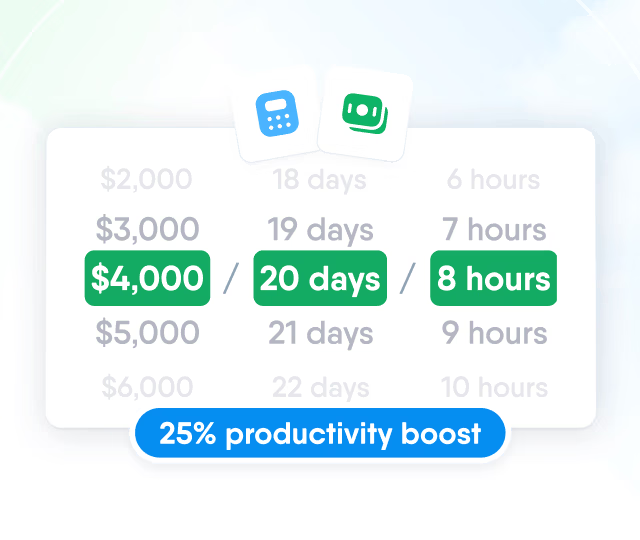
HR efficiency estimator
How does the HR efficiency estimator from PeopleForce work.
Calculate your impact



Written warning
A written warning is a formal, documented disciplinary step that records a specific breach, states what must change, and sets out what happens if it does not.
A written warning is a formal, documented step in a disciplinary procedure. It records a specific breach of conduct or a specific failure to meet a standard, states what has to change, and puts the employee on notice that a repeat carries a heavier consequence. Unlike a conversation, it creates a record both sides can point to later.
In most companies it sits in the middle of a ladder: an informal conversation, a verbal warning, a written warning, a final written warning, and then dismissal. The ladder is a convention rather than a law in most places, but abandoning it without a reason is what makes a later dismissal look arbitrary. Serious cases skip the ladder entirely and go straight to a gross misconduct process.
What has to be in one
- The specific conduct, with dates. Not unprofessional behaviour, but what happened, when, and who was affected. A warning that cannot be pictured cannot be corrected.
- The rule or standard it breached. A clause in the employee handbook, a code of conduct point, a safety procedure.
- The employee's response. What they said when the allegation was put to them, recorded even where it was rejected.
- What has to change, and by when. Observable and checkable, with a review date rather than an open-ended expectation.
- What happens if it does not. Stated plainly, so nobody is surprised at the next stage.
- Any support offered. Training, a schedule change, a different assignment. Its absence is one of the first things a tribunal notices.
- When the warning expires. Covered below, and the field most often left out.
- How to object or appeal, and to whom. Someone other than the person who issued it.
An expiry date is not optional
A warning that never expires is a permanent penalty for a single incident, and most legal systems refuse to treat it that way. Poland makes this automatic: a disciplinary penalty is considered void after a year of faultless work and is removed from the personnel file, and the employee has seven days to file a formal objection when it is imposed. Ukraine works the same way, with a penalty treated as lifted after a year without a new one. Argentina has no fixed expiry, but a sanction the employee did not contest within thirty days is treated as accepted, which cuts in the other direction.
The practical rule is to write the live period into the document itself, typically six to twelve months depending on severity, and to actually let it lapse. Companies that keep a rolling file of every warning ever issued find that it works against them, because a manager escalating on the basis of a warning from three years ago has to explain why the intervening two good years counted for nothing.
Conduct and capability are different problems
This is the distinction that decides which instrument you reach for. Conduct is about choices: lateness, a rule broken, insubordination, an expenses claim that was not real. Capability is about ability: the person is trying and the work is not good enough.
A written warning is the right instrument for the first and the wrong one for the second. Capability needs a performance improvement plan: targets, support, coaching and a realistic window. Using a warning where a plan was needed is the single most common reason a later dismissal is overturned, because the employer never gave the person a fair chance to improve at something they could not simply choose to do differently.
Delivering it
The conversation comes first and the document second. A warning that arrives by email with no prior meeting reads as a decision already taken, and it usually is, which is why it produces an appeal rather than a change in behaviour. Hold the meeting, put the allegation, listen, then decide, then write.
Ask the employee to acknowledge receipt rather than to agree with the content. Those are different things, and conflating them is why people refuse to sign. If they refuse anyway, record the refusal and the date, because a refusal to sign does not invalidate a warning but an undocumented delivery does. Then diarise the review date, because a warning with a review date that nobody returns to teaches the employee that the whole thing was theatre.
Where written warnings fail
The first failure is vagueness: attitude, professionalism and communication style are not conduct, they are impressions, and they cannot be improved against. The second is the ambush, where months of unmentioned irritation surface at once in a document. The third is inconsistency across the company, which is what turns an individual case into a discrimination argument. The fourth is a warning that exists only in a manager's inbox and is never filed, so the pattern it was supposed to establish does not exist when it matters.
Issuing one in PeopleForce
A warning generated from a document template pulls employee fields straight from the profile, so names, position, employee number and dates come from the record rather than from a copy-paste of last year's letter. The finished document is filed in a folder on the person's profile with its own access rules, which is what keeps a disciplinary file visible to HR and the relevant manager rather than to everyone with access to the directory. Every record carries who created it and who changed it last.
The delivery question is answered by the signing states in documents and e-signature. A document moves through requested, delivered, email opened and document opened before it reaches signed, and each state is timestamped, so the argument that a warning never arrived has an answer. Rejected is a state of its own, which matters here more than anywhere else: an employee who declines to sign produces a recorded, dated refusal rather than a document that quietly disappears. Anything still pending can be nudged from the same screen. For the review date, a task with a due date and an owner in workflows is what stops the follow-up from depending on one manager's memory.


Let us show you what's possible
From Core HR to advanced workforce analytics — see the platform saving 80 hours a month for teams just like yours. Fully tailored to your workflow.