
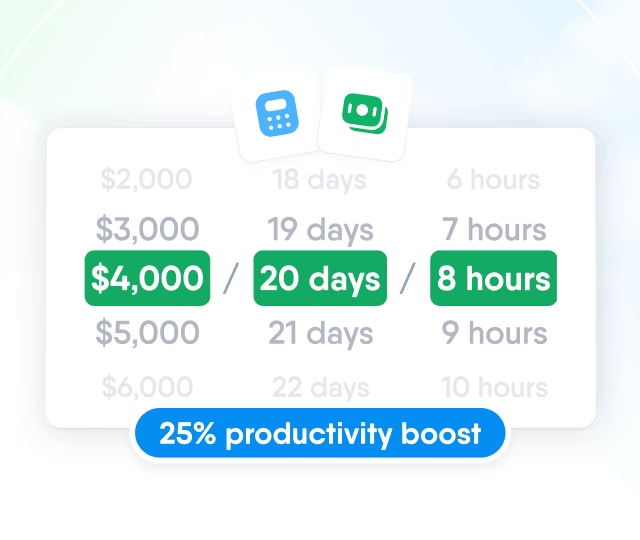
HR efficiency estimator
How does the HR efficiency estimator from PeopleForce work.
Calculate your impact



Internal communication
Internal communication is how an organization moves information among its own people: decisions downward, knowledge upward, coordination sideways. It is a function with owners and channels, not a tool.
Internal communication is how an organization moves information among the people who work in it: what is decided, what is changing, what is expected, and what is being heard back. It covers the formal apparatus (announcements, all-hands, policies, the handbook) and the deliberate routines around it (team meetings, one-on-ones, manager cascades). It is a function, not a tool, and in most companies nobody owns it until something goes badly wrong.
Two things it is not. It is not corporate communications, which faces outward to press, customers and investors. And it is not informal communication, the spontaneous exchange that happens in chats and hallways. Informal channels are faster and often more trusted; the job of internal communication is not to replace them but to make sure they are not the only place the real information lives.
Three directions, three different problems
- Downward. Decisions, strategy, policy, context. The usual failure is not that it does not happen but that it arrives without the reasoning, so people learn what changed and not why, and fill in the rest themselves.
- Upward. What the front line knows and leadership does not: which process is broken, which customer promise cannot be kept, which team is about to lose someone. This is the direction that atrophies first, because it depends on people believing the message will be received without cost.
- Lateral. Between teams that need each other. Mostly a structural question rather than a messaging one: if two functions have no shared ritual and no shared artefact, they will discover their conflicts at the deadline.
Most internal comms effort goes into the first direction and most of the value sits in the second.
Matching the message to the channel
The single most useful rule is to separate durable from disposable. Anything a person will need to look up later, a policy, a decision, a process, belongs in a place with a stable address: the handbook, the knowledge base, an announcement that stays. Anything that is a conversation belongs in chat. When decisions live in chat they are effectively unfindable within a week, and the same question gets asked every month by someone new.
The second rule is push versus pull. Push channels interrupt and should be reserved for what genuinely cannot wait or cannot be missed; pull channels wait to be consulted. A company that pushes everything trains people to ignore the channel, which means the one announcement that mattered gets skimmed alongside the office snack update.
The third is that a manager cascade is a channel, and an unreliable one unless it is supported. Handing managers a slide deck and expecting twelve consistent retellings does not work. Giving them the message, the reasoning, the likely objections and the answer to the question they will actually be asked usually does.
Why messages fail to land
Volume is the most common cause. Attention is finite, and every low-stakes broadcast spends a little of the budget for the high-stakes one. Ownerless communication is the second: if no one is accountable for whether a message arrived, it is only accountable for having been sent.
Then there are the structural gaps. Deskless and shift workers who have no company email. Employees in other countries reading a language they work in but do not think in, which makes nuance in a policy announcement disappear. And the timing gap, where a message reaches half the company on Friday afternoon and the other half on Monday, giving rumour the whole weekend to run first.
Change communication is the real test
Routine internal comms is easy to do adequately. Restructures, layoffs, acquisitions, a change in pay policy or a return-to-office decision are where the function earns its keep, because in the absence of an explanation people do not suspend judgement, they invent one, and the invented version is always worse than the true one.
What works is consistent rather than clever. Announce the decision and the reasoning together. Say plainly what is not yet decided instead of leaving silence where the answer should be, because silence reads as concealment. Compress the cascade so that nobody hears it secondhand from a colleague first. And take real questions live, since a change communicated in one direction only is a change nobody believes.
Measuring something that feels unmeasurable
Reach is the floor: who actually opened the announcement, not how many it was sent to. Above that, useful signals include whether people can restate the current priorities in their own words, how many questions arrive after a message versus how many arrive weeks later as confusion, and whether the same policy question recurs, which points at a findability problem rather than a messaging one.
The most honest instrument is a recurring survey item asking whether people feel informed about decisions that affect them, read per team rather than per company. Communication quality varies enormously between managers inside the same organization, and a company average conceals exactly the team you would want to help. Engagement scores tend to move with this item more closely than with almost anything else.
Running internal communication in PeopleForce
Company communication in PeopleForce covers the durable side. Announcements carry a title and formatted body with image, video and document attachments, can be scheduled to publish at a set time so a cascade lands everywhere at once rather than leaking across time zones, and collect reactions. Each announcement records visits, so reach is who opened it rather than who it was addressed to. Polls collect a quick read on a question without assembling a survey, and the knowledge base holds articles organized in categories with version history, which is where policies belong so that the answer to a recurring question has a stable address.
The upward direction runs through PeoplePulse. Surveys attach questions to drivers, so communication is scored as a theme rather than a single item, results break down by department, location and manager, and each survey carries an anonymity threshold: any slice backed by fewer distinct respondents than the threshold is not displayed, including free-text comments. That is what makes a small team willing to say the message did not reach them. One-on-ones in PeoplePerform carry talking points and action items, which is the part of the cascade that turns an announcement into a conversation the manager is actually accountable for.


Let us show you what's possible
From Core HR to advanced workforce analytics — see the platform saving 80 hours a month for teams just like yours. Fully tailored to your workflow.