
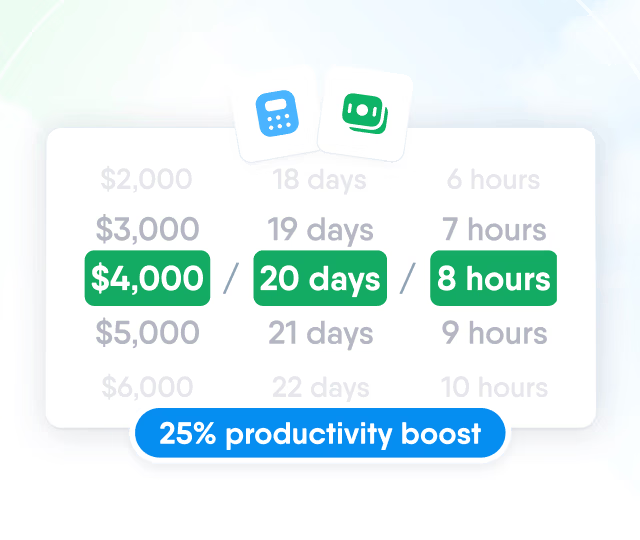
HR efficiency estimator
How does the HR efficiency estimator from PeopleForce work.
Calculate your impact



Payroll
What is payroll?
Payroll is the whole process of working out and paying what a company owes each person for a period: gross pay, deductions, taxes and contributions, the net amount that reaches the bank account, and the records that prove every figure. It does not end with the transfer. It ends when contributions are filed and each person has a payslip that explains the number.
It is one of the few HR processes judged in binary terms. A 2% error in a sales forecast is noise. A 2% error in payroll is dozens of people paid the wrong amount and the same number of difficult conversations, usually on the same morning.
Gross to net: what a payroll run actually calculates
Every run rebuilds the same chain for every person on the list.
- Contractual base pay, whether that is a salary or an hourly rate multiplied by recorded hours.
- Variable pay: commission, bonuses, shift premiums and overtime.
- Absence adjustments: unpaid leave, sick days at a statutory rate, unused or paid-out paid time off.
- Employee deductions: income tax, social contributions, garnishments, voluntary items such as pension top-ups.
- Employer costs that never appear on the payslip but hit the budget, which is why gross wages and true cost of employment are different numbers.
- Net pay, the figure the person actually cares about. The gap between gross and net is where most payroll questions come from.
The payroll cycle
A cycle has a frequency (monthly, semi-monthly, bi-weekly or weekly), a cut-off date after which data is frozen, and a pay date. The cut-off is the part people underestimate: a promotion approved two days late does not move the pay date, it moves into next month as a retroactive correction. Anyone joining or leaving mid-period is prorated, and anything that cannot wait for the next run, such as a termination payout, goes through an off-cycle run.
Who owns the data
Payroll sits on the border between HR and finance, and that border is where the errors live. HR owns the events: hires, terminations, role changes, salary changes, absences. Finance owns the calculation, the filing and the payment. Trouble starts when both sides keep their own list of who works here and what they earn, and the two lists drift apart over a few months. The fix is not more reconciliation meetings, it is one system where the event is recorded once and payroll reads from it.
In-house, outsourced, or a provider per country
Small single-country teams usually run payroll in-house. Once headcount grows or a second country appears, most companies move to a provider, because local rules on contributions, minimum wage and reporting change more often than an internal team can track. Companies hiring across borders often end up with a provider per country plus an HR outsourcing arrangement, and pay for that convenience with fragmented data. Independent contractors sit outside payroll entirely and are invoiced, which is a separate process that still has to reconcile to the same budget.
Where payroll goes wrong
- Changes reported after cut-off. The single most common cause of a correction run.
- Unrecorded absence and overtime. If time tracking and leave requests live outside the payroll input, someone is retyping them, and retyping is where digits get lost.
- Multiple currencies without a locked rate. The rate used must be the rate on the run, not whatever the spreadsheet pulled the day someone reopened it.
- No audit trail. When nobody can say who approved a run, every dispute becomes an investigation.
Payroll in PeopleForce
PeopleForce runs payroll off the same employee records that Core HR already holds, so a salary change or an approved absence reaches the run without being re-entered. A payroll cycle carries its own recurrence rule and frequency, its own currency and its own pay schedule, and can be set either to pay people or to issue invoices. Each run moves through draft, in progress, approved and completed, recording who approved it and who closed it, and a finalised run is locked against quiet edits. Run entries are assembled from base salary, additional compensations and manual adjustments, with a defined proration method for anyone who joined or left mid-period. Runs in foreign currencies pick up exchange rates that can be locked so the figures stop moving, and payroll and additional compensation reports export straight out for accounting. Hours come from Time and leave from Core HR, which removes the retyping step that causes most corrections.


Let us show you what's possible
From Core HR to advanced workforce analytics — see the platform saving 80 hours a month for teams just like yours. Fully tailored to your workflow.