
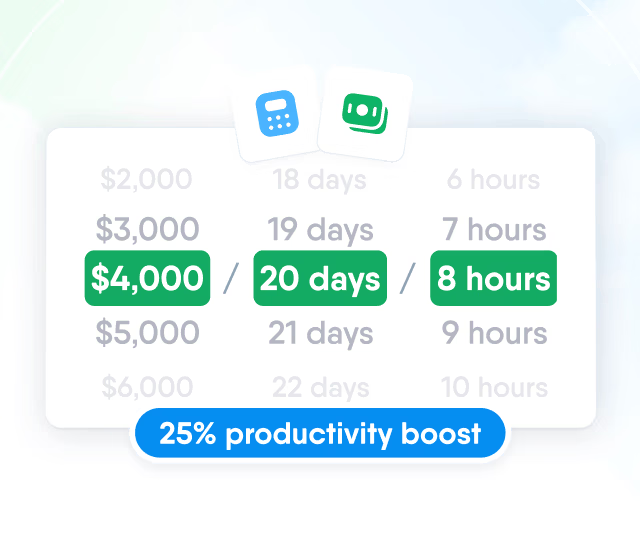
HR efficiency estimator
How does the HR efficiency estimator from PeopleForce work.
Calculate your impact



Quality management
What is quality management?
Quality management is the coordinated set of activities that keeps what a company produces consistently meeting a defined standard. It covers four things: deciding what good looks like, checking whether output matches, building processes that prevent defects rather than catch them, and improving the process once the same defect appears twice.
It belongs in an HR glossary for a simple reason. Quality is produced by people following a process, so almost every quality system that fails does so for a people reason rather than a technical one: the process was documented but nobody was trained on it, the person who spotted the defect was the one who got blamed, or the bonus scheme paid for speed while the quality policy asked for care.
The four components
- Quality planning. Defining the standard in terms someone can check, and deciding how it will be measured, before production starts.
- Quality control. Checking the output after it exists: inspection, testing, review. Necessary, but it finds defects rather than prevents them.
- Quality assurance. Building the process so the defect is unlikely in the first place: checklists, peer review, gates, competence requirements for who is allowed to do the work.
- Quality improvement. Changing the process when a defect repeats, instead of asking people to be more careful.
The frameworks people mean when they say this
ISO 9001 is the certifiable standard for a quality management system, built around documented processes, defined responsibilities and periodic audits. Total quality management is the broader philosophy that quality is everyone's job rather than a department's, which is what makes it an HR topic more than an operations one. Lean targets waste, Six Sigma targets variation, and the two are often run together as Lean Six Sigma with its belt-based training hierarchy. Kaizen is continuous small improvement driven by the people doing the work, and PDCA, the plan-do-check-act cycle, is the loop underneath most of the others. None of them works as a poster on a wall; each one is a set of habits that has to be trained, resourced and rewarded.
Why quality systems fail
- Documented but not taught. A procedure exists, the audit finds it, and nobody on the floor has read it since induction.
- Contradicted by the incentive. If performance-based pay rewards volume alone, the quality policy loses that argument every single time.
- No owner. A standard with no name attached decays quietly until an audit or a customer finds it.
- Punishing the messenger. The fastest way to stop receiving defect reports is to make the first person who files one regret it.
- Audits as theatre. When the annual audit is prepared for rather than passed, the system is measuring preparation, not quality.
The HR side of quality management
Four things sit squarely with HR. First, competence: a map of which competencies each role requires and evidence that each person holds them, kept current through upskilling rather than assumed from a hire date. Second, the standard reaching new people: onboarding that includes the quality process as a task with an owner, not a folder link in a welcome email. Third, the feedback loop: continuous feedback short enough that a defect is discussed in days rather than at the annual review. Fourth, alignment: every quality target paired with the measure it could damage, so nobody has to choose between hitting their number and doing the work properly. Underneath all four sits knowledge management, because a standard nobody can find is a standard nobody follows.
Quality management in PeopleForce
Desk holds the documented side: a knowledge base with draft, editing and published states, version history you can restore from, and visibility rules inherited from the category, so a procedure has one current version and an audit trail of what changed. Workflows turn the process into sequenced tasks with named owners and due dates, which is what makes quality steps in onboarding actually happen, and request forms give defect reports and change requests a structured route to the right approver instead of a message in a chat. In Perform, KPIs carry the quality targets alongside the volume ones so both are visible in the same place, review cycles surface competence gaps through self, manager and peer assessment, and development plans track the training that closes them. Pulse adds the early warning: teams usually report that a process is broken well before the defect rate does.


Let us show you what's possible
From Core HR to advanced workforce analytics — see the platform saving 80 hours a month for teams just like yours. Fully tailored to your workflow.