
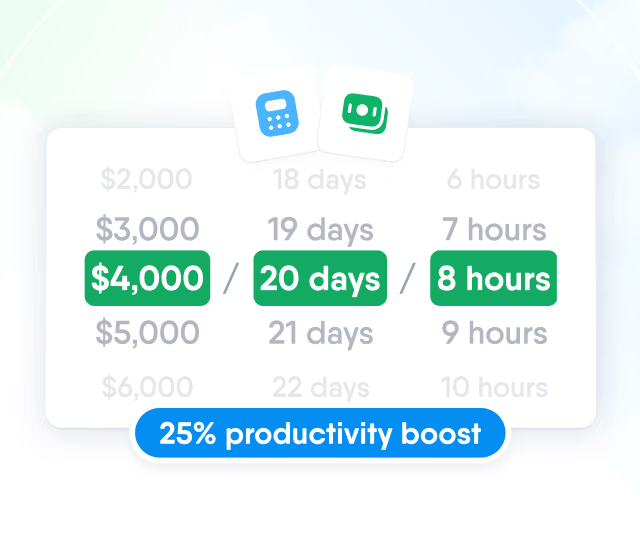
HR efficiency estimator
How does the HR efficiency estimator from PeopleForce work.
Calculate your impact



Self-evaluation
A self-evaluation is the employee's own written assessment of their performance over a review period, submitted as one input into a review cycle alongside the manager's and, often, their colleagues'.
A self-evaluation is the employee's own account of their performance over a period, written before or alongside their manager's assessment as part of a performance review. It usually covers the same questions and the same competencies the manager answers, which is what makes the two comparable.
It is often treated as a formality that has to be filled in before the meeting can be booked. That is a waste of the one document in the whole process written by the person with the most information about the work.
What it is actually for
Three things, and only the first is obvious. It surfaces work the manager did not see, which matters most for people whose contribution is distributed across other teams. It reveals the gap between how the employee and the manager read the same period, and that gap is the single most useful thing in the review: a person who rates themselves far above their manager and a person who rates themselves far below both need a conversation, and they are not the same conversation.
The third is the least discussed. Writing it forces the employee to look at a whole period at once, which is not something the working week ever asks for. That is where people notice that the project they are proudest of was not on anyone's priority list, or that their key metrics stopped describing their actual job three quarters ago.
How to write one worth reading
- Keep a record during the period, not at the end. Almost every weak self-evaluation is a memory problem: the last six weeks are vivid and the eight months before them are gone.
- Lead with outcomes, not activity. Shipped the migration two weeks early with no customer-visible downtime, rather than worked on the migration project.
- Quantify where the number exists and stop there. Inventing precision for work that is not measurable reads worse than describing it plainly.
- Answer against the actual criteria. If the form asks about a competency, give an example of behaviour, not a self-rating with no evidence attached.
- Name one real weakness with what you did about it. A stated weakness that is secretly a strength is transparent to everyone reading it and costs credibility across the whole document.
- Say what you want next. Managers are not able to read minds about scope, promotion or a change of direction, and this is the one document where raising it is expected.
The accuracy problem
Self-ratings and manager ratings correlate weakly, and the divergence is not random. Weaker performers tend to overrate themselves, because judging your own work well requires the same skill as doing it well. Strong performers, especially in cultures where modesty is expected, tend to underrate. The halo effect operates on self-assessment too: one strong quarter colours the rest of the year.
None of this makes self-evaluation useless. It makes it unsuitable as a rating input. Used as evidence and as a conversation starter it works; used as a number that gets averaged into a final score it imports every one of those biases directly into pay decisions, and it also rewards self-promotion over accuracy, which is a lesson employees only need to learn once.
Designing the form
Ask few questions and make them specific to the period. Generic prompts such as describe your strengths generate generic answers that nobody reads. Better questions have an anchor in time: what were you responsible for this period, what did you deliver, what did not go as planned and what would you do differently, what do you need from your manager.
Sequence matters as much as content. Self-evaluations submitted before the manager writes reduce anchoring, since a manager who has already read a confident self-rating is influenced by it. Whether the employee sees the manager's assessment before the meeting is a separate decision, and giving people a day to read it privately usually produces a calmer and more useful conversation than reading it out loud for the first time. Whatever the design, it should be visibly connected to continuous feedback through the year, or the whole exercise becomes an annual performance rather than a summary of one.
Self-evaluation in PeopleForce
In PeoplePerform the self-review is one reviewer type in a cycle, alongside manager, team lead, peer, upward and custom reviewers, and each type carries its own template. That means the employee can answer a different set of questions from the one their manager answers, or the same set, which is what you want when the goal is to compare the two directly. A manager can also have a private template whose answers are not shared with the employee.
The comparison is built in rather than assembled by hand. Competency questions in a cycle are tied to defined competencies with weights that total 100, and the results render as a radar chart with one series per reviewer group, so the distance between the self series and the manager or peer series is visible at a glance instead of buried in two documents. Sharing is controlled at the cycle level, either manually or automatically once the manager submits, so the sequencing decision above is a setting and not a matter of individual discipline. Cycles can also run an AI writing assistant that checks draft answers against a chosen feedback framework, which mostly catches the same two things in self-reviews: claims with no example, and vagueness where a specific number was available.


Let us show you what's possible
From Core HR to advanced workforce analytics — see the platform saving 80 hours a month for teams just like yours. Fully tailored to your workflow.