
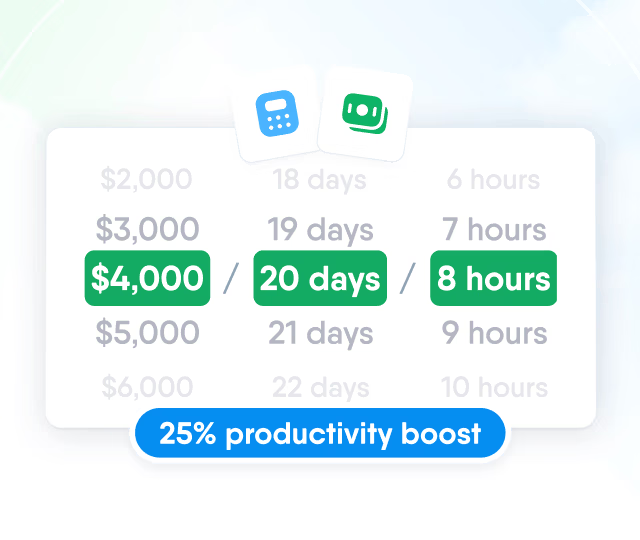
HR efficiency estimator
How does the HR efficiency estimator from PeopleForce work.
Calculate your impact



Employee motivation
Employee motivation is the state that makes someone start a task, invest effort and persist. It comes from the conditions around the work rather than from personality, which is what makes it manageable.
Employee motivation is what makes someone start a task, put effort into it and keep going when it stops being interesting. It is not a personality trait and not a mood. It is a state produced by the interaction between a person and the conditions they work in, which is the reason the same employee can be relentless on one project and hard to reach on the next.
That framing matters because it moves the question. "How do we motivate people" usually produces a list of incentives. "What in this job is draining motivation" usually produces the answer.
Intrinsic and extrinsic
Extrinsic motivation comes from outside the task: pay, bonuses, deadlines, recognition, the risk of looking bad. Intrinsic motivation comes from the task itself: interest, mastery, the sense that the work matters. Both are real and both are useful, but they behave differently and fail differently.
Extrinsic motivation is reliable for work that is routine, measurable and unambiguous. It works badly for work that requires judgement, creativity or collaboration, because it narrows attention onto whatever is being measured. Intrinsic motivation is what sustains effort when nobody is watching and when the payoff is months away, which describes most knowledge work.
The interaction is the part people miss. Paying someone for something they already enjoy can reduce their interest in it once the payment becomes the reason. Not paying people fairly, however, reliably destroys motivation regardless of how interesting the work is: money rarely creates motivation, but a sense of unfair pay removes it.
Three conditions that do most of the work
- Autonomy. Some real control over how the work gets done, and preferably over what gets prioritised. Autonomy is not the absence of direction; it is direction about outcomes rather than about keystrokes.
- Competence. Tasks at the edge of current ability, with feedback that shows progress. Work that is far too easy and work that is impossible both kill effort, and both are common.
- Relatedness. A sense of working with people who notice and depend on the output. The single fastest way to demotivate someone is to have their work disappear without comment.
These three come from self-determination theory, and they are more useful than most motivational frameworks because each one maps to something a manager can change this quarter: how a task is assigned, how difficulty is calibrated, whether the result is ever acknowledged.
When bonuses help and when they backfire
Performance-based pay is a tool with a narrow range. It works when output is individually attributable, when quality is easy to verify and when the target cannot be hit by gaming it. Sales quotas and production volumes fit. Almost nothing in product, engineering, support or HR fits cleanly, which is why variable pay in those functions tends to end up as an expensive thirteenth salary that nobody experiences as motivating.
The predictable failure modes are worth naming. A target that measures one dimension of a multidimensional job moves effort onto that dimension and away from the rest. A bonus that becomes routine is felt as base pay and its removal is felt as a cut. And an individual bonus in genuinely collaborative work buys competition between people who need to help each other.
Recognition avoids most of these problems because it is specific, immediate and not zero-sum. Recognition that names what was done and why it mattered outperforms generic praise by a wide margin, and generic praise outperforms silence.
Diagnose before you intervene
Low output looks the same from the outside whatever causes it, and motivation is the least common cause. Before treating it as a motivation problem, rule out three cheaper explanations. Clarity: does the person know what good looks like and by when. Capability: do they have the skill, the access, the tool, the decision rights. Obstacles: is something in the process eating the time, an approval queue, an unreliable dependency, a meeting load that leaves no continuous hours.
If all three are clear and effort is still low, the motivation question is a real one, and it is usually about one of the three conditions above rather than about money. The useful version of the conversation is specific: what part of this work is worth doing, what part feels pointless, and what would have to change.
What it looks like in the data
Motivation has no direct metric, so it is read from patterns. Goal completion that drops while goal setting continues. Check-ins that stop being updated. A widening gap between hours worked and results delivered. Requests for development or new responsibility that go quiet. Rising turnover among strong performers while weak performers stay, which is the clearest signal of all, since motivated people with options leave first.
Read these at team level, not individual level. One person disengaging is a conversation. A whole team's check-ins going stale in the same month is a management or workload problem, and no incentive scheme will fix it.
Supporting motivation in PeopleForce
The practical work is making effort visible and connecting it to something. In PeoplePerform, objectives hold their own key results, each with regular check-ins that record progress and a short comment on what moved, so the sense of visible advance that competence depends on exists as a record rather than as a feeling. Objectives can be tagged and aligned upward, which is how an individual goal stops being an isolated task and becomes a contribution someone can point at. Separately, KPIs carry targets and recorded results for roles where the number genuinely is the job.
Feedback in PeoplePerform can be requested or given unprompted, with visibility set per item to the employee, the manager or both, which matters because developmental feedback and feedback the manager will act on are different conversations. Recognition runs on custom badges the company defines and awards, so praise is attached to something named rather than left to whoever happens to speak up. Recurring one-on-ones carry talking points and action items with due dates, so a motivation conversation ends with a change rather than with sympathy, and review cycles collect self, manager, peer and upward input, which is often where a demotivated team first says out loud what the problem is. HR analytics then lines goal progress up against turnover per team.


Let us show you what's possible
From Core HR to advanced workforce analytics — see the platform saving 80 hours a month for teams just like yours. Fully tailored to your workflow.