
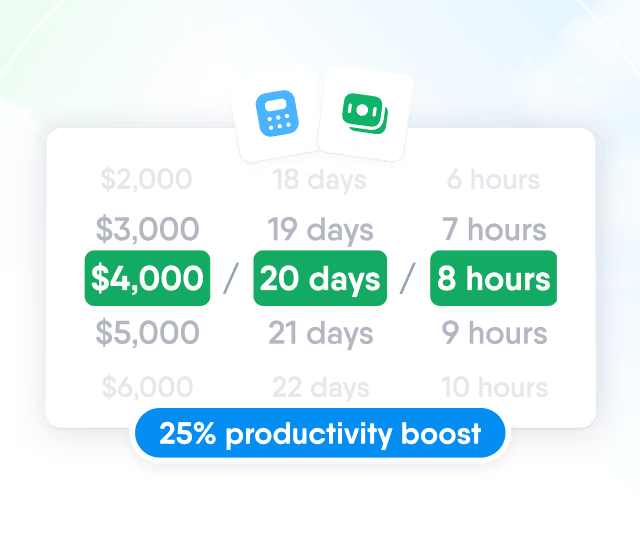
HR efficiency estimator
How does the HR efficiency estimator from PeopleForce work.
Calculate your impact



Hiring process
How does the hiring process work?
What is the hiring process?
The hiring process is the series of steps a company follows from deciding it needs someone to that person's first day at work. It covers defining the role, recruitment and selection, the job offer, the contract and the legal checks before the start date.
Recruitment and hiring are often used interchangeably. Recruitment is about attracting and assessing candidates; hiring adds what comes after the decision: the offer, the paperwork and the start, which then leads into onboarding.
Hiring process steps
- Identify the need and approve the role. The manager requests the position, HR checks budget and level, leadership approves.
- Define the role. A job analysis produces the job description: duties, must-have and nice-to-have requirements, pay range.
- Advertise and source. Post on your careers site and job boards, and source passive candidates in parallel.
- Screen applications. Review resumes and screening answers and build a shortlist.
- Interview and assess. An HR screen, a structured interview with the hiring manager and, if relevant, a skills test or case study.
- Check references with previous managers, with the candidate's consent.
- Make the offer. Salary, benefits, work arrangement, start date and probation, in writing.
- Complete pre-employment checks and paperwork. Right-to-work verification, contract signature, payroll and tax setup.
- Prepare the first day. Equipment, accounts, a plan for the first weeks and a buddy.
How long does the hiring process take?
It depends on the role. Many entry-level roles are filled in two to four weeks, while senior or technical roles can take two months or more. Track two numbers by role type: time to hire, from when a candidate enters the process to when they accept the offer, and time to fill, from job approval to the accepted offer. Then look at which step causes the delay.
Legal checks in the US and UK
Country | Key requirement |
|---|---|
United States | Form I-9 to verify identity and work authorization, completed by the third business day after the start date. Some states also restrict salary history questions or require pay ranges in job ads. |
United Kingdom | A right to work check before employment starts, and a written statement of employment particulars on or before the first day. |
Common hiring process mistakes
- Advertising before the role is approved, then finding out there is no budget.
- Too many interview rounds, so the best candidates accept another offer first.
- No feedback for candidates who do not move forward.
- Making a verbal offer without confirming terms in writing.
- Leaving paperwork until the first day.
How PeopleForce helps
In Recruit, managers raise a vacancy request with the title, department, seniority, salary and number of openings, and it goes through approval before it is published. You then post the job to your careers site and job boards, move candidates through pipeline stages, schedule interviews synced with Google Calendar or Microsoft Outlook and collect scorecards from every interviewer. Offer management lets you prepare and approve the offer, and in Core HR you sign documents with e-signature and launch onboarding tasks.
FAQ
What are the steps of the hiring process?
Role approval, role definition, advertising and sourcing, screening, interviews and assessments, reference checks, the offer, pre-employment paperwork and preparing the first day.
What is the difference between recruitment and hiring?
Recruitment is attracting and assessing candidates. Hiring includes that and adds the offer, the contract, the legal checks and the start.
What happens after the final interview?
The hiring team compares scorecards, checks references for the preferred candidate and, if everything is confirmed, makes a written offer. The others should hear back too, ideally within a few days.


Let us show you what's possible
From Core HR to advanced workforce analytics — see the platform saving 80 hours a month for teams just like yours. Fully tailored to your workflow.