
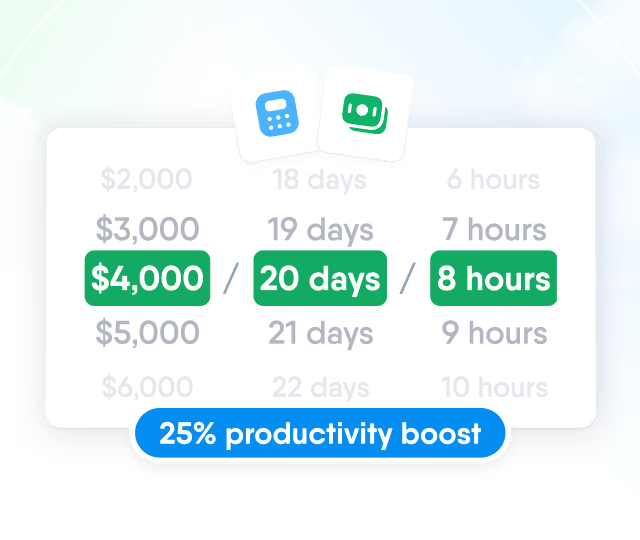
HR efficiency estimator
How does the HR efficiency estimator from PeopleForce work.
Calculate your impact



Job satisfaction
Job satisfaction is how positively an employee evaluates their job overall and in its parts — the work, pay, manager, conditions and prospects. It predicts retention and effort, and it only exists as a measurement.
Job satisfaction is how positively a person evaluates their own job. It is an attitude, not a mood: the accumulated judgement someone has formed about the work itself, the pay, the manager, the colleagues, the conditions and the prospects. That judgement is fairly stable, which is why it predicts behaviour — who stays, who puts in effort beyond the job description, who calls in sick on a Monday — better than any single day's mood does.
It is measured, not observed. Nobody can tell from the outside whether a quiet, productive employee is satisfied or simply has no alternative, and this is the mistake behind most confident statements about how happy a team is.
Global and facet satisfaction
The distinction that makes the concept usable at work is between global satisfaction (how do you feel about your job overall) and facet satisfaction (how do you feel about your pay, your manager, your workload, your career prospects). Global scores are easy to collect and almost impossible to act on. Facet scores tell you where the problem is.
The two also come apart in useful ways. Someone can rate their pay poorly and their job highly because the work matters to them, and someone can rate every facet as acceptable while their overall score drifts downward because the job no longer leads anywhere. When a global score falls and no facet moves, the missing facet is usually growth or meaning.
What actually drives it
- The work itself. Variety, a visible finish, some autonomy over how it is done. The single most consistent finding across decades of research, and the one employers most often try to substitute for.
- The direct manager. Fairness, clarity, whether commitments are kept. Most team-level differences in satisfaction inside the same company trace back here.
- Fairness of pay rather than level of pay. Pay predicts satisfaction weakly in absolute terms and strongly in comparative terms. A raise that is smaller than a peer's damages satisfaction more than no raise at all, which is why pay transparency tends to move this facet more than pay increases do.
- Workload and control. High demands are tolerable where control is high; high demands with low control is the classic strain combination that ends in burnout.
- Relationships. Colleagues are the most common reason people give for staying in a job they otherwise rate badly.
- Prospects. A visible career path, even an unhurried one. Its absence is what turns a satisfied third year into a resignation in the fourth.
Herzberg's old distinction still earns its place here: fixing bad conditions, unfair pay or a difficult manager removes dissatisfaction, but it does not create satisfaction. That comes from the work, the responsibility and the recognition. Which is why a company can eliminate every complaint and still have a flat, indifferent team.
Satisfaction, engagement and motivation are three different things
Satisfaction is an evaluation of the job. Engagement is energy directed at the work and the company's goals. Motivation is what makes someone start and persist at a specific task. They correlate, but not tightly enough to be treated as one number.
The practically important case is the satisfied, unengaged employee: comfortable, well paid, fond of the team, contributing the minimum, in no hurry to leave. Satisfaction surveys score them well. They are also the population that quiet quitting describes. The reverse case matters too: a highly engaged person can be deeply dissatisfied with pay or a manager, and they usually leave faster than the indifferent ones, because they have options.
How to measure it
Validated instruments exist and are worth borrowing from rather than inventing questions. The Job Satisfaction Survey and the Minnesota Satisfaction Questionnaire both break the construct into facets; the Job Descriptive Index covers five classic ones (work, pay, promotion, supervision, coworkers). Single-item global measures work better than their simplicity suggests and are useful when survey fatigue is the binding constraint.
Cadence matters more than instrument. An annual survey tells you about a year you can no longer influence; a short recurring pulse with the same items lets you see a facet moving and attribute it to something. eNPS is a useful companion metric but not a substitute, since it asks about recommending the employer rather than about the job.
Two rules keep the data honest. Guarantee anonymity in a way people can verify, or small teams will tell you what they think you want to hear. And publish what changed as a result of the last round, because the fastest way to destroy a response rate is to collect answers twice and act on neither.
Turning scores into changes
Compare facets across teams rather than against an industry benchmark: the same company, the same pay bands and the same policies, with one team scoring differently, points at something local and fixable. Read the free-text comments before the numbers, since they usually name the cause the scales only measure. Give each weak facet an owner and a date, and keep the list short enough that it gets done. Then measure again on the same items, because a facet that recovers tells you the intervention worked and a facet that does not tells you the diagnosis was wrong.
Measuring job satisfaction in PeopleForce
PeoplePulse is built around exactly this facet logic. Questions are attached to drivers, so pay, workload, manager and development are scored as themes rather than as isolated items, and the driver view is where a falling score becomes a diagnosis instead of a worry. Surveys are assembled from templates or written from scratch with rating scales, including custom scales, plus an eNPS question and free-text comments on any item.
Anonymity is enforced rather than promised. Each survey carries an anonymity threshold, and any slice of the results with fewer distinct respondents behind it than that threshold is simply not displayed, including individual comments and heatmap rows. Results come with a response rate and completion tracking, and can be broken down by department, location and manager to find the local difference that a company-wide average hides. Recurring one-on-ones in PeoplePerform carry talking points and action items, so the follow-up to a weak driver is a commitment with an owner rather than a plan that dissolves after the meeting, and HR analytics lines survey results up against turnover and absence per team.


Let us show you what's possible
From Core HR to advanced workforce analytics — see the platform saving 80 hours a month for teams just like yours. Fully tailored to your workflow.