
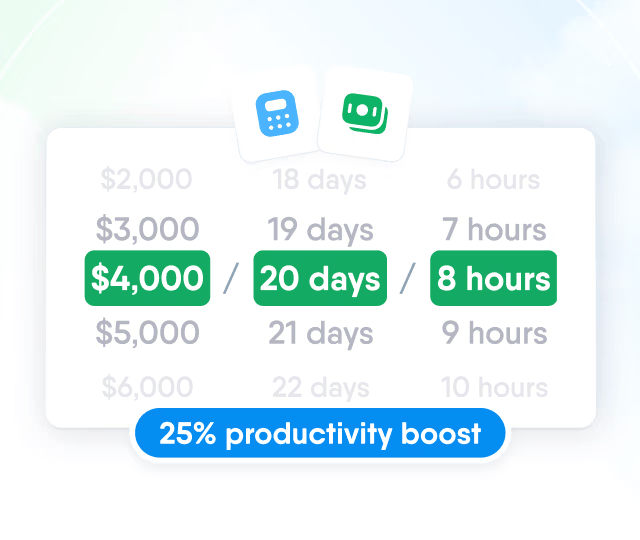
HR efficiency estimator
How does the HR efficiency estimator from PeopleForce work.
Calculate your impact



Knowledge management
What is knowledge management?
Knowledge management is the practice of capturing what a company knows, keeping it somewhere people can actually find it, and making sure it stays true. It covers policies, process descriptions, how-to guides, decision records and the informal know-how that usually lives in the heads of three or four people.
The test is blunt: when someone resigns, goes on leave or moves to another team, how much of what they knew is still usable by everyone else? If the answer is whatever they happened to write in chat, the company has no knowledge management, only luck.
Explicit and tacit knowledge
Two kinds of knowledge behave very differently, and confusing them is why most initiatives stall.
- Explicit knowledge is already written down or easy to write down: policies, templates, instructions, the employee handbook, system documentation. Managing it is mainly a storage and findability problem.
- Tacit knowledge is judgement built through experience: which client tolerates a delay, why a rule exists, what quietly breaks when you change a setting. It resists documentation and moves through mentoring, job shadowing and working side by side.
Companies tend to over-invest in the first and ignore the second, then discover the gap the week a senior specialist hands in notice.
What a company knowledge base holds
- Joining material: what a new hire reads during preboarding and through the onboarding process, including tools, accesses and who to ask about what.
- HR policies people look up rather than read once: leave rules, the attendance policy, expenses, benefits, the absenteeism policy.
- Process instructions: how requests are raised and approved, how HR workflows run, what happens during offboarding.
- Templates and reference documents, which is where knowledge management meets HR document management.
- Product, client and domain knowledge owned by the teams themselves.
- Decision records: what was decided, when, and the reasoning, so the same argument is not reopened every quarter.
Ownership is the whole game
Every article needs a named owner and a review date. A page with no owner is a page that will be wrong within a year and will quietly teach people to stop trusting the whole library. HR owns the HR space, each team owns its own, and internal communication carries the changes so that an update to a policy reaches people instead of sitting in a page nobody revisits.
How to start without launching a six-month project
- Log the questions HR and team leads answer repeatedly for two weeks. That list is your first table of contents, ranked by real demand.
- Write the ten most frequent answers as short articles. One question per article, answer in the first two sentences.
- Agree one home for them. Two competing locations produce two versions of the truth and destroy trust faster than having nothing.
- Assign owners and review dates before publishing, not afterwards.
- Redirect repeat questions to the article instead of answering again, and fix the article whenever the question was asked because the article was unclear.
- Cover tacit knowledge separately through shadowing, recorded walkthroughs and deliberate reverse mentoring in both directions.
How to tell it is working
Article count proves nothing. Useful signals: the share of repeat questions that now get answered by a link, how quickly new hires reach full productivity, the percentage of articles reviewed in the last twelve months, and whether a training needs analysis keeps surfacing gaps that documentation could have closed. A library where half the pages have not been touched in two years is not an asset, it is a liability with a search box.
Knowledge management in PeopleForce
The knowledge base in Desk is built from categories and articles written in a block editor that handles headings, lists, tables, images, video, file attachments, callouts and code blocks. Each article moves through draft, editing and published states, keeps a version history that can be restored, and is searchable across the whole base. Access is set by audience rules: an article is visible to everyone by default, or narrowed to a department, location or another attribute, and the rules set on a category are inherited by the articles inside it. Separate permissions split those who read from those who edit and those who manage the entire base.
Around it, Core HR stores the documents and employee data that articles refer to, onboarding checklists point new hires at the right articles on day one, and requests coming into Desk show exactly which questions keep repeating, which is the most honest backlog a knowledge base can have.


Let us show you what's possible
From Core HR to advanced workforce analytics — see the platform saving 80 hours a month for teams just like yours. Fully tailored to your workflow.