
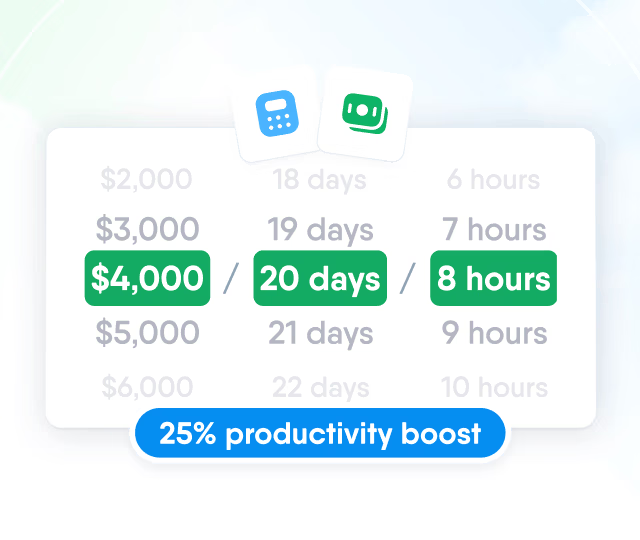
HR efficiency estimator
How does the HR efficiency estimator from PeopleForce work.
Calculate your impact



Resignation
A resignation is the ending of employment at the employee's initiative, effective on their declaration rather than the employer's acceptance.
A resignation is the ending of employment at the employee's initiative. It is a unilateral act: it takes effect because the employee declared it, not because the employer accepted it, which is why the polite phrase about a resignation being accepted is misleading in most legal systems. Once it has been received, withdrawing it usually needs the employer's agreement.
That asymmetry matters in both directions. An employee cannot be talked out of a notice period they are legally entitled to serve, and an employer cannot treat a resignation given in anger as void simply because it would prefer to. What both sides can do is agree a different end date, and that agreement should be written down.
Notice periods and form
Ukraine keeps it simple: an employee on an open-ended contract gives two weeks' written notice, and in a defined set of circumstances, including an employer breach of labour law, they can leave in the period they ask for. Poland applies the same tiered scale as for employer notice, at two weeks, one month or three months depending on length of service with that employer. Argentina works on fifteen days during the probationary period and one month afterwards for the employee.
Form is where companies get caught out, because a Slack message is not everywhere a resignation. Argentina is the strictest: a resignation has to be given by telegrama colacionado or before the labour authority, and a plain letter handed to a manager can be challenged later. Poland and Ukraine expect a written statement. The practical rule is that whatever channel someone uses, you ask for it in the required form and you acknowledge receipt in writing on the same day.
The first forty-eight hours
- Acknowledge in writing and confirm the last working day. Ambiguity about the date is the single most common source of a dispute over final pay.
- Ask the reason, without pressing. What you get in this conversation is usually more honest than what you get in a formal exit interview three weeks later.
- Start the handover while there is time. Named owners for each responsibility, not a document nobody reads.
- Decide the communication. Who tells the team, who tells clients, and when. Silence gets filled.
- Calculate final pay and accrued leave. Including whether unused leave is taken or paid out.
- Book the exit interview for later in the notice period. Not on the last day, when everyone has stopped caring.
Counteroffers
The instinct to counteroffer is strong and the track record is poor. Money is rarely the whole reason someone left, so a raise fixes the stated problem and leaves the real one, which is usually the manager, the scope of the role or the absence of a next step. The person who accepts often leaves anyway within the year, and the raise has meanwhile told everyone else that resigning is the fastest route to a pay review.
There are exceptions, and they are worth naming honestly: a genuinely underpaid person whose market rate has moved, or a role the company was already planning to change. In those cases the fix is real and the counteroffer is just the moment it surfaced. Everywhere else, the better use of the conversation is to learn why, so the next person does not leave for the same reason.
Not every resignation is voluntary
A resignation written under pressure is still a resignation on paper and often something else in law. Poland lets an employee terminate without notice where the employer has committed a serious breach of its basic obligations, with compensation attached. Ukraine allows an employee to leave in the period they specify where the employer has violated labour law, with severance payable. Argentina calls it despido indirecto and requires the employee to put the employer on notice first, so a formal demand letter that goes unanswered is a warning sign, not paperwork.
The management version of this is the quiet resign-or-be-fired conversation. It feels cleaner than a dismissal and it is not: it converts a defensible involuntary termination with a documented reason into a resignation the company cannot explain, and it leaves the person with a claim. If the decision is the company's, the exit should say so.
Leavers are not lost
A well-handled resignation is a recruiting asset. Rehires ramp faster, cost less to source and arrive already knowing the product, and people who left on good terms refer candidates for years. The last two weeks decide which version you get, and they are the cheapest two weeks of employer branding available to you.
The practical version is a rehire decision made at the time, while the manager still remembers, rather than a question someone tries to reconstruct three years later from an empty field.
Handling a resignation in PeopleForce
The termination is recorded against the same controlled lists as any other exit, so a resignation is filed under its own type and reason rather than as an unexplained departure, and shows up separately in the Termination breakdown report. The last working day and the last day in the office are separate fields, which is what you need when someone takes their remaining leave at the end of a notice period. Direct reports can be reassigned to a named manager from the termination date, and the form will not let you attach an offboarding workflow to someone with no manager set.
Offboarding runs from that date. The workflow carries the handover tasks, the equipment return, the access checklist and the exit interview, each with an owner and a due date, and it keeps running even when you cancel the person's other in-flight tasks. On the effective date the account is deactivated, access and integration tokens are revoked, and the Google Workspace user is removed where that provisioning is enabled.
Two things specific to voluntary exits. Marking the person eligible for rehire creates an applicant record in PeopleRecruit automatically, carrying name, personal email, position and contact details across, so the alumni pool builds itself instead of living in a spreadsheet. And in accounts running the Kadry compliance module, the termination process can generate a different application document depending on the termination type, so an employee-initiated resignation and an employer-initiated dismissal produce correctly worded paperwork from the same process.


Let us show you what's possible
From Core HR to advanced workforce analytics — see the platform saving 80 hours a month for teams just like yours. Fully tailored to your workflow.