
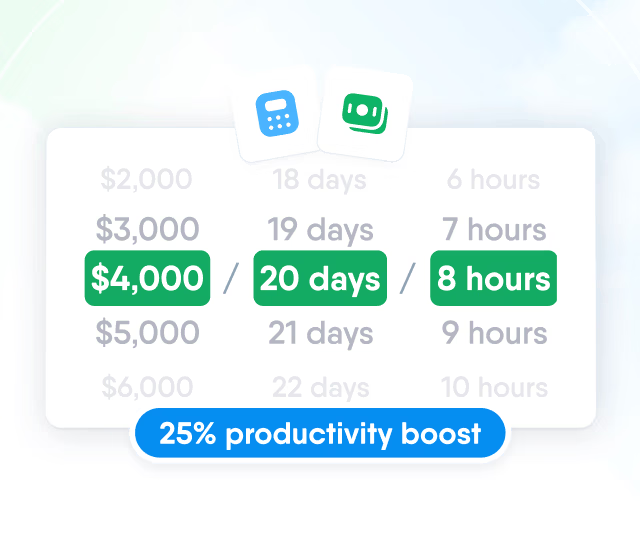
HR efficiency estimator
How does the HR efficiency estimator from PeopleForce work.
Calculate your impact



Retention bonus
A retention bonus is a one-time payment an employer promises to an employee for staying with the company through a specific date or milestone, typically used during mergers, critical projects, restructurings, or when a key person is at risk of leaving.
What is a retention bonus?
A retention bonus is a one-time payment, or a series of payments, that an employer offers an employee in exchange for staying with the company through a specified date or milestone. It is not tied to performance targets like incentive pay, and it does not raise base salary like a merit increase. The only condition is continued employment for the agreed period.
Companies use retention bonuses when losing a specific person at a specific time would be unusually costly: during a merger or acquisition, a system migration, a product launch, a restructuring, or when a key employee has a competing offer in hand. The bonus buys certainty for a defined window. It is a tactical tool, not a substitute for a competitive salary or a good retention strategy.
How retention bonuses work
A retention agreement typically specifies four things: the amount, the retention period or milestone, the payment schedule, and the conditions under which the bonus is forfeited or repaid.
- Amount. Usually 10 to 25 percent of annual base salary for mid-level employees and up to 50 percent or more for executives or people who are critical to a deal. A common rule of thumb is that the bonus should be large enough that a competing offer would need to exceed it by a meaningful margin.
- Period. Six to twenty-four months is typical. Very short periods do not change behavior; very long periods lose motivational force because the payout feels distant.
- Schedule. A lump sum at the end of the period is simplest and most effective for retention. Installments (for example, 50 percent at six months, 50 percent at twelve) reduce the risk of the employee leaving the day after payment but weaken the incentive to stay through the full term.
- Forfeiture and clawback. The employee forfeits unpaid installments if they resign or are dismissed for cause before the end date. Some agreements also require repayment of amounts already paid, prorated for the unserved period. Clawbacks are legally sensitive and must be drafted carefully.
Most agreements also state that the bonus is discretionary and one-off, does not form part of regular pay for the purpose of overtime, holiday pay, or severance calculations where the law permits, and does not create an expectation of future payments.
When to use a retention bonus
- Mergers and acquisitions. The classic case. Key staff at the acquired company are offered bonuses to stay through integration, because the deal's value depends on their knowledge.
- Critical projects. A migration, an audit, a regulatory filing, or a product launch where losing the lead engineer or project manager mid-way would cost far more than the bonus.
- Restructuring and wind-downs. When a site or function is closing, employees know their jobs will end. A retention bonus keeps them until the last day instead of the first offer they receive.
- Counteroffers. When a valued employee has an external offer and a salary match is not possible or not appropriate, a time-bound bonus can bridge the gap.
- Scarce skills. In hot markets, some companies use retention bonuses proactively for roles where replacement time exceeds six months.
Advantages and drawbacks
Advantages. A retention bonus is fast to implement, targeted at the people who matter, temporary (it does not raise fixed cost the way a salary increase does), and highly effective for short, well-defined windows. It also signals to the employee that the company sees them as critical.
Drawbacks. It does not fix the reason the employee was considering leaving; when the period ends, the problem returns, often with the employee now holding a lump sum that makes a move easier. It can create resentment among colleagues who were not offered one, especially if the criteria are opaque. Employees may stay physically while disengaging mentally, doing the minimum until the payout. And repeated use teaches the workforce that threatening to leave is the way to get paid more, which undermines pay equity.
Retention bonus vs. sign-on bonus vs. stay interview
A sign-on bonus is paid at hiring to close the deal with a new employee; a retention bonus is paid to an existing employee to keep them. Both are one-off and both often carry repayment clauses, but they solve opposite problems.
A stay interview is a conversation, not a payment: a structured discussion with a valued employee about what keeps them and what might make them leave. It is cheaper than a bonus and addresses root causes, which is why many HR teams use a stay interview first and a retention bonus only when the answer is a specific, time-limited risk that money can bridge.
How to structure a retention bonus program
- Define the risk. Which departures during which window would cause real damage? Name the roles, the dates, and the estimated cost of losing them.
- Select recipients with written criteria. Criticality to the project, difficulty of replacement, and flight risk. Written criteria make later conversations with colleagues defensible.
- Size the bonus to the risk, not to the person's negotiating position. Use a percentage of base salary tied to criticality tier.
- Choose the schedule. Lump sum at the end for maximum retention effect; installments if cash flow or partial milestones require.
- Draft the agreement. Amount, period, schedule, forfeiture, treatment of termination without cause (usually paid in full), tax treatment, and confidentiality. Have it reviewed under local employment law.
- Pair it with the conversation. Explain why the person is critical and what happens after the period. Without this, the bonus reads as a transaction and does nothing for engagement.
- Plan for the end date. Decide in advance whether the role will be re-benchmarked, promoted, or transitioned when the period closes, so the payout is not simply followed by a resignation.
Managing retention bonuses in an HRIS
Retention agreements are easy to lose track of: a dozen different end dates, some with installments, some with clawbacks, all agreed in email threads. In PeopleForce Core HR, a retention bonus is recorded on the employee's profile as a one-off additional compensation component with its own compensation type, amount, currency, and payment date, so it sits next to base salary history without being mixed into it. The signed retention agreement can be generated from a document template and stored on the same profile with an electronic signature, and access to both is limited by role. If the employee leaves before the end date, the termination form captures the reason and date, which is what HR needs to determine forfeiture. HR analytics then shows whether the people who received retention bonuses actually stayed, and how their turnover compares with peers who did not, which is the only real test of whether the program worked.
Frequently asked questions
Is a retention bonus taxable?
Yes. In virtually every jurisdiction it is treated as employment income and taxed like salary. Whether it counts toward holiday pay, overtime base, or severance depends on local law and how the agreement is drafted.
What happens if the employee is laid off before the end date?
Most agreements pay the bonus in full if the employer ends employment without cause, since the employee did not choose to leave. Dismissal for misconduct usually forfeits it.
Can a retention bonus be paid in stock instead of cash?
Yes. Restricted stock units with a cliff vest at the retention date are a common alternative in listed companies and startups, and they align the employee with company value over the period.
How is a retention bonus different from a bonus for good performance?
A performance bonus is earned by hitting a target; a retention bonus is earned by staying. An employee can receive a retention bonus while performing averagely, and can miss a performance bonus while staying for years.


Let us show you what's possible
From Core HR to advanced workforce analytics — see the platform saving 80 hours a month for teams just like yours. Fully tailored to your workflow.