
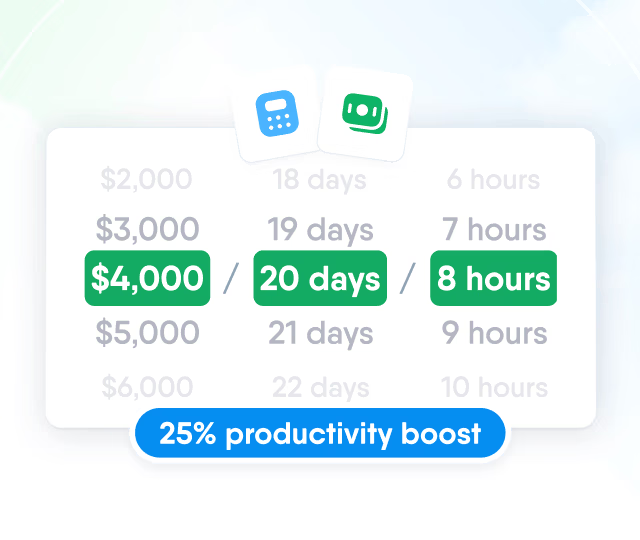
HR efficiency estimator
How does the HR efficiency estimator from PeopleForce work.
Calculate your impact



Shift scheduling
Shift scheduling is the process of assigning employees to specific working hours so that every shift has the right number of qualified people, within legal limits on hours and rest.
Shift scheduling is the process of deciding who works when: matching the hours a business needs covered with the people available to cover them, then publishing the result as a roster. It sits between workforce planning, which answers how many people the operation needs over months, and time tracking, which records what actually happened.
A schedule is good when three things hold at once: every slot has the right number of qualified people, every person has a legal and humane pattern of work and rest, and the plan survives the first sick call of the week.
How the process works
- Forecast demand. Start from what drives workload: patient numbers, footfall, ticket volume, production plan, delivery slots. Use last year's data for the same week rather than a flat average.
- Translate demand into coverage. Convert the forecast into required headcount per hour and per skill. A shift needing a licensed nurse or a certified forklift driver is not filled by a warm body.
- Check availability. Pull in approved leave, training, medical restrictions, contracted hours and declared availability before drafting anything.
- Build and check the roster. Apply the hard rules: rest between shifts, maximum weekly hours averaged over the reference period, night work limits, no two shifts in a row.
- Publish early. The single change that improves retention most in shift environments is giving people their schedule further in advance.
- Manage changes. Define how swaps are requested and approved, who covers absence, and when a change becomes overtime rather than a rearrangement.
Rules that constrain the roster
Scheduling is where working-time law becomes concrete, so the constraints belong in the tool rather than in someone's memory. The EU directive on transparent and predictable working conditions requires that employees with variable schedules be told their reference hours and days and be given reasonable advance notice of assignments, with the right to refuse work outside those hours without penalty. Several US cities and states have fair workweek laws requiring 10 to 14 days' notice and predictability pay when the employer changes a posted shift. In Poland, the roster covers a period of at least a month and must reach employees at least a week before it starts. In Ukraine, the shift roster is agreed with employee representatives and communicated in advance, two shifts in a row are prohibited, and rest between shifts must be at least double the shift worked. In Argentina, rotating team schedules are averaged over a three-week cycle rather than judged day by day.
Beyond the law, watch equity: who consistently gets the unpopular nights and weekends, and who never does. Rotate the burden and record the rule in the employee handbook so it is not a matter of who asks loudest.
Metrics worth tracking
Four numbers tell you whether the schedule works. Coverage gaps: hours where planned staff fell below required staff. Overtime share: how much of total hours came from overtime, which is the clearest sign a roster is being used to patch an understaffed rota. Schedule change rate: how many published shifts were altered after publication, the number employees feel most. Unplanned absence: last-minute call-offs, which tend to rise where notice is short and fall where people can plan.
Treat them together. Cutting planned hours to save cost usually pushes overtime, absence and turnover up by more than the saving.
Scheduling data in PeopleForce
PeopleForce holds the inputs a roster is built from. Working patterns define the hours, breaks and start time for every day of the week and are assigned per employee, so contracted hours and the baseline pattern of each person are in one place rather than in a spreadsheet. Approved absences from leave tracking appear in a shared calendar with public holidays per location, which is where most coverage gaps are spotted, and employees request swaps or extra cover through request forms with a defined approval route instead of chat messages.
Once the shifts are worked, PeopleTime records clock-ins, breaks and overtime against the assigned pattern, flags entries that overlap or exceed the expected duration, and separates night, weekend and holiday hours through special hour types and overtime types with their own multipliers and payroll codes. The result is a timesheet that shows the gap between the plan and reality, and HR analytics that shows which teams keep closing that gap with overtime.


Let us show you what's possible
From Core HR to advanced workforce analytics — see the platform saving 80 hours a month for teams just like yours. Fully tailored to your workflow.