
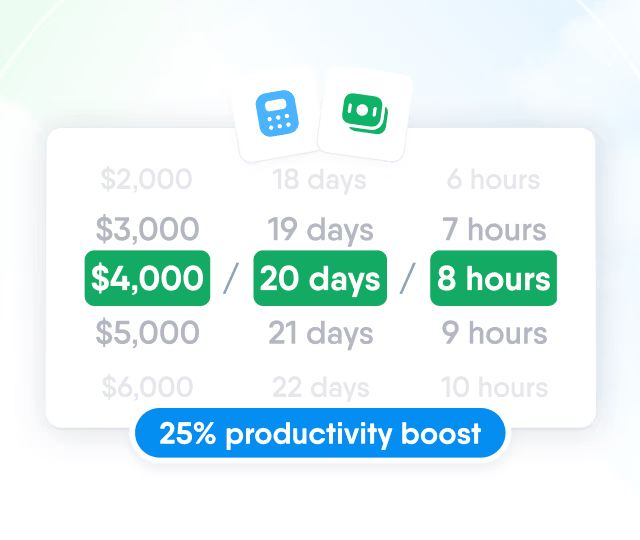
HR efficiency estimator
How does the HR efficiency estimator from PeopleForce work.
Calculate your impact



Timesheet
What a timesheet is, what it contains and how to manage timesheets in HR
A timesheet is a record of the hours an employee has worked over a set period, usually a day, a week or a month, broken down by day and often by project, task or client. It is the document that turns working time into payroll data, billing data and workforce statistics, which is why it sits at the center of time tracking in most companies.
Timesheets started as paper forms and punch cards. Today they are digital: employees log time in an HR system, start a timer, or clock in and out, and the timesheet is assembled automatically. The purpose has not changed. A manager or HR still needs a reliable answer to how many hours were worked, on what, and whether that matches what was expected.
What a timesheet contains
- Employee and period. Who the record belongs to and which week or month it covers.
- Hours per day. Start and end times or total hours, with breaks recorded separately where the law or policy requires it.
- Type of time. Regular hours, overtime, on-call time, and non-working time such as paid time off, sick leave or public holidays.
- Allocation. For project-based or client-based work, the project, task or cost center each block of time belongs to, and whether it is billable.
- Expected vs. actual. The hours the person should have worked according to their contract or working pattern, next to the hours actually logged.
- Approval status. Draft, submitted, approved or returned for revision, with the name of the approver and the date.
How timesheets are filled in
Manual entry. The employee types in hours at the end of the day or week. Simple, but easy to forget and prone to rounding.
Timer. The employee starts and stops a timer per task. Accurate for knowledge work and consulting, where time is allocated to projects and later billed.
Clock-in and clock-out. The employee registers arrival and departure, from a terminal, a web app or a phone. Standard for hourly employees, shift work and roles where the attendance policy matters.
Auto-fill from the schedule. The system pre-fills expected hours from the working pattern and the employee only corrects exceptions. This is the least effort for salaried staff whose days rarely differ from the contract.
Why timesheets matter for HR
Payroll accuracy. Approved timesheets are the input for payroll. Hourly pay, overtime premiums, night or weekend rates and unpaid absences are all calculated from them. An error in the timesheet becomes an error on the payslip.
Compliance. In many jurisdictions employers are required to keep records of hours worked and rest periods. A timesheet with an approval trail is the evidence that labor law limits were respected.
Cost and billing. Agencies, consultancies and IT companies invoice clients based on timesheets, so billable and non-billable hours have to be separated cleanly.
Workload visibility. Comparing expected and actual hours across a team shows who is consistently over their hours long before it turns into burnout or turnover. Aggregated, timesheets feed utilization analysis and headcount decisions.
Good practice for timesheet management
- Define what counts as working time in a written policy: breaks, travel, on-call, training, and how rounding works.
- Approve at manager level. The person who knows what the team actually did should approve the record, not HR. HR reviews exceptions and totals.
- Keep expected hours in the system. Each employee should have a working pattern so that overtime and missing hours are flagged automatically instead of being spotted in a spreadsheet.
- Make submission easy. Mobile access, timers and reminders raise completion rates more than any policy does. Timesheets are one of the most used parts of employee self-service.
- Close the period. Lock approved timesheets before payroll runs and handle corrections as a separate, logged adjustment.
Timesheets in PeopleForce
In PeopleForce Time, employees log timesheets or clock in from the web app or the mobile app, and each entry can be allocated to a project and marked as billable or non-billable. Expected hours are calculated from the person's working pattern, so the system flags exceeded hours automatically and excludes approved leave, holidays and non-working days when auto-filling entries. Managers approve timesheets and overtime requests from one queue, can send a nudge to anyone who has not submitted yet, and can return a timesheet for revision with a comment. Approved records then feed compensation and reporting on the same employee data as Core HR.


Let us show you what's possible
From Core HR to advanced workforce analytics — see the platform saving 80 hours a month for teams just like yours. Fully tailored to your workflow.