
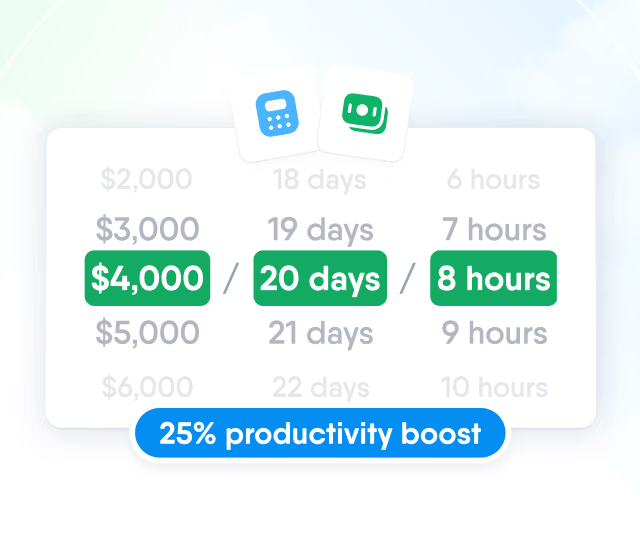
HR efficiency estimator
How does the HR efficiency estimator from PeopleForce work.
Calculate your impact



Executive search
Executive search is retained, exclusive recruitment for senior roles, where a specialist firm maps the market and approaches people who are not looking for a job.
Executive search is a specialised form of recruitment for senior roles, typically C-level, board and functional director positions, carried out by a firm that is paid a retainer to run the search rather than a fee on success. The defining feature is not seniority alone. It is that the search targets people who are not applying to anything, which makes it a mapping and persuasion exercise rather than a selection one.
The term headhunting is used for the same activity, usually with less formality attached. In practice most firms use executive search for retained senior mandates and reserve headhunting for the act of approaching a specific person directly.
Retained versus contingency
The commercial model is what separates executive search from ordinary agency recruitment, and it changes the behaviour on both sides.
- Retained. The client pays in instalments, classically a third on engagement, a third at shortlist and a third on placement. The mandate is exclusive. The consultant is paid to do the market research whether or not a hire happens, which is what makes it possible to approach a hundred people and present four.
- Contingency. The agency is paid only if its candidate is hired, usually competing with two or three other agencies and with the internal team. The rational strategy is speed and volume: send available candidates quickly, before someone else does.
Neither model is better in the abstract. Contingency is efficient for roles with an active candidate market. Retained search is what you use when the right person has a good job, is not reading job ads, and needs a credible third party to open a conversation they would not otherwise have.
How a search actually runs
A typical mandate runs twelve to sixteen weeks and follows a recognisable sequence. It opens with a briefing that is closer to a diagnostic than a job description conversation: what the business problem is, what the first two years require, who the person will have to win over internally, and what the real constraints on compensation and reporting line are.
Then comes the market map, which is the actual product being bought: the full list of people who hold comparable roles in comparable organisations, with an assessment of who is reachable. Approaches are made individually and confidentially, candidates are assessed against the agreed specification, and a shortlist of three to five is presented with written assessments. Referencing happens late and in depth, and the consultant usually handles the offer negotiation, which is where an intermediary earns their fee, because the conversation about money is easier when the principals are not having it directly.
What it costs and what comes with it
Fees generally run at around a third of the first-year total compensation for the role, which for senior positions makes this the most expensive way a company hires. Two contractual terms matter as much as the number. The guarantee period, under which the firm will repeat the search at no fee if the placement leaves within a defined window, usually six to twelve months. And the off-limits clause, which prevents the firm from approaching your employees for a set period; the narrower the firm defines that period and scope, the more carefully you should read it.
When it is worth it and when it is not
It is worth it when the candidate pool is genuinely small and known to a specialist, when the search must stay confidential (replacing an incumbent who does not yet know, or entering a market before competitors notice), or when the cost of a wrong hire in the role is measured in years rather than months.
It is not worth it when your own team could reach the same people. A strong internal talent acquisition function with a maintained network often can, at a fraction of the cost. It is also a bad instrument for roles where the specification is still moving, because the firm will run against a brief that stopped being accurate in week three, and for companies that cannot make a decision in under four weeks, since senior candidates read slow processes as a signal about how the company operates.
Getting value from the relationship
Most disappointing searches are traceable to the client side. The brief was a job description rather than a business problem. Feedback on candidates took two weeks, by which time two had withdrawn. Four people inside the company gave the consultant four different versions of what the role was. The process demanded seven interviews for a candidate who was not looking in the first place. Give the firm one owner internally, agree the decision timeline before the search starts, and treat the market map as information about your market rather than as a list to be delivered.
Running a search with an agency in PeopleForce
External recruiters are a distinct participant on a vacancy in PeopleRecruit, not a shared internal login. An external recruiter is attached to the specific vacancies they are working on and sees only those, alongside the hiring lead and internal collaborators who see the full picture. The separation extends to notes: an agency consultant sees their own notes on a candidate profile and not the client's internal ones, which holds even when a profile is exported to print, so the commentary your interviewers write for each other does not travel to the supplier.
For the confidentiality point above, a vacancy does not have to be published anywhere: career site publication and each multiposting channel are separate, deliberate actions, so a search can run entirely through direct approach with no public trace. Structured comparison across a small shortlist is handled by scorecards with defined questions rather than by recollection, and every candidate carries a source, so an agency's contribution ends up in the same funnel reporting as every other channel and the fee has something to be measured against.


Let us show you what's possible
From Core HR to advanced workforce analytics — see the platform saving 80 hours a month for teams just like yours. Fully tailored to your workflow.