
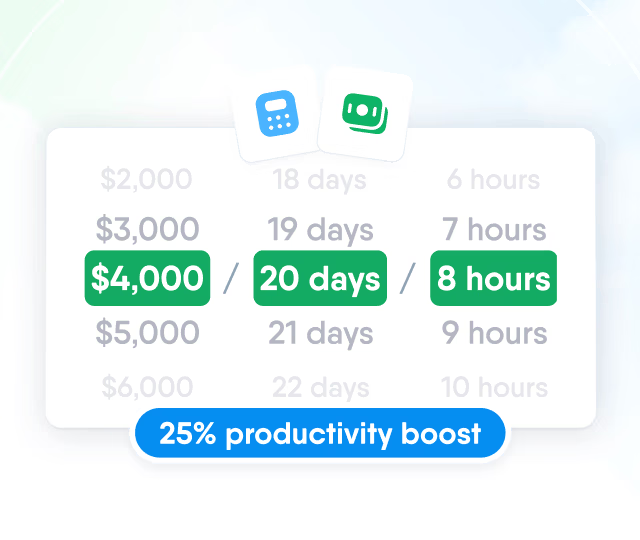
HR efficiency estimator
How does the HR efficiency estimator from PeopleForce work.
Calculate your impact



Chief people officer (CPO)
The executive accountable for how a company hires, pays, develops and organises its people. What the role owns and where it usually fails.
A chief people officer (CPO) is the executive accountable for everything the company does with and about its workforce: how people are hired, paid, developed, organised and retained. The role sits on the executive team and reports to the CEO. The title signals a deliberate shift from administering employment to shaping how the business gets its results through people.
CPO, CHRO and HR director
The three titles overlap heavily and the differences are cultural rather than legal. CHRO, chief human resources officer, is the older and more common term in large corporates and carries a compliance and governance weight. Chief people officer emerged from technology companies and usually signals a broader remit including culture, internal communications and workplace, with less emphasis on administration. An HR director typically runs the function without a seat at the executive table, which is the real distinction: whether the person is in the room when the business strategy is set, or receives it afterwards to staff.
What the role owns
The scope varies with company size, but a CPO is normally accountable for:
- HR strategy and the operating model of the people function itself, including whether to run HR business partners, centres of expertise or generalists.
- Workforce planning and headcount cost, which in most companies is the single largest line in the budget.
- Compensation architecture: bands, equity, and the trade-offs between paying at market and paying for performance.
- Leadership capability and succession for the layer below the executive team.
- Culture and employee experience, including what the company actually rewards as opposed to what its values statement says.
- Organisational design during growth, restructuring or integration after an acquisition.
What makes the role difficult
A CPO is usually the only executive whose function is simultaneously expected to advocate for employees and to execute decisions that work against them, such as a restructuring. Holding both credibly is the central difficulty of the job, and the failure modes run in both directions: a CPO who only advocates loses influence with the rest of the executive team, and one who only executes loses the trust that makes the advocacy worth anything.
The second difficulty is evidential. Finance and sales arrive at executive meetings with numbers; people functions historically arrived with anecdotes. A CPO who cannot answer what attrition in the engineering org costs the company this year, or how long roles stay open by level, will lose those arguments regardless of how good the underlying judgement is.
The data a CPO needs to have
Credibility at executive level rests on a small set of numbers being available on demand rather than assembled over two weeks. HR analytics in PeopleForce builds those from the records the company already keeps, so headcount, attrition, absence, recruiting funnel and compensation history come from the same source as the day to day operations rather than from a parallel spreadsheet. Because every module writes into one employee record, the answer to a question that crosses domains, such as whether people who left in their first year came from particular hiring sources, does not require reconciling exports.
On the planning side, headcount positions are held as structured records with their department, location, manager, FTE and salary, and a status that moves from vacant through recruiting to filled, with vacancy requests attached. That gives a CPO a view of committed versus actual headcount cost that is closer to the finance view than a typical HR report, which is usually where the two functions argue. HR dashboards put the same figures in front of line managers, which removes a surprising amount of the reporting load from the function itself.
When a company actually needs one
There is no headcount threshold that makes the role necessary, but there are signals. Hiring a CPO makes sense when people decisions have become interdependent enough that solving them separately produces contradictions: when pay bands, career levels and performance ratings have to agree with each other, when the management layer has grown faster than management capability, or when the company is entering markets with different employment law. Hiring one to fix a specific problem, typically attrition or culture, rarely works, because those are symptoms with causes that sit in how the business is run rather than in the people function.


Let us show you what's possible
From Core HR to advanced workforce analytics — see the platform saving 80 hours a month for teams just like yours. Fully tailored to your workflow.