
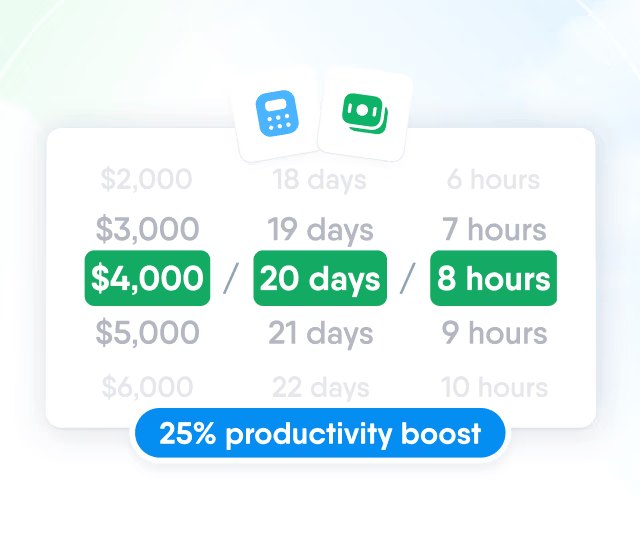
HR efficiency estimator
How does the HR efficiency estimator from PeopleForce work.
Calculate your impact



Cost per hire
How to calculate cost per hire, what to include and how to bring it down
Cost per hire is a recruiting metric that shows how much a company spends, on average, to fill one open position. It adds up every cost tied to hiring over a period, both money paid to outside parties and the internal time and tools used, and divides the total by the number of people hired in that period. The result is the price tag of a single hire, which makes recruiting budgets comparable across teams, years and channels.
The metric was standardized by SHRM and ANSI so companies could benchmark against each other. Absolute values vary widely by country, seniority and industry, so the number is most useful when tracked over time and broken down by role or channel rather than compared to a single global average.
Cost per hire formula
Cost per hire = (external recruiting costs + internal recruiting costs) ÷ number of hires
If a company spends 40,000 on external costs and 20,000 on internal costs in a quarter and makes 15 hires, cost per hire is 60,000 ÷ 15 = 4,000. The formula is simple; the work is in deciding what goes into each bucket and applying the same rule every time.
What counts as a recruiting cost
External costs are payments to third parties:
- Agency and headhunter fees
- Job board postings and sponsored listings
- Employer branding campaigns and career page advertising
- Recruiting events, career fairs and university partnerships
- Background checks, assessments and pre-employment tests
- Applicant tracking system and sourcing tool subscriptions
- Relocation assistance and signing bonuses
- Candidate travel and interview expenses
Internal costs are the company's own resources spent on hiring:
- Salaries of the recruiting team, prorated to time spent on hiring
- Hiring managers' and interviewers' time, estimated from hours × hourly cost
- Employee referral bonuses
- Onboarding administration if the company includes it in the definition
Two things are usually excluded: the new hire's own salary and the cost of the vacancy while the role was open. The second one matters and is worth tracking, but it belongs to time to fill, not cost per hire.
How to use cost per hire
Compare channels. Cost per hire by source shows whether agency placements, job boards, referrals or the career page deliver hires at the lowest cost. Paired with quality of hire data, it shows which channel deserves more budget rather than just which is cheapest.
Budget and forecast. If the hiring plan calls for 30 people next year and cost per hire is 3,500, the recruiting budget needs at least 105,000 before any change in mix or market. This is the link between workforce planning and finance.
Justify investments. An applicant tracking system, a referral program or an employer brand campaign each add to cost in the short term. Cost per hire before and after is the cleanest way to show whether they paid off.
Spot problems. A rising cost per hire with flat hiring volume usually means longer time to fill, more agency use or a weaker candidate experience that loses people late in the process.
How to lower cost per hire without lowering quality
- Shift from agencies to owned channels. A career page, a referral program and a talent pool of past candidates are one-time investments that cut per-hire cost for years.
- Shorten the process. Every extra interview round costs interviewer time and loses candidates. Define stages, owners and deadlines and remove steps that do not change the decision.
- Re-engage past candidates. Silver-medalist candidates from previous searches are already screened and often cheaper to hire than starting from zero.
- Track source of hire properly. Without it, the channel comparison above is guesswork.
- Automate the administration. Scheduling, status updates, offer letters and onboarding paperwork eat recruiter hours that count as internal cost.
Tracking cost per hire in PeopleForce
PeopleForce Recruit supplies the denominator and the channel breakdown: every vacancy has a pipeline with defined stages, each candidate carries a source, and hires are recorded when an offer is accepted, so the number of hires per period and per source is available without a spreadsheet. Vacancies can be published to job boards and a branded career page from the same place, and referral candidates are tagged on entry. When a candidate is hired, the profile moves to Core HR with a hire date, which is what a cost-per-hire calculation joins against the spend recorded in finance. Interview scheduling, candidate messaging and offer documents run inside Recruit, so the recruiter hours that make up internal cost stay low.


Let us show you what's possible
From Core HR to advanced workforce analytics — see the platform saving 80 hours a month for teams just like yours. Fully tailored to your workflow.