
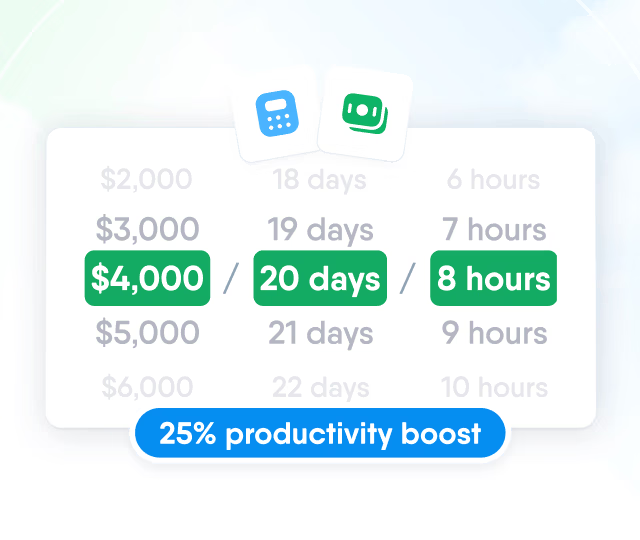
HR efficiency estimator
How does the HR efficiency estimator from PeopleForce work.
Calculate your impact



Four-day work week
Two models hide behind the same name. Which one you pick decides whether the pilot delivers rested teams or eleven-hour days.
A four-day work week is a schedule where employees work four days instead of five. Two very different models share the name. In the reduced-hours model the week drops to around 32 hours with no cut in pay, often described as 100:80:100 for full pay, 80 percent of the time and 100 percent of the output. In the compressed work week, the same 38 to 40 hours are packed into four longer days.
The two models are not interchangeable
This distinction matters more than any other design decision, and most failed rollouts trace back to blurring it. A compressed week keeps total hours constant and mainly changes when people work. It is simple to run in payroll and overtime terms, but it delivers little recovery benefit, because ten-hour days are tiring and childcare rarely stretches to cover them. A genuine reduction to 32 hours forces the harder work: cutting meetings, removing handoffs, and killing low-value tasks. That is where the reported gains in employee engagement and well-being actually come from.
What the trials showed
Large coordinated pilots, most visibly the UK trial involving 61 companies in 2022, reported lower employee burnout, reduced sickness absence and revenue that broadly held steady, with the large majority of participants continuing afterwards. The results are strongest in knowledge work where output is project-based and an individual's hours loosely determine what gets delivered. They are hardest to reproduce in shift-based operations, customer support and retail, where coverage rather than individual productivity sets the staffing level. In those settings a four-day week usually means hiring more people, not doing the same work in less time, and the business case has to be built on retention and absenteeism rather than on cost neutrality.
Decisions to make before the pilot starts
- Which model you are running, reduced hours or compressed, and what happens to pay in each case.
- Whether the day off is fixed company-wide or staggered to preserve coverage.
- How paid time off, public holidays and sick days convert when a working day is longer or the week is shorter. This is where most rollouts hit their first real snag.
- What counts as success: two or three output metrics you will compare before and after, agreed in advance.
- Whether overtime on the fifth day is permitted at all, and who approves it.
- Local labour law limits on daily hours, which in several countries cap a compressed day below what the model needs.
Running the mechanics in PeopleForce
A four-day week collapses without accurate data on hours and absence, which is what PeopleTime covers. Attendance policies are defined per location with their own special hours, break rules, overtime types and approval flows, so a site running a four-day schedule can operate under different rules from one that is not, without splitting the company into separate systems. Timesheets record clock-in and clock-out against a daily target, which makes it visible whether a compressed day is genuinely ten hours or quietly eleven. Leave balances and holidays sit in leave tracking, so a day of leave no longer silently equals one fifth of a week. HR analytics then lets you compare absence, overtime and headcount cost before and after the change instead of relying on impressions from the loudest team.
Where four-day weeks fail
Pilots collapse when the fifth day is removed but the workload is not. People answer messages on their day off, time tracking shows hours creeping back, and the company ends up with a four-day week in name and five days of availability in practice. The second common failure is uneven application: office teams get the day, operational teams do not, and the split does more damage to trust than the benefit ever recovers. Deciding in advance what the organisation will stop doing is the part that determines whether the model survives its first busy quarter.


Let us show you what's possible
From Core HR to advanced workforce analytics — see the platform saving 80 hours a month for teams just like yours. Fully tailored to your workflow.