
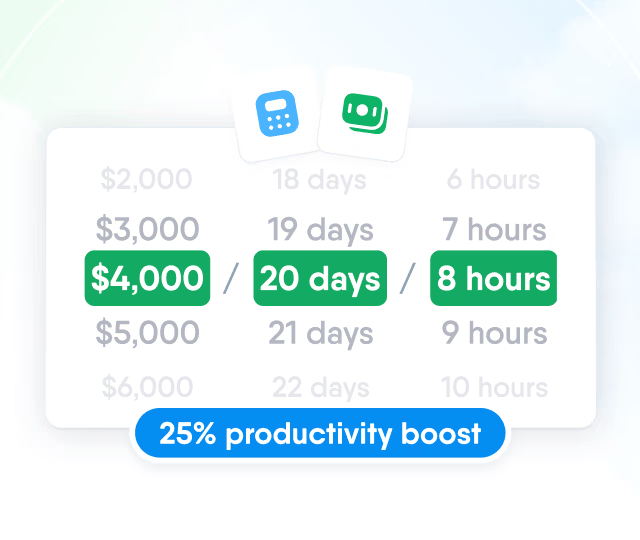
HR efficiency estimator
How does the HR efficiency estimator from PeopleForce work.
Calculate your impact



Leave management
Leave management is the set of policies, approvals and records that govern every type of employee absence, from annual leave to sick days, and keeps balances and payroll accurate.
Leave management is how an organisation defines, approves, records and reports every kind of time away from work: annual leave, sick leave, parental leave, unpaid leave, study days, compensatory days off and everything a local labour code adds on top. It covers the policy (who is entitled to what), the process (how a request becomes an approved absence) and the record (what the balance is and what payroll should be told).
It sounds administrative until the numbers are wrong. Accrued but untaken leave is a liability on the balance sheet, unrecorded absence is a compliance risk in an inspection, and a manager who cannot see who is away next week is a coverage problem.
What a leave policy has to define
- Entitlement and accrual. How much leave each group gets, whether it is granted upfront or accrues over the year, and whether the allowance period starts on a fixed date or on each person's hire date.
- Unit of measure. Days or hours. Half days and hourly leave need a rule about rounding before the first dispute, not after.
- Working or calendar days. Whether weekends and public holidays inside a leave period are counted, which differs by country and by leave type.
- Paid or unpaid. And who pays: employer, social insurance, or nobody. See unpaid leave for the version where the answer is nobody.
- Notice and limits. Minimum notice before a request, maximum booking horizon, maximum consecutive days, blackout periods.
- Approval route. Manager only, manager plus HR, or a route that depends on length. Add a substitute approver, or approvals stall every time somebody is away.
- Carryover and expiry. How many unused days move into the next period, until when they can be used, and what happens to the rest.
- Payout on exit. Which balances are compensated when someone leaves. In most jurisdictions untaken statutory annual leave is.
Write it once, in the employee handbook, then configure it in a system rather than reinterpreting it per request.
Why spreadsheets fail at this
Leave tracking in a spreadsheet survives about twenty people. After that the failure modes are predictable: balances drift because accrual was recalculated by hand, mid-year joiners get a full year's entitlement, a promotion or a contract change is not reflected in the allowance, approvals live in email threads nobody can find during an audit, and nobody notices that a whole team booked the same week off until it happens.
The compliance side matters just as much. Most labour codes require records of leave granted and taken, and some require that annual leave be taken rather than endlessly deferred. Untracked absence is also the first place where a burnout pattern hides: people who never take leave are not more committed, they are usually closer to leaving.
Numbers worth reporting
Leave balance and liability: accrued, taken and outstanding days per team, valued at current salary cost. Utilisation: what share of entitlement people actually use, which says more about culture than an engagement survey. Absence rate: unplanned absence as a share of scheduled days, tracked by team and season. Approval time: how long requests sit unanswered, the part employees notice most. And carryover concentration: if one team carries over three times more than the rest, that is a staffing signal rather than a leave signal.
Leave management in PeopleForce
Leave tracking in PeopleForce is built around leave type policies, so every decision above becomes a setting rather than a convention. A policy defines whether time is tracked in days or hours, whether the absence is counted in working days or calendar days, whether it is paid, unpaid or working-paid, whether the allowance period starts on a fixed date or on the employee's hire date, how balances are rounded, the minimum and maximum notice period, an on-demand balance limit, and whether requests can be withdrawn and up to what deadline. Policies are drafted and then published, with versioning behind them, so changing the rules next year does not rewrite last year's history.
Each employee's balance is held as a leave cycle with opening balance, accruals, adjustments, carryover and allocated days, and every movement is written to a leave history that shows why a number changed. Requests follow the approval route set in the policy, with substitute approvers when someone is away, and appear in the shared team calendar together with public holidays per location. Approved absences flow into the timesheet as paid or unpaid hours ready for payroll export, employees check their own balances through their profile instead of asking HR, and HR analytics reports balances, liability and absence by team.


Let us show you what's possible
From Core HR to advanced workforce analytics — see the platform saving 80 hours a month for teams just like yours. Fully tailored to your workflow.