
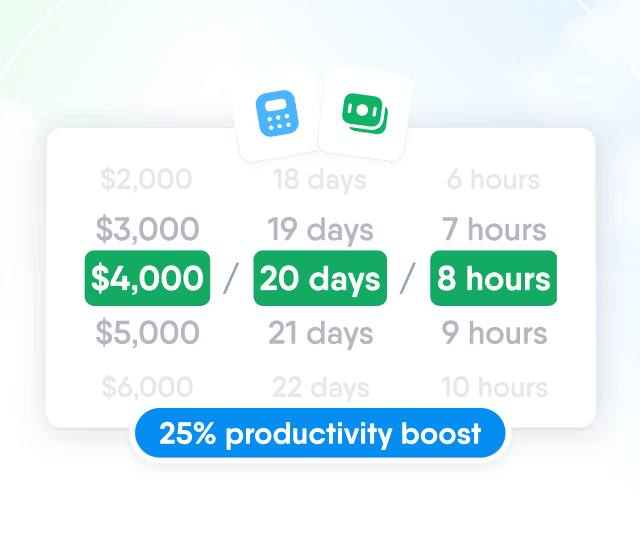
HR efficiency estimator
How does the HR efficiency estimator from PeopleForce work.
Calculate your impact



Promotion
A move into a role with greater responsibility, usually with a new title and higher pay, and one of the most visible fairness tests a company runs.
A promotion is a move into a role with greater responsibility, scope or authority, normally accompanied by a new title and higher pay. It is not the same as a raise, which changes compensation inside the same role, and not the same as a title change, which adjusts the label without changing the work. Promotions are among the most visible decisions a company makes, which is why the process behind them shapes trust far beyond the person being promoted.
Types of promotion
- Vertical promotion. A step up the same career path, usually from specialist to senior specialist or from specialist to manager.
- Horizontal promotion. Broader scope at the same level, often described through a career lattice, where growth runs sideways as well as upward.
- Internal move into an open role. A promotion that runs through internal recruitment with an application and evaluation, rather than being awarded directly.
- Dry promotion. More responsibility and a better title with no pay increase. Companies use it under budget pressure, and it reliably produces resentment once the person compares the new job description with the old salary.
What a defensible process looks like
The single factor that separates a fair promotion process from an arbitrary one is when the criteria are written. If expectations for the next level exist in advance, through competency mapping or a levelling framework, the decision is about evidence. If criteria are assembled after a name is proposed, the decision is about advocacy, and the people with the loudest managers win.
A workable process usually has four elements: published expectations per level, evidence gathered through the performance review cycle rather than from the last quarter alone, a calibration step where managers compare candidates against the same bar, and a compensation decision anchored to the range for the new level rather than to a percentage of the old salary.
What to record when a promotion happens
A promotion changes several things at once and each needs to land on the employee record with an effective date: the new position and its job description, reporting lines if they change, the salary change, and any adjustment to employment terms. Recording these with dates rather than overwriting the previous values is what makes tenure-to-promotion analysis possible later, and what lets you answer questions about promotion rates across teams without reconstructing history from memory.
Mistakes that cost good people
The most expensive one is promoting the strongest specialist into management by default, because management is the only route upward. This removes a good specialist from the work and adds an untrained manager, and it is exactly what a dual career track is designed to prevent. A second is the retention promotion, granted when someone resigns, which teaches the rest of the team that a competing offer is faster than performance. A third is silence: people who are never told what the next level requires eventually reach a career plateau they interpret as a ceiling, and the resignation arrives before the conversation does.
Handling promotions in PeopleForce
In PeopleHR, position and employment status changes are stored with effective dates, so a promotion adds to the job history instead of replacing what was there and the org chart updates from the same record. The evidence behind the decision comes from PeoplePerform, where goals, feedback and review cycles accumulate over time rather than being reconstructed at decision day. Supporting documents such as annexes can be generated and sent for electronic signature, and HR analytics then shows promotion patterns by department and level.


Let us show you what's possible
From Core HR to advanced workforce analytics — see the platform saving 80 hours a month for teams just like yours. Fully tailored to your workflow.