
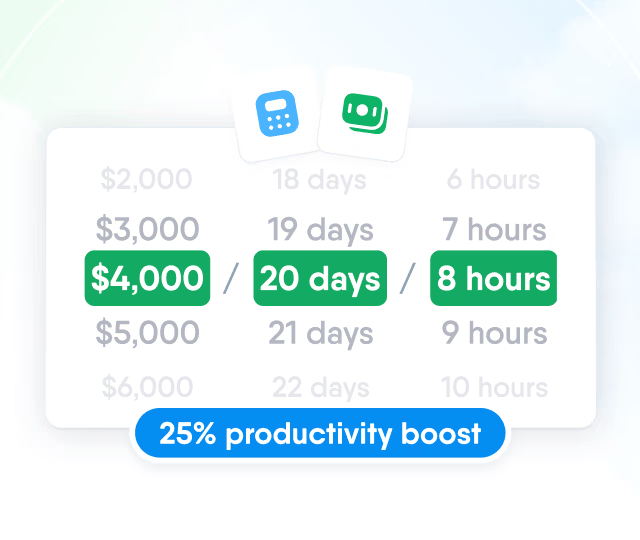
HR efficiency estimator
How does the HR efficiency estimator from PeopleForce work.
Calculate your impact



Diversity, equity and inclusion (DEI)
Three separate ideas that get written as one acronym: who is in the company, how fairly processes treat them, and whether they can actually participate.
DEI stands for diversity, equity and inclusion. The three words are usually written together and mean different things, which is why programmes that treat them as one initiative tend to stall. Diversity describes who is in the organization. Equity describes how fairly its processes treat people who start from different positions. Inclusion describes whether those people can actually contribute once they are inside. A company can score well on one and poorly on the other two.
The three parts, separately
Diversity is a property of a population: the mix of backgrounds, experiences and characteristics present in a team or company. It is countable, which is why it dominates reporting.
Equity is about process design. Equality means giving everyone the same thing; equity means accounting for the fact that people arrive at the same process with different constraints. A hiring process that only sources from one university is equal in form and unequal in effect.
Inclusion is about daily experience: whether people are consulted before decisions, whether they can disagree without cost, whether informal networks are open. Inclusion is what determines whether a diverse hire stays.
Where DEI actually gets decided
DEI rarely fails at the level of values statements. It fails inside ordinary HR processes:
- Hiring. How a job is written, where it is advertised, and whether interviews follow a structured interview format rather than a conversation shaped by unconscious bias.
- Pay. Whether salary decisions follow a documented structure or individual negotiation, which is the mechanism behind most unexplained pay gaps.
- Promotion. Who is considered for advancement, and whether the criteria are written down before the decision rather than justified after it. This is where the glass ceiling becomes measurable.
- Work design. Meeting formats, flexible arrangements and accommodations that determine whether neurodiversity in the workplace is supported or merely tolerated.
- Conduct. Whether reports of harassment lead to consistent outcomes regardless of who is involved.
How companies measure it
Representation data is the starting point, usually a headcount breakdown by level rather than company-wide, since aggregate numbers hide the pattern where representation drops at each seniority step. Process metrics matter more: conversion rates at each hiring stage, promotion rates, pay distribution within the same level, and employee turnover by group. Inclusion cannot be counted from records at all and is measured through surveys, which only produce usable answers when they are anonymous. What is legally permitted to collect varies significantly by country, so local rules come first.
Why DEI programmes commonly fail
The most frequent pattern is a training-only approach: a workshop is delivered, awareness rises briefly, and no process changes, so behaviour returns to baseline within months. The second is measuring representation while leaving the decision points untouched, which produces hiring pushes followed by the same attrition. The third is treating DEI as an HR project rather than a set of constraints on how managers hire, pay and promote, which leaves the people making those decisions outside the effort entirely.
What PeopleForce provides
PeoplePulse runs engagement and pulse surveys that can be set as anonymous, which is the practical requirement for inclusion questions to be answered honestly. HR analytics lets you break headcount, turnover and tenure down by department, level and location instead of reading a single company average. And in PeopleRecruit, consistent evaluation criteria and a recorded hiring pipeline make it possible to see where candidates drop out rather than guess.


Let us show you what's possible
From Core HR to advanced workforce analytics — see the platform saving 80 hours a month for teams just like yours. Fully tailored to your workflow.