
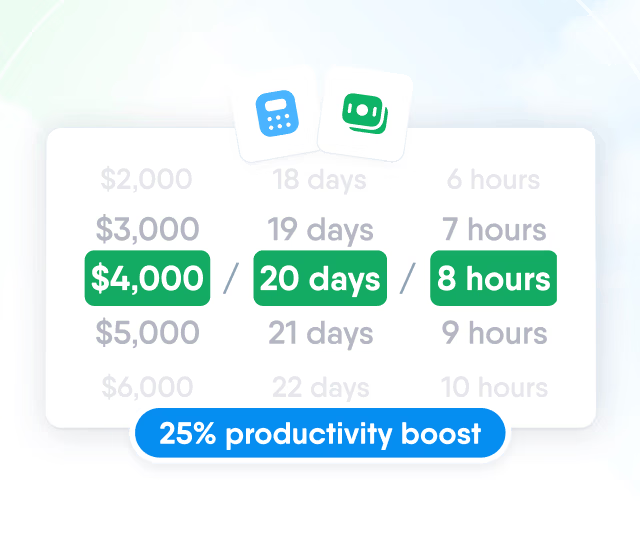
HR efficiency estimator
How does the HR efficiency estimator from PeopleForce work.
Calculate your impact



Employer of record (EOR)
An employer of record (EOR) is a third-party organization that legally employs workers on behalf of another company, handling payroll, taxes, benefits, and compliance in a country where that company has no legal entity.
What is an employer of record?
An employer of record (EOR) is a company that becomes the legal employer of your workers in a given country while you retain full control over their day-to-day work. The EOR signs the employment contract, runs local payroll, withholds and remits taxes, provides statutory employee benefits, and keeps the employment compliant with local labor laws. You decide who to hire, what they work on, and how they are managed.
The model exists because setting up a legal entity abroad takes months and significant cost, while talent is increasingly distributed. An EOR lets a company make a global hire in days rather than quarters.
How the EOR model works
- Your company selects a candidate and agrees on role, salary, and start date.
- The EOR issues a locally compliant employment contract and becomes the legal employer.
- The employee works for your team, follows your processes, and reports to your managers.
- The EOR pays salary, social contributions, and taxes in the local currency and invoices your company for the total cost plus a service fee, typically a flat monthly amount per employee or a percentage of payroll.
- The EOR handles leave entitlements, statutory benefits, terminations, and any local filings.
In legal terms this creates a co-employment relationship: the EOR carries the employment liability, your company directs the work.
What an EOR does and does not do
An EOR does: draft and sign compliant employment contracts, register the employee with local authorities, run payroll and tax withholding, administer mandatory benefits and insurance, manage statutory leave, process terminations and severance pay, and sponsor work permits where its license allows.
An EOR does not: recruit or select candidates, manage performance, set goals, run onboarding into your team, own the employee's equipment or intellectual property (this is handled through agreements between you and the EOR), or represent your company culture. All of that remains with you.
EOR vs. PEO vs. independent contractors
EOR vs. PEO. A professional employer organization (PEO) also shares employment responsibilities, but only in countries where your company already has a legal entity. A PEO is an HR outsourcing arrangement for existing entities; an EOR replaces the need for an entity altogether.
EOR vs. independent contractor. Engaging an independent contractor is cheaper and faster, but only appropriate for project-based work with real autonomy. If the person works fixed hours, uses your tools, and reports to your manager, most jurisdictions will treat them as a misclassified employee, with back taxes and penalties as the consequence. The EOR model exists precisely for these full-time, integrated roles.
EOR vs. outstaffing. Outstaffing providers also employ people who work for your team, but they typically source the talent as well and are common in IT services. An EOR employs candidates you have already chosen and is industry-agnostic.
When to use an employer of record
- Testing a new market before committing to a local subsidiary.
- Hiring one to a few dozen people in a country where you have no entity.
- Retaining an employee who relocates abroad.
- Converting long-term contractors into compliant employees.
- Bridging the gap while your own entity is being registered.
Once headcount in one country grows past roughly 15 to 25 people, a local entity is usually cheaper than paying EOR fees indefinitely. Many companies use the EOR as a first step and migrate employees to their own entity later.
Managing EOR employees alongside the rest of the team
The most common operational problem with EOR hires is fragmentation: the EOR holds the contract and payslips, while the manager, HR, and the rest of the team barely see the person in their systems. The fix is to run all people processes in your own HRIS regardless of who the legal employer is.
In PeopleForce Core HR, each employee record carries a legal entity, so EOR-employed staff can be assigned to the EOR as their entity and still sit in the same employee directory, org chart, and reporting lines as everyone else. Position and employment status history keep track of work type, probation, and changes over time, which makes a later migration from the EOR to your own entity a matter of updating a record rather than rebuilding it. Onboarding workflows, leave tracking, and performance reviews in PeopleForce Perform then apply to EOR employees exactly as they do to direct hires.
How to choose an EOR provider
Check whether the provider owns its entity in the target country or subcontracts to a local partner, since owned entities usually mean faster onboarding and clearer accountability. Compare the full cost, including onboarding fees, deposits, currency conversion margins, and termination costs. Confirm who holds intellectual property and confidentiality obligations, how quickly the EOR can execute a compliant termination, and whether it integrates with your HRIS so that employee data does not have to be maintained twice.


Let us show you what's possible
From Core HR to advanced workforce analytics — see the platform saving 80 hours a month for teams just like yours. Fully tailored to your workflow.